 Back
BackMicrobial Growth: Requirements, Culture Methods, and Measurement
Study Guide - Smart Notes
 Tailored notes based on your materials, expanded with key definitions, examples, and context.
Microbial Growth
Definition and Overview
Microbial growth refers to the increase in the number of cells in a population, not the size of individual cells. Understanding the requirements and methods for microbial growth is essential for microbiology, especially in clinical, environmental, and industrial contexts.
Physical requirements: Temperature, pH, and osmotic pressure.
Chemical requirements: Carbon, nitrogen, sulfur, phosphorus, oxygen, trace elements, and organic growth factors.
Physical Requirements for Microbial Growth
Temperature
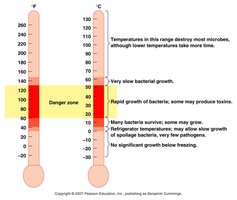
Microorganisms are classified by their preferred temperature ranges, which affect their growth rates and ecological niches.
Psychrophiles: Cold-loving microbes; optimum growth at 15°C, cannot grow above 25°C. Found in ocean depths and polar regions.
Psychrotrophs: Grow at 0°C, optimum at 20–30°C, maximum at 40°C. More common than psychrophiles and often cause food spoilage.
Mesophiles: Moderate temperature-loving; optimum at 25–40°C. Most common type, includes most pathogens and spoilage organisms.
Thermophiles: Heat-loving; optimum at 50–60°C, maximum at 75°C. Important in composting, not a public health concern.
Hyperthermophiles: Optimum at 80–105°C, maximum at 110°C. Members of Archaea, found in hot springs and volcanic areas.
pH
pH affects microbial growth by influencing enzyme activity and membrane transport.
Most bacteria grow between pH 6.5 and 7.5.
Molds and yeasts prefer pH 5–6.
Acidophiles thrive in acidic environments.
Buffers (e.g., peptones, amino acids, phosphate salts) are added to media to neutralize acids produced by bacteria.
Osmotic Pressure
Osmotic pressure is the force with which a solvent moves across a semipermeable membrane from low to high solute concentration.
Microorganisms are 80–90% water and obtain nutrients from their environment.
Hypertonic environments (high salt/sugar) cause plasmolysis (cell shrinkage).
Hypotonic environments (low salt/sugar) can cause cell lysis (membrane rupture).
Extreme or obligate halophiles require high salt; facultative halophiles tolerate up to 15% salt.
Chemical Requirements for Microbial Growth
Major Elements
Carbon: Over 50% of cell dry weight; backbone of organic molecules. Chemoheterotrophs use organic carbon; autotrophs use CO2.
Nitrogen: About 14% of cell dry weight; found in amino acids and proteins. Obtained from protein decomposition, NH4+, NO3–, or N2 fixation.
Sulfur: For amino acids and vitamins (thiamine, biotin); obtained from proteins, SO42–, or H2S.
Phosphorus: In DNA, RNA, ATP, and membranes; supplied as PO43–.
Trace elements: Inorganic elements (e.g., iron, copper, zinc) required in small amounts, usually as enzyme cofactors.
Oxygen Requirements
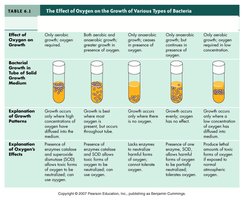
Oxygen is essential for some microbes but toxic to others. Its effect depends on the organism's ability to detoxify reactive oxygen species.
Type | Growth Pattern | Oxygen Requirement |
|---|---|---|
Obligate aerobe | Growth at top of tube | Requires O2 |
Facultative anaerobe | Growth throughout, more at top | Grows with or without O2, better with O2 |
Obligate anaerobe | Growth at bottom | Cannot tolerate O2 |
Aerotolerant anaerobe | Even growth | Tolerates O2, does not use it |
Microaerophile | Growth just below surface | Requires low O2 |
Toxic Forms of Oxygen
Singlet oxygen (1O2): Highly reactive.
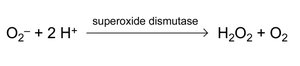
Superoxide free radicals (O2–): Detoxified by superoxide dismutase.
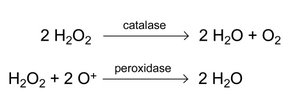
Peroxide anion (O22–): Detoxified by catalase and peroxidase.
Hydroxyl radical (OH•): Most reactive and damaging.
Key detoxification reactions:
Organic Growth Factors
Organic compounds that microbes cannot synthesize and must obtain from the environment, such as vitamins, amino acids, purines, and pyrimidines.
Culture Media and Methods
Types of Culture Media
Chemically defined media: Exact chemical composition is known.
Complex media: Contains extracts and digests of yeasts, meat, or plants (e.g., nutrient broth, nutrient agar).
Agar: A solidifying agent, not metabolized by microbes; liquefies at 100°C, solidifies at ~40°C.
Special Culture Techniques
Anaerobic culture methods: Use reducing media (e.g., thioglycollate) to remove O2.
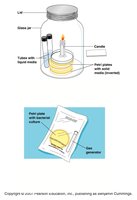
Capnophiles: Require high CO2 concentrations; grown in candle jars or CO2 packets.
Selective, Differential, and Enrichment Media
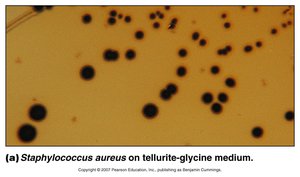
Selective media: Suppress unwanted microbes and encourage desired ones.
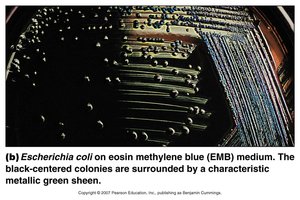
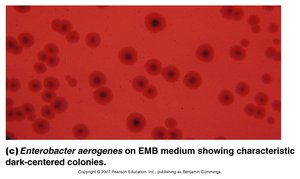
Differential media: Distinguish colonies of different microbes by appearance.
Enrichment media: Enhance growth of specific microbes from a mixed sample.
Pure Cultures and Colony Formation
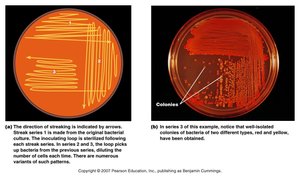
A pure culture contains only one species or strain.
A colony arises from a single cell or group of attached cells (colony-forming unit, CFU).
The streak plate method is used to isolate pure cultures.
Preserving Bacterial Cultures
Deep-freezing: Pure cultures are frozen at –50° to –95°C.
Lyophilization (freeze-drying): Cultures are frozen and dehydrated in a vacuum.
Microbial Reproduction
Methods of Reproduction
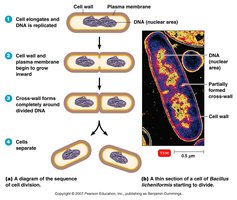
Binary fission: Most common; cell divides into two identical cells.
Budding, conidiospores, fragmentation: Other less common methods.
Generation time: Time required for a cell to divide and population to double.
Measuring Microbial Growth
Direct Measurement Methods
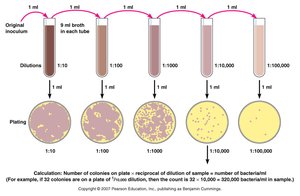
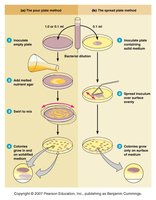
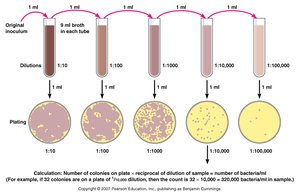
Plate counts: Serial dilutions and plating to count CFUs.
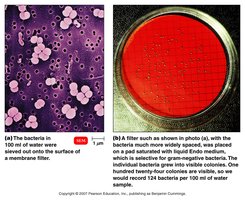
Filtration: Used for small quantities; bacteria are trapped on a filter and then cultured.
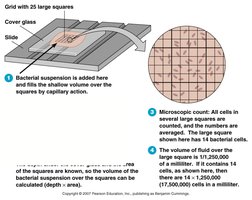
Direct microscopic count: Counting cells using a microscope and a counting chamber.
Dry weight: Used for filamentous organisms.
Indirect Measurement Methods
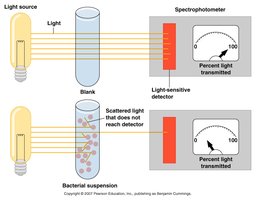
Turbidity: Cloudiness of a culture measured by spectrophotometer; more turbid means more cells.
Metabolic activity: Measuring products of metabolism (e.g., CO2 production).
Dry weight: Weighing dried biomass.
Summary Table: Methods for Measuring Microbial Growth
Method | Direct/Indirect | Description |
|---|---|---|
Plate count | Direct | Counts viable cells by colony formation |
Filtration | Direct | Counts bacteria trapped on a filter |
MPN | Direct | Statistical estimation by dilution |
Direct microscopic count | Direct | Counts cells under microscope |
Turbidity | Indirect | Measures cloudiness with spectrophotometer |
Metabolic activity | Indirect | Measures metabolic products |
Dry weight | Both | Weighs dried biomass |
