 Back
BackMicrobial Growth: The Effect of Oxygen on Bacterial Growth
Study Guide - Smart Notes
 Tailored notes based on your materials, expanded with key definitions, examples, and context.
Microbial Growth
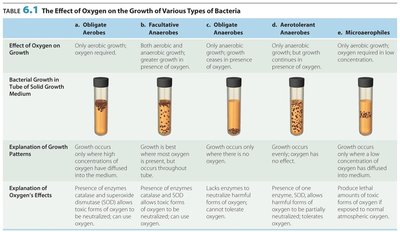
The Effect of Oxygen on the Growth of Various Types of Bacteria
Oxygen is a critical environmental factor influencing the growth and distribution of bacteria. Different bacterial species exhibit distinct requirements and tolerances for oxygen, which are reflected in their growth patterns in laboratory media. Understanding these oxygen relationships is essential for classifying bacteria and predicting their behavior in natural and clinical environments.
Type | Effect of Oxygen on Growth | Bacterial Growth in Tube of Solid Growth Medium | Explanation of Growth Patterns | Explanation of Oxygen's Effects |
|---|---|---|---|---|
Obligate Aerobes | Only aerobic growth; oxygen required. | Growth occurs only where high concentrations of oxygen have diffused into the medium. | Growth occurs at the top of the tube where oxygen is most plentiful. | Presence of enzymes catalase and superoxide dismutase (SOD) allows toxic forms of oxygen to be neutralized; can use oxygen. |
Facultative Anaerobes | Both aerobic and anaerobic growth; greater growth in presence of oxygen. | Growth is best where most oxygen is present, but occurs throughout the tube. | Can grow with or without oxygen, but grow better with oxygen. | Presence of SOD and catalase allows toxic forms of oxygen to be neutralized; can use oxygen. |
Obligate Anaerobes | Only anaerobic growth; growth ceases in presence of oxygen. | Growth occurs only where there is no oxygen. | Cannot tolerate oxygen; growth at the bottom of the tube. | Lacks enzymes to neutralize toxic forms of oxygen; cannot tolerate oxygen. |
Aerotolerant Anaerobes | Only anaerobic growth, but growth continues in presence of oxygen. | Growth occurs evenly throughout the tube. | Can survive in oxygen but do not use it for growth. | Presence of SOD allows toxic forms of oxygen to be neutralized; cannot use oxygen. |
Microaerophiles | Only aerobic growth; oxygen required in low concentration. | Growth occurs only where a low concentration of oxygen has diffused into the medium. | Require oxygen, but at lower concentrations than are present in air. | Produce lethal amounts of toxic forms of oxygen if exposed to normal atmospheric oxygen. |
Key Terms and Definitions
Obligate Aerobes: Bacteria that require oxygen for growth and cannot survive without it.
Facultative Anaerobes: Bacteria that can grow with or without oxygen, but grow better in its presence.
Obligate Anaerobes: Bacteria that cannot tolerate oxygen and grow only in its absence.
Aerotolerant Anaerobes: Bacteria that do not use oxygen but can survive in its presence.
Microaerophiles: Bacteria that require oxygen at lower concentrations than atmospheric levels.
Catalase: An enzyme that breaks down hydrogen peroxide, a toxic byproduct of oxygen metabolism.
Superoxide Dismutase (SOD): An enzyme that converts superoxide radicals to less toxic molecules.
Examples and Applications
Obligate Aerobes: Mycobacterium tuberculosis (causative agent of tuberculosis).
Facultative Anaerobes: Escherichia coli (common gut bacterium).
Obligate Anaerobes: Clostridium botulinum (causative agent of botulism).
Aerotolerant Anaerobes: Lactobacillus species (used in yogurt production).
Microaerophiles: Campylobacter jejuni (causative agent of foodborne illness).
Summary Table Purpose
The table above compares the oxygen requirements, growth patterns, and enzymatic defenses of five major bacterial groups. It is essential for understanding microbial ecology, clinical microbiology, and laboratory culturing techniques.
