 Back
BackMicrobial Infections Affecting the Skin and Eyes: Structure, Pathogenesis, and Clinical Features
Study Guide - Smart Notes
 Tailored notes based on your materials, expanded with key definitions, examples, and context.
Microbial Infections Affecting the Skin and Eyes
The Skin: Structure and Defenses
The skin is a complex organ that serves as the primary barrier against microbial invasion. Its structure and associated defenses are crucial for maintaining health and preventing infection.
Epidermis: The outermost layer, about 25 cells thick, composed of dead cells. It is replaced every 25–45 days.
Keratin: A protein that provides resistance to damage, abrasion, and water penetration.
Normal Biota: Microorganisms are sparsely distributed over dry, flat areas but grow densely in moist regions and skin folds. They also inhabit hair follicles and glandular ducts.
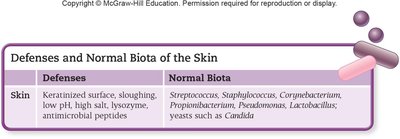
Defenses and Normal Biota of the Skin
The skin's defenses include physical and chemical barriers, as well as resident microbiota that compete with pathogens.
Defenses | Normal Biota |
|---|---|
Keratinized surface, sloughing, low pH, high salt, lysozyme, antimicrobial peptides | Streptococcus, Staphylococcus, Corynebacterium, Propionibacterium, Pseudomonas, Lactobacillus, yeasts such as Candida |
Microbial Infections of the Skin
MRSA Skin and Soft-Tissue Infection
Methicillin-resistant Staphylococcus aureus (MRSA) is a common cause of skin lesions, particularly in non-hospitalized individuals. It is notable for its resistance to multiple antibiotics.
Symptoms: Raised, red, tender, localized lesions with pus; may feel hot to the touch; fever may be present.
Transmission: Occurs easily in breaks in the skin and may localize around hair follicles. Contaminates surfaces such as gym equipment and razors.
Diagnosis: PCR or isolation on blood agar or mannitol salt agar.
Prevention: Good hygiene; covering active infections to prevent transmission.
Treatment: Incision and drainage of pus; antimicrobial therapy with more than one antibiotic.
Maculopapular Rash Diseases
Maculopapular rashes are characterized by flat to slightly raised colored bumps. Several diseases cause this type of rash, including measles, rubella, fifth disease, roseola, and scarlet fever.
Measles (Rubeola)
Measles is a highly contagious viral disease with significant morbidity and mortality, especially in unvaccinated populations.
Causative Agent: Measles virus (Rubeola).
Symptoms: Sore throat, dry cough, headache, fever, red maculopapular exanthem starting on the head and progressing to the trunk and extremities.
Transmission: Respiratory droplets; humans are the only reservoir.
Prevention: MMR vaccine (live, attenuated virus) confers protection for up to 20 years; recommended for children at 12–15 months with a booster before school entry.
Treatment: Supportive care: reducing fever, suppressing cough, replacing lost fluids.
Rubella (German Measles)
Rubella is a mild viral rash disease but can cause serious congenital defects if contracted during pregnancy.
Causative Agent: Rubella virus.
Symptoms: Rash of pink macules and papules, starting on the face and progressing down the trunk; milder than measles. Adults may experience joint inflammation and pain.
Congenital Rubella: Teratogenic; infection in the first trimester can cause miscarriage or permanent defects (deafness, cardiac abnormalities, ocular lesions, mental and physical retardation).
Transmission: Respiratory secretions, occasionally urine; moderately communicable.
Prevention: MMR vaccination; booster at 4 or 6 years.
Treatment: Symptomatic; no specific treatment for congenital rubella.
Fifth Disease (Erythema Infectiosum)
Fifth disease is a mild viral illness in children, characterized by a distinctive "slapped cheek" rash.
Causative Agent: Parvovirus B19.
Symptoms: Slapped cheek appearance, rash spreads to arms, legs, and trunk; may persist for weeks.
Transmission: Highly contagious.
Prevention and Treatment: No vaccine or treatment; disease is usually mild.
Roseola
Roseola is a common childhood disease, sometimes called "sixth disease," often presenting with high fever and a maculopapular rash.
Causative Agent: Human herpesvirus 6 (HHV-6), sometimes HHV-7.
Symptoms: High fever (up to 41°C/105°F) for 3 days, followed by rash on chest and trunk.
Transmission: Nearly all adults are infected by HHV-6.
Prevention and Treatment: No vaccine or treatment.
Scarlet Fever
Scarlet fever is caused by Streptococcus pyogenes producing erythrogenic exotoxin, often following pharyngitis.
Symptoms: Maculopapular rash, often following strep throat.
Transmission: Respiratory droplets.
Treatment: Antibiotics for strep throat; supportive care for rash.
Impetigo
Impetigo is a superficial bacterial infection causing skin to flake or peel, primarily affecting children.
Causative Agents: Staphylococcus aureus or Streptococcus pyogenes, or both.
Symptoms: Peeling skin, crusty and flaky scabs, honey-colored crusts, often around the mouth and face.
Transmission: Direct contact, fomites, mechanical vectors; highly contagious.
Prevention: Good hygiene; vaccines in development.
Vesicular or Pustular Rash Diseases
Chickenpox
Chickenpox is a common, mostly benign viral disease presenting as a generalized vesicular rash.
Causative Agent: Human herpesvirus 3 (HHV-3), also called varicella-zoster virus (VZV).
Symptoms: Fever, rash beginning on scalp, face, and trunk, progressing to extremities; lesions progress from macules and papules to itchy vesicles.
Transmission: Respiratory droplets and fluid from lesions; highly contagious.
Prevention: Live attenuated vaccine.
Treatment: Supportive therapy; oral acyclovir for at-risk individuals.
Shingles (Herpes Zoster)
Shingles is caused by reactivation of VZV, resulting in painful, localized vesicular eruptions.
Symptoms: Asymmetrical distribution of vesicles, often on trunk or head; postherpetic neuralgia may occur.
Transmission: People can acquire chickenpox from exposure to fluid from shingles lesions.
Prevention: Vaccine approved to prevent shingles.
Treatment: Supportive therapy; oral acyclovir for complications.
Smallpox
Smallpox is a highly virulent viral disease, now eradicated, but remains a concern for bioterrorism.
Causative Agent: Variola virus.
Symptoms: Fever, malaise, rash beginning in the pharynx and spreading to the face; rash progresses through macular, papular, vesicular, pustular stages, then crusts over.
Transmission: Droplets and fomites; eradicated by global vaccination.
Treatment: No treatment available.
Wartlike Eruptions
Warts (Papillomas)
Warts are caused by human papillomaviruses (HPVs), affecting skin and mucous membranes.
Causative Agent: Over 100 types of HPVs.
Symptoms: Common warts (rough growths on fingers), plantar warts (painful papillomas on feet), flat warts (smooth lesions on face, trunk, elbows, knees).
Transmission: Direct contact, autoinoculation, indirect contact (towels, shower stalls).
Prevention and Treatment: Warts often resolve spontaneously; home remedies and cryosurgery; no guarantee of virus elimination.
Molluscum Contagiosum
Molluscum contagiosum is caused by a poxvirus, resulting in smooth, waxy nodules on the skin.
Symptoms: Firm nodules, indented in the middle; in children, nodules on face, arms, legs, trunk; in adults, genital areas.
Transmission: Direct contact, fomites; adults may acquire through sexual contact.
Treatment: Usually no treatment; physician may remove lesions or use topical chemicals.
Cutaneous and Superficial Mycoses: Ringworm
Dermatophytes are fungi causing ringworm, confined to nonliving epidermal tissues (hair and nails).
Transmission: Direct and indirect contact with humans, animals, or soil.
Treatment: Topical antifungal agents; several drugs speed up loss of outer skin layer.
Symptoms: Mottled appearance of trunk, face, and limbs.
Microbial Infections of the Eye
The Eye: Structure and Defenses
The eye is protected by several anatomical and physiological defenses, including the conjunctiva and cornea.
Conjunctiva: Thin, membrane-like tissue covering the eye (except cornea) and lining the eyelids; secretes oil and mucus for lubrication and protection.
Cornea: Dome-shaped central portion over the iris; 5–6 layers of epithelial cells that regenerate quickly.
Tears: Best defense, containing lysozyme and other antimicrobial factors.
Conjunctivitis (Pinkeye)
Conjunctivitis is a common infection of the conjunctiva, caused by various microorganisms or contaminants.
Symptoms: Bacterial infections produce milky discharge; viral infections produce clear, watery exudate; eye may be "glued" shut by secretions.
Causative Agents: Neonatal infections: Neisseria gonorrhoeae, Chlamydia trachomatis, herpes simplex. Non-neonatal: Staphylococcus epidermidis, Streptococcus pyogenes, Haemophilus influenzae, adenoviruses.
Transmission: Direct contact; highly contagious.
Prevention: Newborns receive antimicrobials after delivery to prevent infection.
Treatment: Ciprofloxacin covers all possible bacterial infections; prophylactic antibiotic eye drops may be prescribed.
Summary Table: Signs and Symptoms of Cutaneous Mycoses
Type | Location | Symptoms |
|---|---|---|
Ringworm of the Scalp (Tinea Capitis) | Scalp | Scaly patches, hair loss |
Ringworm of the Beard (Tinea Barbae) | Beard | Red, inflamed skin, pustules |
Ringworm of the Body (Tinea Corporis) | Body | Red, ring-shaped patches |
Ringworm of the Groin (Tinea Cruris) | Groin | Red, itchy patches |
Ringworm of the Foot (Tinea Pedis) | Foot | Itchy, scaly skin, blisters |
Ringworm of the Nail (Tinea Unguium) | Nail | Thickened, discolored nails |
