 Back
BackMicrobial Infections of the Nervous System: Disease Snapshots
Study Guide - Smart Notes
 Tailored notes based on your materials, expanded with key definitions, examples, and context.
Microbial Infections of the Nervous System
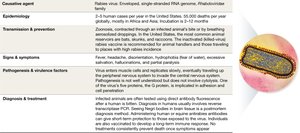
Rabies
Rabies is a viral infection of the nervous system, primarily transmitted through animal bites. It is a significant zoonotic disease with fatal outcomes if untreated.
Causative agent: Rabies virus (enveloped, single-stranded RNA virus, Rhabdoviridae family)
Epidemiology: 3–5 human cases per year in the U.S.; 55,000 deaths worldwide annually, mostly in Africa and Asia
Transmission & prevention: Zoonosis, contracted via infected animal bite or by breathing aerosolized virus; most common animal source is wild animals such as bats, raccoons, and skunks. Vaccination is recommended for animal handlers and travelers to high-risk areas.
Signs & symptoms: Fever, headache, discomfort, hydrophobia, fear of water, excessive salivation
Pathogenesis & virulence factors: Virus replicates in muscle cells, then travels to the CNS, causing encephalitis and death
Diagnosis & treatment: Diagnosis involves direct fluorescent antibody test after a human bite. Treatment includes wound cleaning, rabies immunoglobulin, and vaccination.
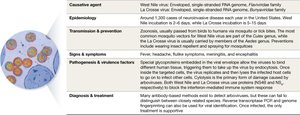
Arboviral Encephalitis: West Nile and La Crosse
Arboviral encephalitis is caused by viruses transmitted by arthropods, such as mosquitoes. West Nile and La Crosse viruses are notable causes in the United States.
Causative agent: West Nile virus (enveloped, single-stranded RNA virus, Flaviviridae family); La Crosse virus (Bunyaviridae family)
Epidemiology: Around 1,200 cases of encephalitis annually in the U.S.; La Crosse cases mainly in the Midwest
Transmission & prevention: Zoonosis via mosquito bites; prevention includes mosquito control and avoiding bites
Signs & symptoms: Fever, headache, flu-like symptoms, neurological symptoms
Pathogenesis & virulence factors: Virus replicates in the CNS, causing inflammation and encephalitis
Diagnosis & treatment: Many antibody-based tests available; treatment is supportive
Meningococcal Meningitis
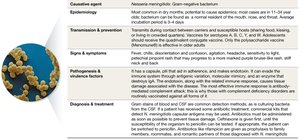
Meningococcal meningitis is a bacterial infection of the meninges, caused by Neisseria meningitidis. It is highly contagious and can cause outbreaks, especially in close-contact settings.
Causative agent: Neisseria meningitidis (Gram-negative bacterium)
Epidemiology: Most common in young adults; potential for outbreaks; incubation period 3–4 days
Transmission & prevention: Transmitted via respiratory droplets; prevention includes vaccination
Signs & symptoms: Fever, chills, delirium, stiff neck, photophobia, sensitivity to light
Pathogenesis & virulence factors: Capsule resists phagocytosis; endotoxin causes inflammation
Diagnosis & treatment: Gram stain and culture of CSF; antibiotics required
Pneumococcal Meningitis
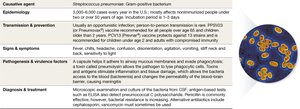
Pneumococcal meningitis is caused by Streptococcus pneumoniae, a Gram-positive bacterium. It is a major cause of bacterial meningitis in children and adults.
Causative agent: Streptococcus pneumoniae (Gram-positive bacterium)
Epidemiology: 3,000–6,000 cases per year in the U.S.; mostly affects unvaccinated people under two or over 65 years of age
Transmission & prevention: Person-to-person transmission; vaccination recommended
Signs & symptoms: Fever, chills, headache, confusion, agitation, vomiting
Pathogenesis & virulence factors: Capsule resists phagocytosis; inflammation damages CNS
Diagnosis & treatment: Gram stain and culture of CSF; antigen-based tests; antibiotics required
Listeria Meningitis (Listeriosis)
Listeriosis is a bacterial infection caused by Listeria monocytogenes, often affecting immunocompromised individuals and pregnant women.
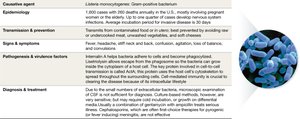
Causative agent: Listeria monocytogenes (Gram-positive bacterium)
Epidemiology: 1,000 cases with 200 deaths annually in the U.S.; high risk for pregnant women
Transmission & prevention: Contaminated food; prevention includes proper food handling
Signs & symptoms: Fever, headache, stiff neck, confusion, agitation
Pathogenesis & virulence factors: Intracellular growth; resists phagocytosis
Diagnosis & treatment: Culture from blood or CSF; antibiotics required
Botulism
Botulism is a neuroparalytic disease caused by the toxin produced by Clostridium botulinum. It can occur via foodborne, wound, or infant botulism.
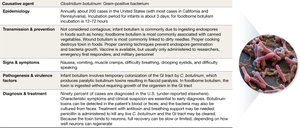
Causative agent: Clostridium botulinum (Gram-positive bacterium)
Epidemiology: About 100 cases annually in the U.S.; most cases are infant botulism
Transmission & prevention: Not contagious; foodborne botulism from improperly canned foods; prevention includes proper food handling
Signs & symptoms: Flaccid paralysis, blurry vision, difficulty swallowing, dry mouth
Pathogenesis & virulence factors: Botulinum toxin blocks acetylcholine release, causing paralysis
Diagnosis & treatment: Identification of toxin in serum/stool; antitoxin and supportive care
Cryptococcosis
Cryptococcosis is a fungal infection of the CNS, caused by Cryptococcus neoformans and C. gattii. It is most common in immunocompromised patients.
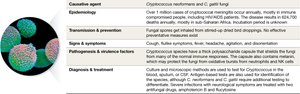
Causative agent: Cryptococcus neoformans and C. gattii (fungi)
Epidemiology: Over 1 million cases annually worldwide; mostly in immunocompromised individuals
Transmission & prevention: Fungal spores inhaled from bird droppings; no effective prevention
Signs & symptoms: Cough, flu-like symptoms, fever, headache, agitation, disorientation
Pathogenesis & virulence factors: Polysaccharide capsule resists phagocytosis; infects CNS
Diagnosis & treatment: Culture and microscopy; antifungal drugs required
Toxoplasmosis
Toxoplasmosis is a protozoan infection caused by Toxoplasma gondii. It is widespread and can cause severe disease in immunocompromised individuals and pregnant women.
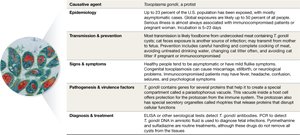
Causative agent: Toxoplasma gondii (protozoan)
Epidemiology: Up to 23% of U.S. population exposed; severe disease in immunocompromised and pregnant women
Transmission & prevention: Ingestion of contaminated food/water; prevention includes proper food handling and avoiding cat feces
Signs & symptoms: Healthy people often asymptomatic; severe disease includes fever, confusion, neurological symptoms
Pathogenesis & virulence factors: Intracellular growth; evades immune response
Diagnosis & treatment: ELISA or PCR for diagnosis; antiparasitic drugs required
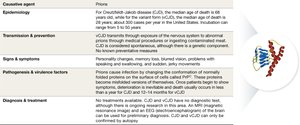
Human Transmissible Spongiform Encephalopathy (Prion Diseases)
Prion diseases are rare, fatal neurodegenerative disorders caused by misfolded proteins (prions). They include Creutzfeldt-Jakob disease (CJD) and variant CJD (vCJD).
Causative agent: Prions (misfolded proteins)
Epidemiology: Median age of death is 68 years for CJD; vCJD affects younger individuals; incubation can be years to decades
Transmission & prevention: vCJD transmitted via contaminated medical procedures or ingestion of infected tissue; prevention is difficult
Signs & symptoms: Personality changes, memory loss, mental decline, problems with movement
Pathogenesis & virulence factors: Prions cause misfolding of normal proteins, leading to neurodegeneration
Diagnosis & treatment: No treatment available; diagnosis via MRI, EEG, and brain biopsy
Additional info:
These diseases illustrate the diversity of microbial and non-microbial agents (viruses, bacteria, fungi, protozoa, prions) that can infect the nervous system.
Diagnosis often relies on laboratory tests, including culture, microscopy, serology, and molecular methods.
Prevention strategies include vaccination, proper food handling, and avoiding exposure to vectors or contaminated materials.
