Back
BackMicrobial Infections of the Skin and Eyes: Key Diseases and Clinical Principles
Study Guide - Smart Notes
 Tailored notes based on your materials, expanded with key definitions, examples, and context.
Microbial Infections of the Skin and Eyes
Overview
The skin and eyes are critical barriers against microbial invasion, but they are also susceptible to a variety of infections caused by viruses, bacteria, and fungi. This section summarizes the causative agents, epidemiology, transmission, clinical features, pathogenesis, and treatment of major skin and eye infections relevant to clinical microbiology.
Viral Skin Infections
Chickenpox and Shingles
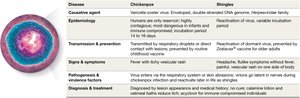
Chickenpox and shingles are caused by the varicella-zoster virus, a member of the Herpesviridae family. Chickenpox is a common childhood disease, while shingles is a reactivation of the virus later in life.
Causative Agent: Varicella-zoster virus (enveloped, double-stranded DNA virus)
Epidemiology: Chickenpox is highly contagious, especially in children; shingles occurs in adults due to reactivation.
Transmission & Prevention: Chickenpox spreads via respiratory droplets; shingles is not spread person-to-person. Vaccination is effective for prevention.
Signs & Symptoms: Chickenpox presents with fever and itchy vesicular rash; shingles causes painful, localized vesicular rash.
Pathogenesis: Virus enters through the respiratory tract, establishes latency in sensory ganglia, and can reactivate as shingles.
Diagnosis & Treatment: Diagnosis is clinical; antiviral therapy may be used for severe cases.
Herpes Simplex Virus Type 1 (HSV-1)
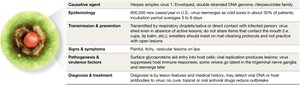
HSV-1 is a common cause of oral and sometimes skin lesions, transmitted primarily through direct contact.
Causative Agent: Herpes simplex virus 1 (enveloped, double-stranded DNA virus)
Epidemiology: Affects millions worldwide; often manifests as cold sores.
Transmission & Prevention: Spread by direct contact with infected secretions; avoid sharing personal items.
Signs & Symptoms: Painful, vesicular lesions on lips or skin.
Pathogenesis: Virus establishes latency in sensory ganglia; reactivation causes recurrent lesions.
Diagnosis & Treatment: Clinical diagnosis; antiviral drugs can reduce severity and recurrence.
Measles (Rubeola)
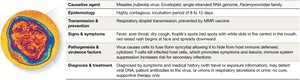
Measles is a highly contagious viral disease with significant complications, preventable by vaccination.
Causative Agent: Measles virus (enveloped, single-stranded RNA virus, Paramyxoviridae family)
Epidemiology: Highly contagious; incubation period of 8–12 days.
Transmission & Prevention: Spread by respiratory droplets; prevented by MMR vaccine.
Signs & Symptoms: Fever, cough, Koplik's spots, and maculopapular rash.
Pathogenesis: Virus suppresses immune response, increasing risk of secondary infections.
Diagnosis & Treatment: Clinical diagnosis; supportive therapy is mainstay.
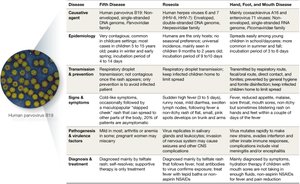
Other Viral Exanthems: Fifth Disease, Roseola, and Hand, Foot, and Mouth Disease
These viral diseases are common in children and present with characteristic rashes.
Causative Agents: Parvovirus B19 (Fifth Disease), Human herpesvirus 6/7 (Roseola), Coxsackievirus A16 and Enterovirus 71 (Hand, Foot, and Mouth Disease)
Epidemiology: All are highly contagious, primarily affecting children.
Transmission & Prevention: Spread by respiratory droplets or direct contact; prevention is mainly hygiene-based.
Signs & Symptoms: Fifth Disease: "slapped cheek" rash; Roseola: sudden high fever, then rash; Hand, Foot, and Mouth: vesicular lesions on hands, feet, and mouth.
Pathogenesis: Viruses replicate in target tissues, causing characteristic rashes.
Diagnosis & Treatment: Clinical diagnosis; supportive care is typical.
Bacterial Skin Infections
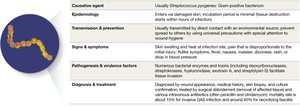
Necrotizing Fasciitis
Necrotizing fasciitis is a rapidly progressing, life-threatening infection of the fascia, most commonly caused by Streptococcus pyogenes.
Causative Agent: Usually Streptococcus pyogenes (Gram-positive bacterium)
Epidemiology: Enters via damaged skin; rapid progression.
Transmission & Prevention: Direct contact with infected secretions; universal precautions and wound hygiene are critical.
Signs & Symptoms: Severe pain, swelling, fever, and tissue necrosis.
Pathogenesis: Bacterial toxins and enzymes destroy tissue and facilitate rapid spread.
Diagnosis & Treatment: Clinical assessment, imaging, and surgical intervention; antibiotics are essential.
Pseudomonas Wound and Ear Infections
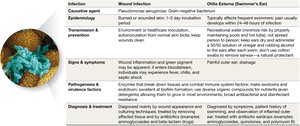
Pseudomonas aeruginosa is a Gram-negative bacterium that causes wound and ear infections, especially in healthcare settings.
Causative Agent: Pseudomonas aeruginosa (Gram-negative bacterium)
Epidemiology: Associated with burns, wounds, and moist environments.
Transmission & Prevention: Healthcare-associated; prevented by proper wound care and hygiene.
Signs & Symptoms: Wound inflammation, green pigment, and ear pain (in otitis externa).
Pathogenesis: Produces enzymes and toxins that damage tissue and evade immune response.
Diagnosis & Treatment: Clinical diagnosis; treated with antibiotics based on susceptibility testing.
Gangrene
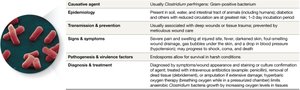
Gangrene is a severe infection of tissue, often caused by Clostridium perfringens, leading to tissue death and systemic toxicity.
Causative Agent: Usually Clostridium perfringens (Gram-positive, spore-forming bacterium)
Epidemiology: Associated with trauma, diabetes, and poor circulation.
Transmission & Prevention: Enters through wounds; prevention involves wound care and hygiene.
Signs & Symptoms: Severe pain, swelling, tissue death, and systemic toxicity.
Pathogenesis: Bacterial toxins destroy tissue and produce gas.
Diagnosis & Treatment: Clinical diagnosis; treated with antibiotics, surgery, and sometimes hyperbaric oxygen.
Fungal Skin Infections
Cutaneous Candidiasis
Cutaneous candidiasis is a fungal infection of the skin, most often caused by Candida albicans, especially in immunocompromised individuals.
Causative Agent: Yeast species, usually Candida albicans
Epidemiology: Risk factors include antibiotic use, diabetes, and immunosuppression.
Transmission & Prevention: Overgrowth of normal flora; prevention includes hygiene and blood sugar control in diabetics.
Signs & Symptoms: Red, itchy rash with satellite lesions.
Pathogenesis: Fungal enzymes facilitate tissue invasion.
Diagnosis & Treatment: Clinical diagnosis; topical or oral antifungals are used for treatment.

Microbial Infections of the Eye
Conjunctivitis (Non-neonatal)
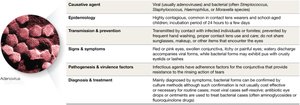
Conjunctivitis, or "pink eye," is an inflammation of the conjunctiva caused by viruses or bacteria, and is highly contagious in school settings.
Causative Agent: Usually viral (adenovirus) or bacterial (Streptococcus, Staphylococcus, Haemophilus)
Epidemiology: Common in children; spreads rapidly in close-contact environments.
Transmission & Prevention: Spread by direct contact; prevented by hand hygiene and avoiding sharing personal items.
Signs & Symptoms: Redness, irritation, discharge, and sometimes crusting of eyelids.
Pathogenesis: Pathogens adhere to conjunctiva, resisting tear action.
Diagnosis & Treatment: Clinical diagnosis; bacterial cases may require antibiotics, while viral cases are self-limiting.