 Back
Microbial Interactions, Bacterial and Viral Structure, and Medical Microbiology Essentials
Study Guide - Smart Notes
 Tailored notes based on your materials, expanded with key definitions, examples, and context.
Interactions Between Microbes & Hosts
Pathogenicity and Virulence
Microorganisms interact with hosts in various ways, ranging from harmless coexistence to causing disease. Understanding these interactions is fundamental in microbiology and medicine.
Pathogenicity: The ability of a microorganism to cause disease in a host.
Pathogen: A microbe that causes disease.
Intracellular pathogen: Survives and reproduces inside host cells.
Non-pathogenic microbe: Does not cause disease in a given host.
Opportunistic pathogens: Normally non-pathogenic but can cause disease under certain conditions (e.g., immunocompromised hosts).
Virulence: The degree of pathogenicity of a microorganism.
Virulence factors: Molecules that enable pathogens to infect, evade immune responses, and cause disease (e.g., adhesins, toxins, capsules, enzymes).
Examples of Virulence Factors:
Adhesins: Help pathogens attach to host cells.
Toxins: Disrupt host cell integrity and function.
Capsules: Protect bacteria from phagocytosis.
Enzymes: Such as coagulase (induces clotting) and hyaluronidase (breaks down connective tissue).
Invasins: Enable entry and spread within the host.
Types of Symbiosis
Mutualism: Both species benefit.
Parasitism: One benefits, the other is harmed.
Commensalism: One benefits, the other is unaffected.
Microbiota: The community of microbes in a specific area of a host, including commensal, pathogenic, and mutualistic organisms.
Normal/resident microbiota: Permanent colonizers, often protective.
Transient microbiota: Temporary inhabitants, more likely to cause disease.
Bacterial Structure, Classification, and Metabolism
Bacterial Shapes and Arrangements
Bacteria are classified by their shapes and arrangements, which are important for identification and understanding their biology.
Bacillus: Rod-shaped
Coccus: Spherical
Helical/Spirillum/Spirochete: Spiral-shaped
Vibrio: Comma-shaped
Pleomorphic: Variable shape
Budding/appendaged: Reproduce by budding, may have stalks or hyphae
Arrangements:
Diplo-: Pairs
Strepto-: Chains
Staphylo-: Clusters
Palisade: Side-by-side (bacilli)
Tetrad/Sarcinae: Groups of 4 or 8 (cocci)
Filamentous: Long, thin chains, sometimes branched
Bacterial Metabolism and Oxygen Requirements
Metabolism: All chemical reactions in an organism.
Aerobic metabolism: Requires oxygen.
Fermentative (anaerobic) metabolism: Does not require oxygen.
Obligate aerobe: Requires oxygen.
Facultative anaerobe: Can grow with or without oxygen.
Obligate anaerobe: Cannot grow with oxygen.
Aerotolerant anaerobe: Tolerates oxygen but does not use it.
Microaerophile: Requires low levels of oxygen.
Bacterial Differentiation: Staining and Structures
Gram stain: Distinguishes bacteria by cell wall structure.
Gram-positive: Thick peptidoglycan, purple stain.
Gram-negative: Thin peptidoglycan, outer membrane, pink/red stain.
Endospore stain: Identifies endospore-forming bacteria.
Acid-fast stain: Identifies bacteria with mycolic acid in cell walls (e.g., Mycobacterium).
Capsule and slime layer: Protective outer layers, contribute to virulence.
Flagella: Whip-like structures for motility.
Medical Microbiology: Disease, Epidemiology, and Immunity
Disease Spread and Epidemiology
Endemic: Constant presence in a region.
Epidemic: Sudden increase in cases in a region.
Pandemic: Global spread.
Sporadic: Scattered, infrequent cases.
Incidence: Number of new cases in a time period.
Reservoir: Habitat where a pathogen grows/multiplies.
Nosocomial infections (HAIs): Acquired in healthcare settings.
Persistent infections: Pathogen remains in body long-term (chronic, latent, slow-progressing).
Immunity: Resistance to infection.
Herd immunity: Indirect protection when most of a population is immune.
Portals of Microbial Entry
Respiratory tract: Inhalation through mucous membranes (most common).
Parenteral route: Entry via breaks in skin/mucous membranes.
Skin, hair follicles, sweat ducts: Colonization without broken skin.
Gastrointestinal tract: Ingestion.
Genitourinary tract: Entry via mucous membranes (STDs, UTIs).
Predisposing Factors for Infectious Disease
Genetic background
Climate & environment
Lifestyle (nutrition, hygiene, etc.)
Occupation (healthcare, farming, etc.)
Important Bacterial Genera and Phyla
Key Genera
Bacillus: Gram-positive, endospore-forming rods; some are pathogens (e.g., B. anthracis).
Bacteroides: Gram-negative, obligate anaerobes; common in gut, usually mutualistic.
Campylobacter: Gram-negative, causes diarrheal disease.
Clostridium: Gram-positive, obligate anaerobes, endospore-forming.
Escherichia: Gram-negative, facultative anaerobes; E. coli is common in GI tract.
Lactobacillus: Gram-positive, aerotolerant/microaerophilic; important in microbiota and probiotics.
Legionella: Gram-negative, aerobic, facultative intracellular pathogens.
Mycobacterium: Gram-positive, mycolic acid-rich cell walls; includes M. tuberculosis.
Mycoplasma: Lack cell wall, pleomorphic, resistant to cell wall antibiotics.
Pseudomonas: Gram-negative, aerobic, metabolically diverse, opportunistic pathogens.
Rickettsia: Gram-negative, obligate intracellular parasites.
Salmonella: Gram-negative, facultative aerobes, cause foodborne illness.
Staphylococcus: Gram-positive, cluster-forming cocci, includes S. aureus.
Streptococcus: Gram-positive, chain-forming cocci, includes many pathogens.
Vibrio: Gram-negative, comma-shaped, causes cholera and vibriosis.
Key Phyla
Bacteroidetes: Gram-negative rods, common in GI tract.
Actinobacteria: Gram-positive, includes decomposers and antibiotic producers.
Firmicutes: Gram-positive, includes Bacillus and Clostridium.
Proteobacteria: Large, diverse group of gram-negative bacteria.
Chlorobiota: Green sulfur bacteria, anaerobic photoautotrophs.
Cyanobacteria: Oxygenic photosynthetic prokaryotes.
Spirochaetota: Gram-negative, spiral-shaped.
Fungi, Algae, Dinoflagellates, and Lichens
Fungi
Eukaryotic, cell walls of chitin, heterotrophic/saprotrophic.
Produce fruiting bodies and spores (asexual and sexual).
Most are not pathogenic to humans; exceptions include dermatophytes (ringworm) and Candida (yeast infections).
Algae
Photosynthetic, aquatic, can be unicellular or multicellular.
Dinoflagellates
Single-celled, mostly marine, can cause harmful algal blooms (red tides).
Produce neurotoxins affecting marine life.
Lichens
Symbiotic association of fungi and algae/cyanobacteria.
Important in nutrient cycling and as pioneer species on bare surfaces.
Viruses, Viroids, and Prions
Characteristics and Structure of Viruses
Viruses are infectious agents that require living cells to replicate. They are not considered living organisms and consist mainly of genetic material (DNA or RNA) enclosed in a protein coat (capsid). Some viruses have an additional lipid envelope derived from the host cell membrane.
Capsid: Protein shell enclosing the genome.
Capsomere: Protein subunit of the capsid.
Envelope: Lipid bilayer present in some viruses.
Spike proteins: Surface proteins for host cell attachment.
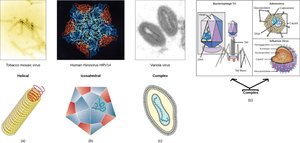
Virus Morphologies
Icosahedral: Spherical, 20-sided (e.g., polio, rhinovirus, herpes).
Helical: Rod-shaped, can be rigid or flexible (e.g., tobacco mosaic virus, Ebola).
Complex: Combination of shapes, often with additional structures (e.g., bacteriophages).
Classification of Viruses
By genome type (DNA or RNA, single or double stranded)
By morphology
By replication strategy (Baltimore classification)
Viral Replication Cycle
Adsorption (Attachment): Virus binds to host cell receptors.
Penetration (Entry): Virus or genome enters host cell (endocytosis, fusion, or injection).
Uncoating: Capsid degrades, releasing genome.
Replication/Synthesis: Genome and proteins are produced using host machinery.
Assembly/Maturation: New virions are assembled.
Release: Virions exit the cell (lysis or budding).
Bacteriophages vs. Animal Viruses
Bacteriophages inject their genome; animal viruses often enter whole.
Uncoating is typical for animal viruses, not for phages.
Both hijack host machinery for replication.
Phages usually release by lysis; animal viruses may also bud from the cell.
Viroids and Virusoids
Viroid: Infectious naked RNA, lacks capsid.
Virusoid: Similar to viroid but requires a helper virus.
