 Back
BackMicrobial Interactions: Types, Mechanisms, and Examples
Study Guide - Smart Notes
 Tailored notes based on your materials, expanded with key definitions, examples, and context.
Microbial Interactions
Overview of Microbial Interactions
Microbial interactions encompass a wide range of relationships between different species of microorganisms and between microbes and other organisms. These interactions are fundamental to microbial ecology and evolution, influencing nutrient cycling, population dynamics, and ecosystem stability. The main types of microbial interactions include mutualism, cooperation, commensalism, amensalism, predation, parasitism, and competition.
Symbiosis: An association of two or more different species of organisms. Symbionts must colonize, reproduce, persist within the host, and transmit to new hosts.
Ectosymbiont: Organism located on the surface of another organism.
Endosymbiont: Organism located within another organism, sometimes inside cells.
Symbiont: Any organism in a specific relationship with another, such as mutualism, cooperation, or commensalism.
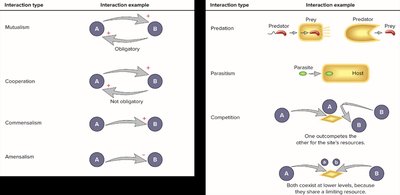
Types of Microbial Interactions
Mutualism and Cooperation
Mutualism and cooperation are two-way interactions where both partners benefit. In mutualism, the relationship is often obligatory, meaning the partners are dependent on each other for survival. In cooperation, the relationship is beneficial but not essential for survival.
Mutualism: Reciprocal benefit to both partners; often obligatory. Example: Buchnera aphidicola (bacterium) and aphids.
Cooperation: Both partners benefit, but the relationship is not obligatory.
Genomic Studies: Aphid-Buchnera Mutualism
Buchnera aphidicola is an obligate nutritional endosymbiont in aphids, providing essential amino acids. 150 million years old
Aphids contain millions of these bacteria within specialized cells called bacteriocytes.
The endosymbiont has a highly reduced genome, reflecting extreme genomic stability and coevolution.
Protozoan-Termite Symbiosis
Termites rely on protozoa in their gut to digest cellulose, but the protozoa themselves depend on symbiotic bacteria for cellulase production.
This three-way mutualism allows termites to utilize wood as a food source.
Termite-associated protists are members of the Excavata supergroup and possess hydrogenosomes instead of mitochondria due to reductive evolution.
Zooxanthellae and Marine Invertebrates
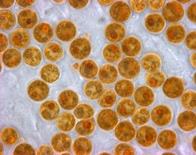
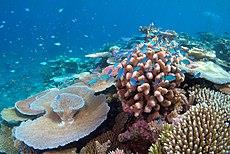
Corals and jellyfish harbor photosynthetic dinoflagellate algae called zooxanthellae.
Corals provide protection and nutrients; algae supply oxygen, remove wastes, and provide organic compounds via photosynthesis.
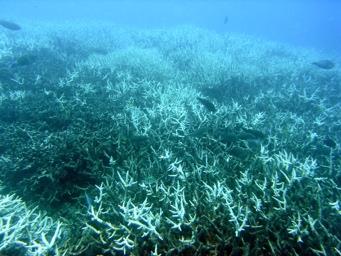
Coral bleaching results from the loss of zooxanthellae or their pigments, often due to increased temperature.
Sulfide-Based Mutualism: Tube Worms and Bacteria
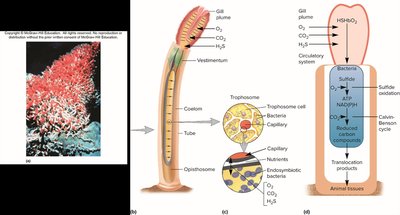
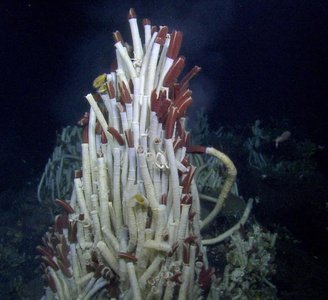
Giant tube worms (Riftia) live near hydrothermal vents and lack a digestive tract.
They harbor chemolithotrophic gammaproteobacteria in a specialized organ (trophosome).
Bacteria use the Calvin-Benson cycle to fix CO2 into organic carbon, using electrons from hydrogen sulfide.
Commensalism and Amensalism
Commensalism and amensalism are one-way interactions. In commensalism, one organism benefits while the other is unaffected. In amensalism, one organism is inhibited or destroyed while the other is unaffected.
Commensalism: One organism (commensal) benefits; the other is neither harmed nor helped.
Examples: Microbial succession during milk spoilage (acid-tolerant species benefit from acid produced by others), formation of biofilms (initial colonizer modifies surface for others).
Amensalism: One organism is negatively affected by a compound released by another.
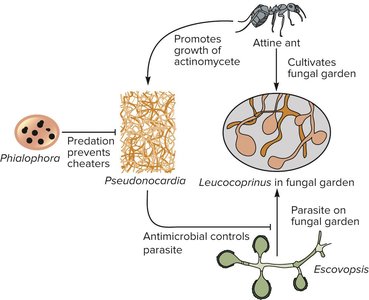
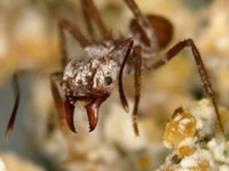
Examples: Antibiotic production by fungi and bacteria; complex symbiosis in attine ants, actinobacteria, cultivated fungi, and parasitic fungi.
Antagonistic Interactions: Predation, Parasitism, and Competition
Antagonistic interactions involve one organism benefiting at the expense of another. Predation and parasitism are forms of symbiosis where one organism is harmed, while competition involves both organisms vying for the same resource.
Predation: One organism (predator) attacks and usually kills another (prey). Examples include epibiotic predators like Vampirococcus and endobiotic predators like Daptobacter.
Parasitism: One organism (parasite) benefits, the other (host) is harmed, but coexistence is typical. Example: Lichens, where the fungal partner (mycobiont) may act as a parasite on the algal or cyanobacterial partner (phycobiont).
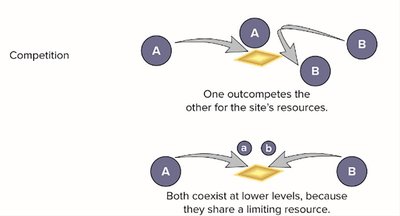
Competition: Two organisms compete for the same resource. Outcomes include competitive exclusion (one dominates) or resource sharing (both survive at lower levels).
Summary Table: Types of Microbial Interactions
Interaction Type | Definition | Example |
|---|---|---|
Mutualism | Both partners benefit; often obligatory | Aphid and Buchnera; coral and zooxanthellae |
Cooperation | Both partners benefit; not obligatory | Microbial consortia in soil |
Commensalism | One benefits, other unaffected | Biofilm formation; milk spoilage succession |
Amensalism | One harmed, other unaffected | Antibiotic production by fungi |
Predation | One benefits, other killed | Vampirococcus attacking bacteria |
Parasitism | One benefits, other harmed (but not killed immediately) | Lichens (fungus and alga/cyanobacteria) |
Competition | Both harmed by reduced access to resource | Soil microbes competing for nutrients |
