 Back
BackMicrobial Mechanisms of Pathogenicity: Study Notes
Study Guide - Smart Notes
 Tailored notes based on your materials, expanded with key definitions, examples, and context.
Microbial Mechanisms of Pathogenicity
Introduction to Pathogenicity and Virulence
Pathogenicity refers to the ability of a microorganism to cause disease, while virulence describes the degree of pathogenicity. Understanding these concepts is essential for studying how microbes interact with hosts and the mechanisms they use to establish infections.
Pathogenicity: The capacity of a microbe to cause disease in a host organism.
Virulence: The quantitative measure of pathogenicity, often assessed by infectious or lethal doses.
How Microorganisms Enter a Host
Portals of Entry
Microorganisms can enter the host through several specific routes, known as portals of entry. The effectiveness of infection often depends on the portal used.
Mucous membranes: Entry via respiratory, gastrointestinal, or genitourinary tracts.
Skin: Entry through cuts, abrasions, or direct penetration.
Parenteral route: Direct deposition into tissues beneath the skin or mucous membranes, such as by injections, bites, wounds, or surgery.
Most pathogens have a preferred portal of entry that is critical for their ability to cause disease.
Numbers of Invading Microbes
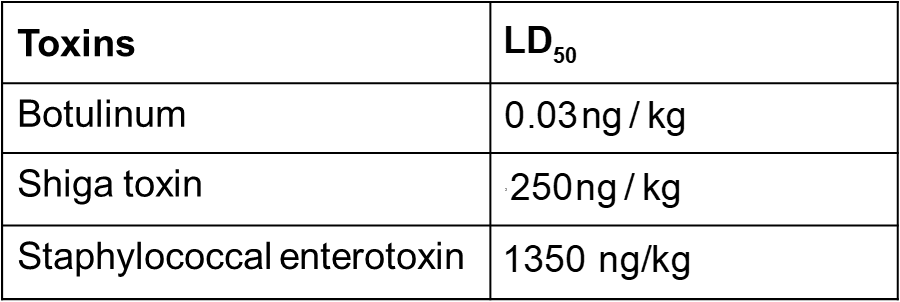
The likelihood of disease depends on the number of microbes entering the host. Two important measures are ID50 and LD50.
ID50 (Infectious Dose 50): The number of microbes required to cause infection in 50% of a sample population. It measures the virulence of a microbe.
LD50 (Lethal Dose 50): The amount of toxin required to kill 50% of a sample population. It measures the potency of a toxin.
Adherence to Host Tissues
Mechanisms of Adherence
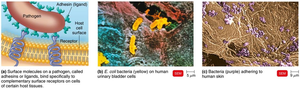
Adherence is a critical step in the establishment of infection. Pathogens use specific molecules to attach to host cells.
Adhesins (ligands): Surface molecules on pathogens that bind specifically to complementary receptors on host cells.
Structures involved include glycocalyx, fimbriae, and viral spikes.
Penetration of Host Defenses
Capsules
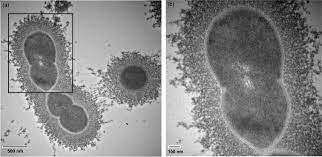
Some bacteria produce a glycocalyx (capsule) around their cell wall, which impairs phagocytosis by host immune cells.
Biofilms
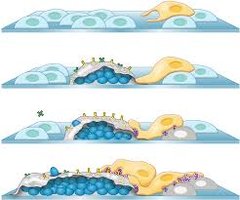
Biofilms are communities of microorganisms attached to surfaces and embedded in a self-produced matrix. They help pathogens evade phagocytosis and contribute to antimicrobial resistance.
Cell Wall Components
Certain cell wall components enhance pathogenicity:
M protein: Resists phagocytosis (e.g., Streptococcus pyogenes).
Opa protein: Mediates attachment to host cells (e.g., Neisseria gonorrhoeae).
Waxy lipid (mycolic acid): Resists digestion by phagocytes (e.g., Mycobacterium tuberculosis).
Enzymes
Pathogenic bacteria produce enzymes that facilitate invasion and evasion of host defenses:
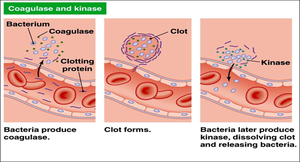
Coagulases: Coagulate fibrinogen to form clots.
Kinases: Digest fibrin clots (dissolve clots to release bacteria).
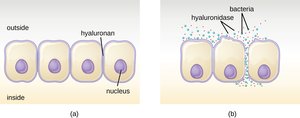
Hyaluronidase: Digests hyaluronic acid, a polysaccharide that holds cells together.
Collagenase: Breaks down collagen in connective tissue.
IgA proteases: Destroy IgA antibodies.
Antigenic Variation
Some pathogens can alter their surface antigens, rendering host antibodies ineffective. This allows them to evade the immune response.
Examples: Influenza virus, Neisseria gonorrhoeae, Trypanosoma brucei gambiense
Penetration into the Host Cell
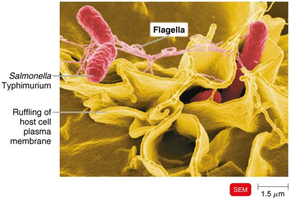
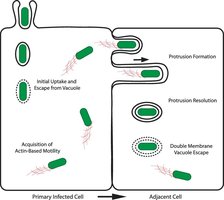
Pathogens may use invasins to rearrange actin filaments of the host cytoskeleton, causing membrane ruffling and facilitating entry into cells. Some can survive inside phagocytes.
Examples: Shigella, Listeria
Using the Host’s Nutrients
Siderophores
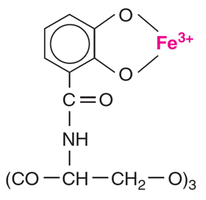
Iron is essential for bacterial growth. Pathogens secrete siderophores, which are proteins that bind iron more tightly than host iron-binding proteins, allowing bacteria to acquire iron from the host.
Direct Damage to Host Cells
Pathogens can cause direct damage by disrupting host cell function, using host nutrients, producing waste products, and multiplying within host cells, leading to cell rupture.
Production of Toxins
General Concepts
Toxins are poisonous substances produced by microorganisms that contribute to disease symptoms such as fever, cardiovascular problems, diarrhea, and shock.
Toxigenicity: The ability of a microorganism to produce a toxin.
Toxemia: Presence of toxin in the host’s blood.
Intoxications: Disease caused by the presence of toxin without microbial growth.
Exotoxins
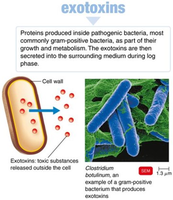
Exotoxins are proteins produced and secreted by bacteria. They are highly specific in their action and can be neutralized by antitoxins (antibodies). Toxoids are inactivated exotoxins used in vaccines.
Produced by both gram-positive and gram-negative bacteria.
Types of Exotoxins
A-B toxins: Consist of an enzyme (A part) and a binding component (B part). Example: Diphtheria toxin.
Genotoxins: Damage DNA, causing mutations and possibly cancer.
Membrane-disrupting toxins: Lyse host cells by disrupting plasma membranes.
Leukocidins: Kill phagocytic leukocytes.
Hemolysins: Kill erythrocytes by forming protein channels.
Streptolysins: Produced by streptococci, lyse red blood cells and other cells.
Superantigens: Cause intense immune responses due to cytokine release, leading to fever, nausea, vomiting, diarrhea, shock, and death.
Endotoxins
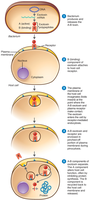
Endotoxins are the lipid A portion of lipopolysaccharides (LPS) found in the outer membrane of gram-negative bacteria. They are released when the bacteria die and the cell wall breaks apart.
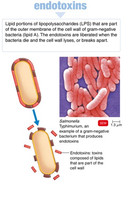
Pyrogenic Response
Endotoxins can trigger a pyrogenic (fever) response by stimulating the release of cytokines from host cells, which can lead to fever and shock.
Comparison of Exotoxins and Endotoxins
Feature | Exotoxins | Endotoxins |
|---|---|---|
Chemical Nature | Proteins | Lipid A (part of LPS) |
Source | Gram-positive and Gram-negative bacteria | Gram-negative bacteria only |
Heat Stability | Unstable (destroyed by heat) | Stable (withstands autoclaving) |
Toxicity | High | Low (but can be fatal in large amounts) |
Immunogenicity | Strong (stimulate antitoxin production) | Weak |
Fever Production | No | Yes |
Pathogenic Properties of Viruses
Viruses evade host defenses by residing intracellularly, using host cell surface molecules, directly attacking immune components, and undergoing antigenic variation. Cytopathic effects (CPE) are visible changes in host cells due to viral infection, such as cell lysis, inclusion body formation, and cytokine storms.
Pathogenic Properties of Fungi
Fungi can produce toxins that cause disease symptoms:
Ergot: Alkaloid toxins causing hallucinations.
Aflatoxin: Carcinogenic toxin produced by Aspergillus.
Pathogenic Properties of Protozoa
Protozoa cause disease by their presence and waste products. They evade host defenses by digesting cells and tissue fluids, growing in phagocytes, and antigenic variation.
Examples: Giardia intestinalis, Toxoplasma gondii, Trypanosoma
Pathogenic Properties of Helminths
Helminths use host tissue for growth, produce large parasitic masses, and release waste products that cause cellular damage and symptoms.
Portals of Exit
Microorganisms leave the host through specific portals of exit, which are often the same as the portals of entry.
Respiratory tract: Coughing and sneezing
Gastrointestinal tract: Feces and saliva
Genitourinary tract: Urine; secretions from the penis and vagina
Skin
Blood: Arthropod bites; needles or syringes
Summary Table: Microbial Mechanisms of Pathogenicity
Step | Description |
|---|---|
1. Portal of Entry | Microbe enters host via specific route |
2. Adherence | Microbe attaches to host tissues |
3. Penetration/Evasion of Host Defenses | Microbe evades or penetrates host immune responses |
4. Damage to Host Cells | Direct damage, toxin production, or induction of hypersensitivity |
5. Portal of Exit | Microbe exits host to infect new hosts |
Key Questions for Review
What is ID50? What does it measure?
What is LD50? What does it measure?
Which factors contribute to adherence?
Which factors allow a pathogen to be invasive (penetrate host defenses)?
Which roles do biofilms play in invasiveness?
What are siderophores? What are they used for?
What are exotoxins? Which are the different types of exotoxins?
What are endotoxins? What are the differences between endotoxins and exotoxins based on chemistry and production?
What is the pyrogenic mechanism associated with endotoxins?
Which toxins are produced by fungi? What do these cause?
What are the different portals of entry/exit?
What is the order of events for microbial pathogenicity?
Additional info: Some explanations and table entries were expanded for clarity and completeness based on standard microbiology textbooks.
