 Back
BackMicrobial Metabolic Diversity and Phototrophy: Mechanisms, Pathways, and Ecological Roles
Study Guide - Smart Notes
 Tailored notes based on your materials, expanded with key definitions, examples, and context.
Microbial Metabolic Diversity
Anaerobic Respiration and Syntrophy
Microorganisms display remarkable metabolic diversity, especially in anaerobic environments where oxygen is absent. In these settings, microbes utilize a variety of terminal electron acceptors in a sequential manner, depending on their reduction potential. This process is often syntrophic, meaning that the metabolic byproducts of one organism serve as substrates for another, facilitating complex community interactions and nutrient cycling.
Anaerobic Respiration: Utilizes electron acceptors other than O2, such as nitrate (NO3-), manganese (MnO2), iron (Fe(OH)3), sulfate (SO42-), and carbon dioxide (CO2).
Syntrophy: Cooperative interaction where one microbe's waste product is another's substrate, enabling processes that would be energetically unfavorable for a single organism.
Reduction Potential: The electron acceptor with the highest reduction potential is used first, followed by others as conditions change.
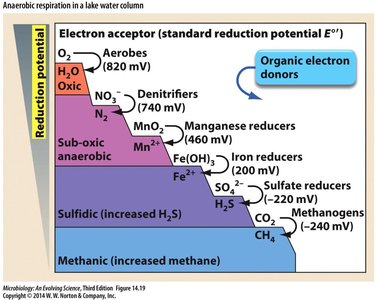
Microbial Metabolism and Environmental Redox Changes
Microbial metabolism drives redox transformations in the environment, which are essential for nutrient cycling and ecosystem function. These redox changes underpin the cycling of key elements such as carbon, nitrogen, sulfur, iron, and manganese.
Primary Production: Chemolithotrophy and anaerobic respiration are crucial for primary production in extreme environments, such as hydrothermal vents.
Pipeline Corrosion: Microbial metabolic activities, especially those involving sulfate-reducing bacteria, can lead to industrial challenges like pipeline corrosion.
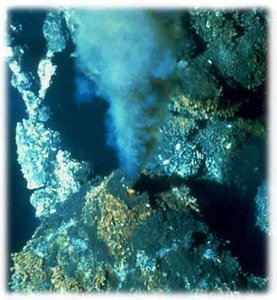
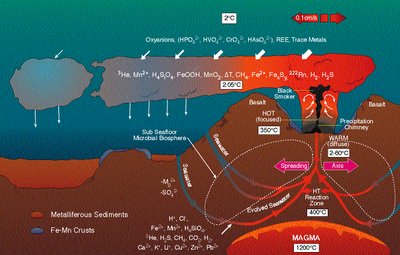
Electron Donors and Acceptors in Lithotrophy
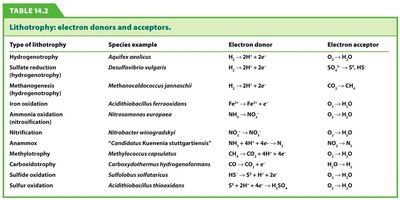
Microbes can use a wide range of inorganic compounds as electron donors and acceptors, a process known as lithotrophy. This metabolic flexibility supports diverse ecological roles and drives biogeochemical cycles.
Type of Lithotrophy | Species Example | Electron Donor | Electron Acceptor |
|---|---|---|---|
Hydrogenotrophy | Aquifex aeolicus | H2 → 2H+ + 2e- | O2 → H2O |
Sulfate reduction | Desulfovibrio vulgaris | H2 → 2H+ + 2e- | SO42- → H2S |
Methanogenesis | Methanococcus jannaschii | H2 → 2H+ + 2e- | CO2 → CH4 |
Iron oxidation | Acidithiobacillus ferrooxidans | Fe2+ → Fe3+ + e- | O2 → H2O |
Ammonia oxidation | Nitrosomonas europaea | NH3 → NO2- | O2 → H2O |
Nitrite oxidation | Nitrobacter winogradskyi | NO2- → NO3- | O2 → H2O |
Microbial Roles in Biogeochemical Cycles
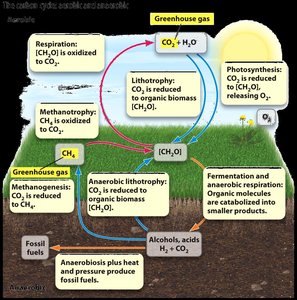
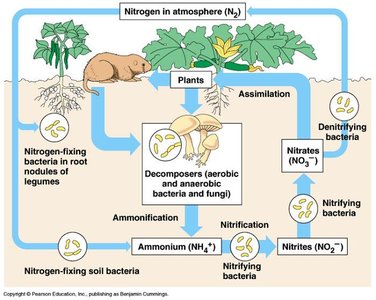
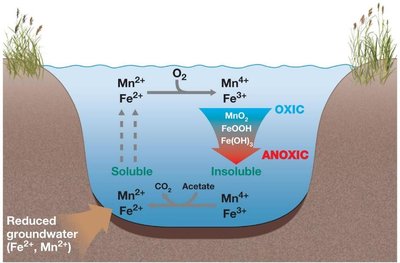
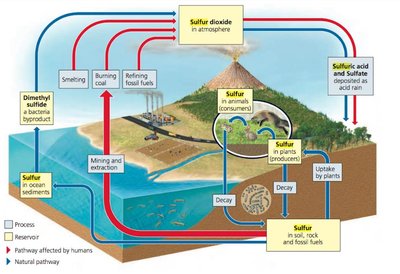
Microbes are central to the cycling of carbon, nitrogen, sulfur, phosphorus, calcium, silica, iron, and manganese. Their metabolic activities transform these elements between different oxidation states, facilitating ecosystem productivity and stability.
Carbon Cycle: Involves processes such as photosynthesis, respiration, methanogenesis, and methanotrophy.
Nitrogen Cycle: Includes nitrogen fixation, nitrification, denitrification, and ammonification.
Sulfur Cycle: Encompasses sulfate reduction, sulfur oxidation, and assimilation by plants and microbes.
Phosphorus, Calcium, Silica Cycles: Driven by weathering, uptake, and recycling by organisms.
Oxidation States of Cycled Compounds
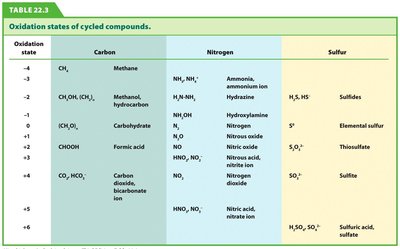
Understanding the oxidation states of key elements is essential for tracking their transformations in microbial metabolism and environmental cycles.
Oxidation State | Carbon | Nitrogen | Sulfur |
|---|---|---|---|
-4 | CH4 (Methane) | NH4+, NH3 (Ammonia) | H2S, HS- (Sulfides) |
0 | CO (Carbon monoxide) | N2 (Nitrogen gas) | S0 (Elemental sulfur) |
+4 | CO2, HCO3- (Carbon dioxide, bicarbonate) | NO2- (Nitrite) | SO32- (Sulfite) |
+6 | - | NO3- (Nitrate) | SO42- (Sulfate) |
Phototrophy and Photosynthesis in Microbes
Principles of Phototrophy
Phototrophy is the process by which organisms capture light energy to drive cellular metabolism. In prokaryotes, this process is highly diverse, involving different pigments, electron donors, and metabolic pathways.
Photoexcitation: Absorption of light by pigments (e.g., chlorophyll, bacteriochlorophyll) excites electrons, initiating electron transport chains (ETCs).
Photolysis: Light-driven separation of electrons from donors such as H2O, H2S, or organic molecules.
Energy Capture: Electron transfer through ETCs generates NADPH, ATP (via proton motive force), and sometimes O2 as a byproduct.
Types of Phototrophic Bacteria
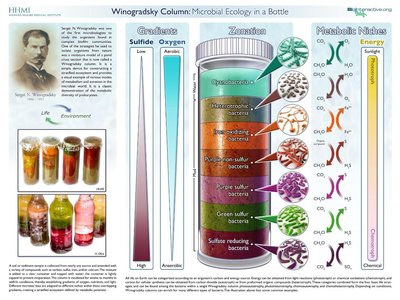
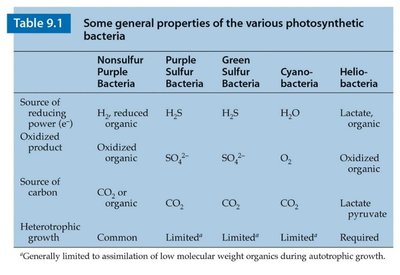
Photosynthetic bacteria are classified based on their pigments, electron donors, and metabolic products. These differences reflect adaptations to various ecological niches and evolutionary histories.
Nonsulfur Purple Bacteria | Purple Sulfur Bacteria | Green Sulfur Bacteria | Cyanobacteria | Heliobacteria | |
|---|---|---|---|---|---|
Source of e- | H2, reduced organic | H2S | H2S | H2O | Lactate, organic |
Oxidized product | Oxidized organic | SO42- | SO42- | O2 | Oxidized organic |
Source of carbon | CO2 or organic | CO2 | CO2 | CO2 | Organic |
Heterotrophic growth | Common | Limited | Limited | Limited | Required |
Photosynthetic Pigments and Light Absorption
Pigment molecules, including chlorophylls and bacteriochlorophylls, are finely tuned to absorb specific wavelengths of light. This adaptation allows microbes to occupy different ecological niches, such as varying depths in aquatic environments.
Bacteriochlorophyll: Absorbs at 805/870 nm, used in anoxygenic photosynthesis (cannot split water).
Chlorophyll: Absorbs at 680 nm, used in oxygenic photosynthesis (can split water, producing O2).
Porphyrin Ring: Structural motif common to pigments, cytochromes, and hemoglobin.
Photosystems and Electron Transport Chains
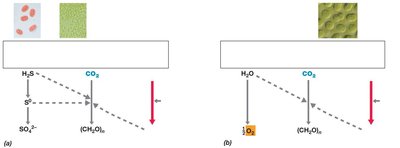
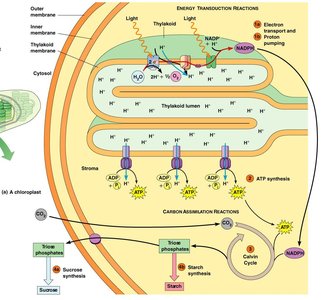
Photosystems are protein complexes that organize pigments and electron carriers, enabling efficient capture and transfer of light energy. Oxygenic photosynthesis involves two photosystems (PSII and PSI), while anoxygenic photosynthesis uses only one.
Photosystem II (PSII): Splits water, releases O2, and generates high-energy electrons.
Photosystem I (PSI): Further elevates electron energy, reducing NADP+ to NADPH.
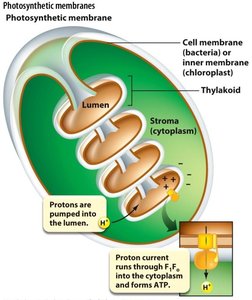
Electron Transport Chain: Transfers electrons through a series of carriers, generating a proton gradient for ATP synthesis.
Light-Dependent and Light-Independent Reactions
Photosynthesis is divided into light-dependent reactions (which generate ATP and NADPH) and light-independent reactions (which fix carbon via the Calvin cycle).
Light-Dependent Reactions: Occur in thylakoid membranes, split water, release O2, and produce ATP and NADPH.
Light-Independent Reactions (Calvin Cycle): Use ATP and NADPH to fix CO2 into sugars.
Alternative Mechanisms of Autotrophy
Some bacteria use alternative pathways for carbon fixation, such as the reverse TCA cycle or the hydroxypropionate pathway. These mechanisms are especially important in anoxygenic phototrophs and certain chemolithoautotrophs.
Reverse TCA Cycle: Used by green sulfur and green nonsulfur bacteria to fix CO2.
Hydroxypropionate Pathway: Utilized by Chloroflexus and some nonphototrophic autotrophs.
Summary Table: Microbial Metabolic Pathways and Ecological Roles
Pathway | Electron Donor | Electron Acceptor | Product | Ecological Role |
|---|---|---|---|---|
Anaerobic Respiration | Organic/inorganic compounds | NO3-, SO42-, CO2, Fe(III) | N2, H2S, CH4, Fe(II) | Nutrient cycling, syntrophy |
Oxygenic Photosynthesis | H2O | CO2 | O2, Sugars | Primary production, O2 generation |
Anoxygenic Photosynthesis | H2S, organic compounds | CO2 | S0, Sugars | Primary production in anaerobic environments |
Chemolithotrophy | H2, Fe2+, NH3 | O2, NO3- | H2O, NO2- | Energy generation, biogeochemical cycling |
Additional info: The study of microbial metabolic diversity is foundational for understanding global biogeochemical cycles, ecosystem functioning, and the evolution of life on Earth. Microbial processes underpin the cycling of essential elements and have significant implications for biotechnology, environmental remediation, and climate change.
