 Back
BackMicrobial Metabolism: An Overview of Energy Transformations in Microorganisms
Study Guide - Smart Notes
 Tailored notes based on your materials, expanded with key definitions, examples, and context.
Microbial Metabolism
Introduction to Metabolism
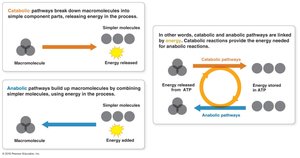
Microbial metabolism encompasses all the chemical reactions that occur within a microorganism, enabling it to grow, reproduce, maintain its structures, and respond to environments. These reactions are broadly categorized into catabolic (energy-releasing) and anabolic (energy-consuming) pathways.
Catabolism and Anabolism
Catabolism: The breakdown of complex organic molecules into simpler ones, typically by hydrolysis, releasing energy that can be used for cellular work.
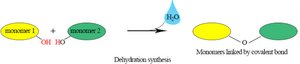
Anabolism: The synthesis of complex molecules from simpler ones, usually by dehydration synthesis, requiring energy input.
Metabolism: The sum of all chemical reactions in a living organism, balancing catabolic and anabolic processes to sustain life.

Role of ATP in Metabolism
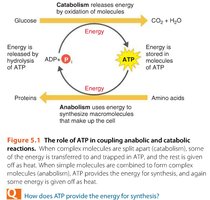
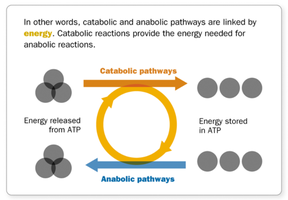
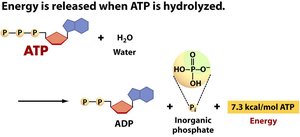
ATP (adenosine triphosphate) acts as the energy currency of the cell, linking catabolic and anabolic reactions. Energy released from catabolic reactions is stored in ATP, which is then used to drive anabolic reactions.
ATP Structure: Composed of adenine, ribose, and three phosphate groups.
ATP Hydrolysis: The removal of the terminal phosphate group releases energy ( kcal/mol ATP).
Enzymes and Metabolic Pathways
Enzymes: Biological Catalysts
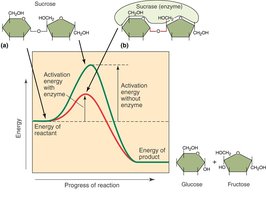
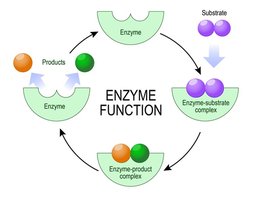
Enzymes are proteins that speed up chemical reactions by lowering the activation energy required. They are highly specific for their substrates and are not consumed in the reaction.
Active Site: The region on the enzyme where the substrate binds.
Enzyme-Substrate Complex: Temporary association between enzyme and substrate during the reaction.
Enzyme Components
Apoenzyme: The protein portion of an enzyme, inactive without its cofactor.
Cofactor: Non-protein component required for enzyme activity (can be a metal ion or organic molecule).
Coenzyme: An organic cofactor, such as NAD+, NADP+, or FAD.
Holoenzyme: The complete, active enzyme with its cofactor.
Naming and Classification of Enzymes
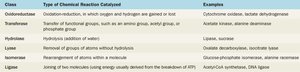
Enzyme names typically end in -ase and are classified by the type of reaction they catalyze:
Class | Type of Reaction Catalyzed | Examples |
|---|---|---|
Oxidoreductase | Oxidation-reduction | Cytochrome oxidase, lactate dehydrogenase |
Transferase | Transfer of functional groups | Aminotransferase, kinase |
Hydrolase | Hydrolysis | Lipase, sucrase |
Lyase | Removal of groups without hydrolysis | Decarboxylase |
Isomerase | Isomerization | Phosphoglucoisomerase |
Ligase | Joining of molecules | DNA ligase |
Factors Influencing Enzyme Activity
Enzyme activity is affected by several factors:
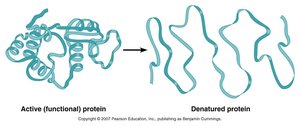
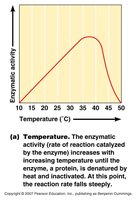
Temperature: Each enzyme has an optimal temperature; activity decreases below or above this point due to reduced kinetic energy or denaturation, respectively.
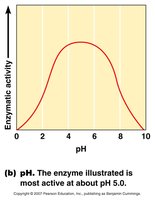
pH: Each enzyme has an optimal pH; deviations can lead to denaturation and loss of activity.
Substrate Concentration: Increasing substrate increases activity until the enzyme is saturated.
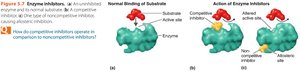
Inhibitors: Chemicals that reduce enzyme activity (competitive or noncompetitive).
Enzyme Inhibition
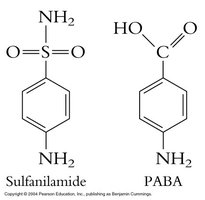
Competitive Inhibition: Inhibitor resembles the substrate and binds to the active site, blocking substrate access.
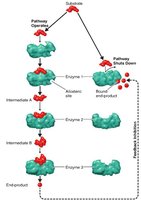
Noncompetitive (Allosteric) Inhibition: Inhibitor binds to a site other than the active site, changing the enzyme's shape and preventing substrate binding.
Feedback Inhibition: The end product of a pathway inhibits an enzyme involved earlier in the pathway, regulating the amount of product formed.
Energy Production and Metabolic Pathways
Oxidation-Reduction (Redox) Reactions
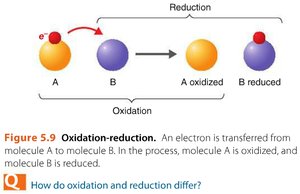
Energy production in cells involves redox reactions, where electrons are transferred from one molecule (oxidized) to another (reduced). These reactions are essential for extracting energy from nutrients.
Oxidation: Loss of electrons (often as hydrogen atoms).
Reduction: Gain of electrons.
Electron Carriers: NAD+ and FAD act as shuttles for electrons during metabolic reactions.

Carbohydrate Catabolism: Pathways for Energy Extraction
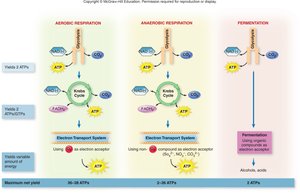
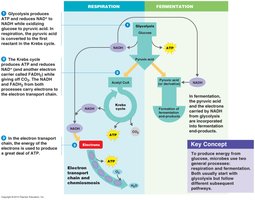
Microorganisms extract energy from carbohydrates through three main pathways: aerobic respiration, anaerobic respiration, and fermentation.
Glycolysis: The oxidation of glucose to pyruvic acid, generating ATP and NADH.
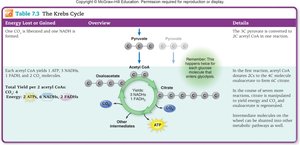
Krebs Cycle (Citric Acid Cycle): Oxidation of acetyl-CoA to CO2, producing NADH, FADH2, and ATP.
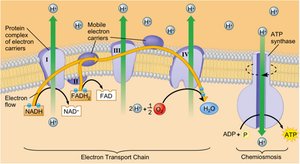
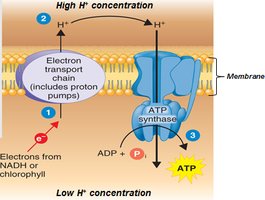
Electron Transport Chain (ETC): Electrons from NADH and FADH2 are transferred through a series of carriers, releasing energy to generate ATP via chemiosmosis.
Aerobic vs. Anaerobic Respiration
Aerobic Respiration: Oxygen is the final electron acceptor; yields the most ATP (up to 38 ATP per glucose in prokaryotes).
Anaerobic Respiration: An inorganic molecule other than oxygen (e.g., nitrate, sulfate) is the final electron acceptor; yields less ATP (1-2 ATP per glucose).
Fermentation
Fermentation is an anaerobic process that allows ATP production in the absence of oxygen. It uses an organic molecule as the final electron acceptor and produces diverse end products such as lactic acid and ethanol.
Does not use the Krebs cycle or ETC.
Yields much less ATP than respiration.
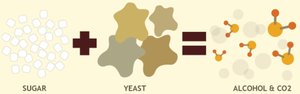
Summary Table: Comparison of Energy Pathways
Pathway | Final Electron Acceptor | ATP Yield (per glucose) | Key Products |
|---|---|---|---|
Aerobic Respiration | O2 | Up to 38 | CO2, H2O, ATP |
Anaerobic Respiration | Inorganic molecule (NO3-, SO42-, etc.) | 1-2 | Varies (e.g., NO2-, H2S) |
Fermentation | Organic molecule | 2 | Lactic acid, ethanol, CO2 |
Key Terms and Concepts
Metabolism: All chemical reactions in a cell.
Catabolism: Breakdown of molecules, energy-releasing.
Anabolism: Synthesis of molecules, energy-consuming.
Enzyme: Protein catalyst, specific for substrate.
ATP: Main energy currency of the cell.
Redox Reaction: Paired oxidation and reduction reactions.
Fermentation: Anaerobic ATP production with organic electron acceptor.
Additional info: This summary integrates textbook figures, lecture objectives, and foundational concepts to provide a comprehensive overview of microbial metabolism for college-level microbiology students.
