 Back
BackMicrobial Metabolism: Anabolism, Catabolism, and Enzyme Function
Study Guide - Smart Notes
 Tailored notes based on your materials, expanded with key definitions, examples, and context.
Metabolism: An Overview
Definition and Importance
Metabolism encompasses all the chemical reactions occurring within a living cell, enabling the cell to extract energy from nutrients and synthesize the molecules necessary for life. These reactions are organized into metabolic pathways, which are determined by enzymes encoded by genes.
Catabolism: The breakdown of complex molecules into simpler ones, releasing energy.
Anabolism: The synthesis of complex molecules from simpler ones, requiring energy input.
Metabolic Pathways: Sequences of enzymatically catalyzed reactions, often interconnected.
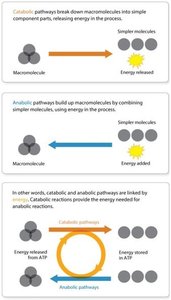
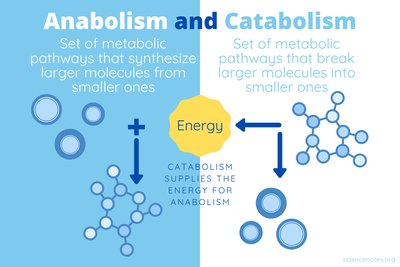
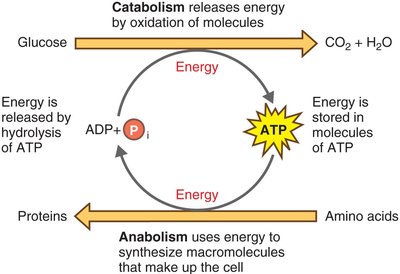
Example: Catabolic pathways break down glucose to release energy, while anabolic pathways use that energy to build proteins from amino acids.
Catabolism vs. Anabolism
Key Differences
Catabolism:
Hydrolytic reactions (breaking bonds with water)
Exergonic (energy-releasing)
Example: Glucose breakdown to CO2 and H2O
Anabolism:
Dehydration synthesis (forming bonds by removing water)
Endergonic (energy-consuming)
Example: Protein synthesis from amino acids
Energy Transfer: Energy released from catabolic reactions is stored in ATP and used to drive anabolic reactions.
ATP: The Energy Currency
Role in Metabolism
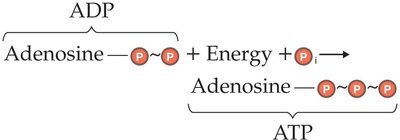
ATP (adenosine triphosphate) acts as an intermediate, capturing energy from catabolic reactions and providing it for anabolic processes.
ATP Structure: Adenosine molecule with three phosphate groups
Energy Release: Hydrolysis of ATP to ADP + Pi releases energy
Equation:
Enzymes: Biological Catalysts
Mechanism and Components
Enzymes are proteins that accelerate chemical reactions by lowering the activation energy required. They are highly specific for their substrates.
Active Site: Region where substrate binds
Enzyme-Substrate Complex: Temporary association during reaction
Turnover Number: Number of substrate molecules converted per second
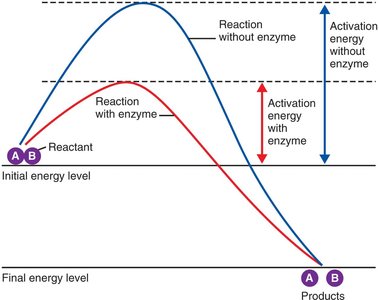
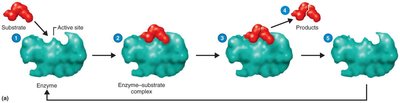
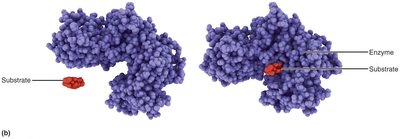
Example: The enzyme sucrase catalyzes the hydrolysis of sucrose into glucose and fructose.
Enzyme Components
Apoenzyme: Protein portion (inactive alone)
Cofactor: Non-protein component (can be inorganic or organic)
Coenzyme: Organic cofactor (often derived from vitamins)
Holoenzyme: Apoenzyme plus cofactor (active form)
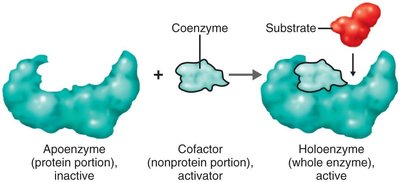
Example: NAD+, NADP+, FAD, and Coenzyme A are important coenzymes in metabolism.
Factors Influencing Enzyme Activity
Environmental and Chemical Factors
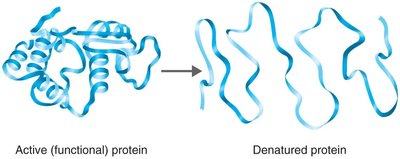
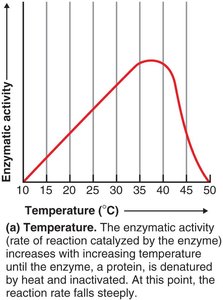
Temperature: Enzyme activity increases with temperature up to an optimum, then decreases due to denaturation.
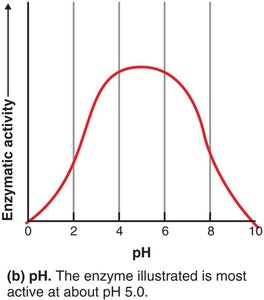
pH: Each enzyme has an optimal pH; extreme pH can denature enzymes.
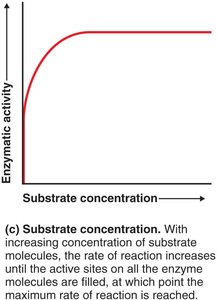
Substrate Concentration: Activity increases with substrate concentration until saturation is reached.
Inhibitors: Chemicals that decrease enzyme activity (competitive or noncompetitive).
Enzyme Inhibition
Types of Inhibition
Competitive Inhibition: Inhibitor competes with substrate for active site; can be overcome by increasing substrate concentration.
Noncompetitive Inhibition: Inhibitor binds to allosteric site, changing enzyme shape and function; cannot be overcome by substrate increase.
Feedback Inhibition: End-product of pathway inhibits an earlier enzyme, regulating pathway activity.
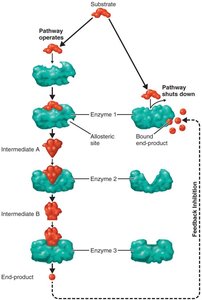
Example: Feedback inhibition is common in amino acid biosynthesis pathways.
Oxidation-Reduction (Redox) Reactions
Definitions and Biological Importance
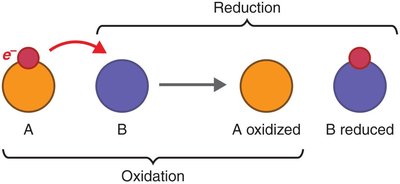
Redox reactions involve the transfer of electrons between molecules, fundamental to energy production in cells.
Oxidation: Loss of electrons
Reduction: Gain of electrons
Redox Pair: One molecule is oxidized, another is reduced
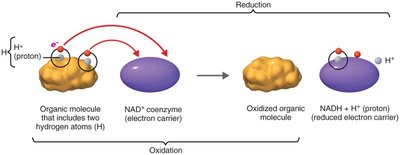
Example: NAD+ is reduced to NADH during glycolysis and the Krebs cycle.
ATP Generation: Phosphorylation Mechanisms
Three Types of Phosphorylation
Substrate-Level Phosphorylation: Direct transfer of phosphate group to ADP from a substrate.
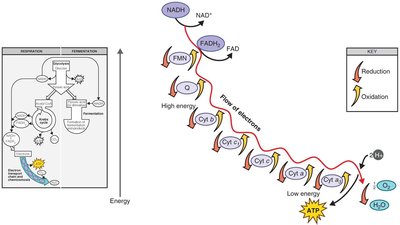
Oxidative Phosphorylation: ATP generated via electron transport chain and chemiosmosis.
Photophosphorylation: ATP generated using light energy in photosynthetic cells.
Equation:
Metabolic Pathways of Energy Production
Carbohydrate Catabolism
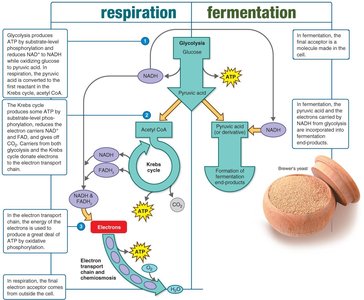
Microorganisms primarily use carbohydrates, especially glucose, as energy sources. The two main processes are cellular respiration and fermentation.
Cellular Respiration: Includes glycolysis, Krebs cycle, and electron transport chain.
Fermentation: Partial breakdown of glucose without oxygen.
Glycolysis
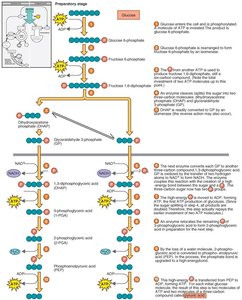
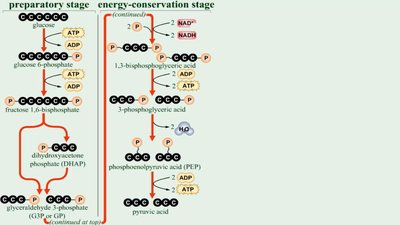
Glycolysis is the oxidation of glucose to pyruvic acid, producing ATP and NADH. It consists of a preparatory stage (ATP investment) and an energy-conserving stage (ATP and NADH production).
Preparatory Stage: Glucose is phosphorylated and split into two three-carbon molecules.
Energy-Conserving Stage: Glyceraldehyde 3-phosphate is oxidized to pyruvic acid, generating ATP and NADH.
Equation:
Alternative Pathways
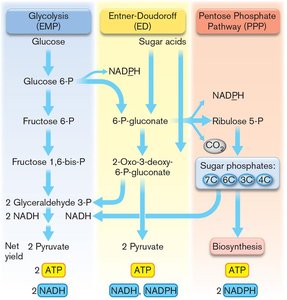
Pentose Phosphate Pathway: Breaks down pentose sugars, produces NADPH, and provides intermediates for biosynthesis.
Entner-Doudoroff Pathway: Produces NADPH, NADH, and ATP; occurs in some bacteria.
Cellular Respiration
Aerobic Respiration
Aerobic respiration uses oxygen as the final electron acceptor and includes glycolysis, the Krebs cycle, and the electron transport chain.
Transition Step: Pyruvic acid is converted to acetyl-CoA.
Krebs Cycle: Acetyl-CoA is oxidized, producing NADH, FADH2, ATP, and CO2.
Electron Transport Chain: Electrons are transferred through carrier molecules, generating ATP via chemiosmosis.
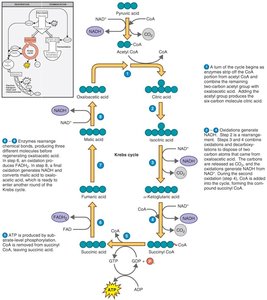
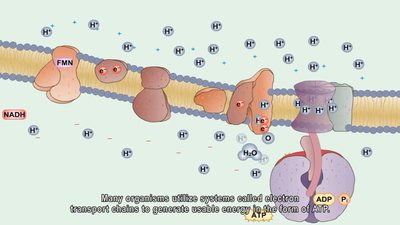
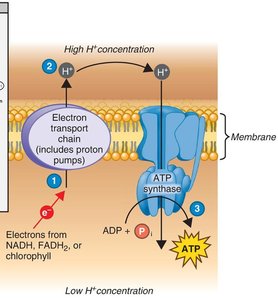
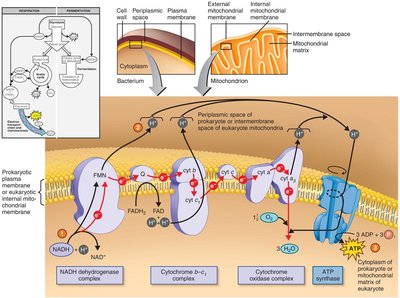
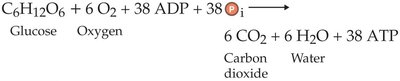
Overall Reaction:
Anaerobic Respiration
Anaerobic respiration uses a molecule other than oxygen as the final electron acceptor, yielding less ATP.
Electron Acceptor | Products |
|---|---|
NO3- | NO2-, N2, H2O |
SO42- | H2S, H2O |
CO32- | CH4, H2O |
Fermentation
Process and Products
Fermentation is the partial oxidation of organic molecules without oxygen, producing small amounts of ATP and various end-products.
Lactic Acid Fermentation: Produces lactic acid (homolactic or heterolactic).
Alcohol Fermentation: Produces ethanol and CO2.
Example: Yeast (Saccharomyces cerevisiae) ferments sugars to produce ethanol in brewing.
Lipid and Protein Catabolism
Pathways and End-Products
Lipids and proteins are catabolized by microorganisms to extract energy and generate intermediates for the Krebs cycle.
Lipid Catabolism: Lipids are broken down into glycerol and fatty acids; glycerol enters glycolysis, fatty acids undergo beta-oxidation to form acetyl-CoA.
Protein Catabolism: Proteins are degraded to amino acids, which are deaminated and converted to intermediates that enter the Krebs cycle.
Example: Bacteria can use proteins and lipids as energy sources when carbohydrates are unavailable.
Summary Table: ATP Yield During Prokaryotic Aerobic Respiration
Stage | Electron Carrier | ATP Yield (Method) |
|---|---|---|
Glycolysis | 2 NADH | 2 ATP (substrate-level) |
Transition Step | 2 NADH | - |
Krebs Cycle | 6 NADH, 2 FADH2 | 2 ATP (substrate-level) |
Electron Transport Chain | All NADH, FADH2 | 34 ATP (oxidative phosphorylation) |
Total | - | 38 ATP |
Additional info: These notes cover the essential concepts of microbial metabolism, including the roles of catabolism, anabolism, enzymes, ATP, and the major metabolic pathways. The included images directly reinforce the explanations and are selected for their clear relevance to the adjacent content.
