 Back
BackMicrobial Metabolism and Cellular Respiration
Study Guide - Smart Notes
 Tailored notes based on your materials, expanded with key definitions, examples, and context.
Microbial Metabolism
Overview of Metabolism
Metabolism encompasses all biochemical reactions within a cell, including both energy-releasing and energy-consuming processes. These reactions are essential for cellular maintenance, growth, and reproduction.
Anabolism: The synthesis of complex molecules from simpler ones, requiring energy input (building bonds).
Catabolism: The breakdown of complex molecules into simpler ones, releasing energy (breaking bonds).
Redox Reactions: Oxidation (loss of electrons) and reduction (gain of electrons) are coupled processes essential for energy transfer. "LEO goes GER" is a mnemonic: Lose Electrons = Oxidation; Gain Electrons = Reduction.
Electron Carriers: Molecules such as NAD+ and FAD shuttle electrons and hydrogen ions within the cell, facilitating ATP production and other reactions.
Additional info: Oxidation does not always require oxygen; anaerobic respiration uses alternative electron acceptors.
Enzymes and Catalysis
Enzymes are biological catalysts, typically proteins, that accelerate chemical reactions by lowering activation energy. Their structure is closely related to their function.
Naming: Enzyme names often end in -ase (e.g., dehydrogenase, oxidase).
Denaturation: Extreme temperature, pH, salts, heavy metals, and radiation can disrupt enzyme structure and function.
Holoenzyme: The complete, active enzyme, consisting of an apoenzyme (protein part) and cofactors/coenzymes (non-protein helpers).
Active Site: The region where substrates bind, facilitating the reaction (lock & key or induced fit models).
Inhibition:
Competitive Inhibitor: Competes with substrate for the active site.
Non-competitive Inhibitor: Binds to an allosteric site, altering enzyme activity.
Feedback Inhibition: End products or intermediates inhibit pathway enzymes to regulate metabolic flow.
ATP: The Energy Currency
Structure and Function of ATP
ATP (Adenosine Triphosphate) is a modified nucleotide composed of ribose, adenine, and three phosphate groups. It stores and transfers energy within the cell.
Dephosphorylation: ATP → ADP + Pi + energy (energy release)
Phosphorylation: ADP + Pi + energy → ATP (energy storage)
ATP is generated by two main mechanisms:
Substrate-Level Phosphorylation: Direct transfer of a phosphate group from a substrate to ADP.
Oxidative Phosphorylation: Electrons harvested from food are transferred through an electron transport chain, generating ATP via chemiosmosis.
Types of Cellular Respiration
Fermentation
Fermentation is the simplest and most ancient form of respiration. It occurs in the cytoplasm and does not require oxygen. Mainly found in prokaryotes, it produces ATP through glycolysis and recycles NAD+ by excreting pyruvate derivatives as waste.
General Equation: Glucose + 2ADP + 2Pi → 2ATP + Organic Acids and/or Alcohols ± CO2
Lactic Acid Fermentation: Glucose + 2ADP + 2Pi → 2ATP + Lactic Acid (e.g., Lactobacillus species)
Alcoholic Fermentation: Glucose + 2ADP + 2Pi → 2ATP + 2 Ethanol + CO2 (e.g., yeast)
Final Electron Acceptor: Organic pyruvate derivative
Diagnostic and Industrial Importance: Waste products help identify pathogens and are used in manufacturing.
Aerobic Respiration
Aerobic respiration requires oxygen and is used by many unicellular and multicellular organisms. It occurs in the cytoplasm and plasma membrane of prokaryotes, and in the cytoplasm and mitochondria of eukaryotes.
General Equation: Glucose + 6O2 + 38ADP + 38Pi → 38ATP + 6H2O + 6CO2
ATP Yield: 38 ATP per glucose in prokaryotes (36 ATP in eukaryotes)
Final Electron Acceptor: O2
Pathway Steps: Glycolysis, Pre-Krebs, Krebs Cycle, Oxidative Phosphorylation
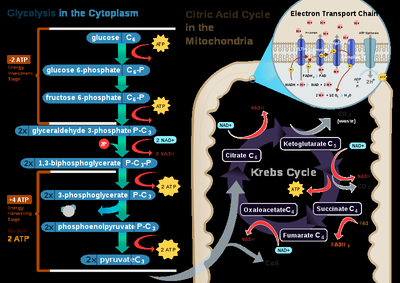
Anaerobic Respiration
Anaerobic respiration does not require oxygen but uses alternative electron acceptors such as nitrate (NOx), sulfate (SOx), or carbonate (COx). It is important in certain prokaryotes and some multicellular organisms.
ATP Yield: Variable (between 2 and 38 ATP per glucose)
Final Electron Acceptors: NOx, SOx, COx, CH4, S
Waste Products: May include H2S, NO2-, NH3, S
Diagnostic Use: Less common than fermentation, but useful for identifying certain microbes.
Alternative Nutrient Utilization
Catabolism of Other Nutrients
Microbes can metabolize a variety of nutrients besides glucose:
Carbohydrates: Digested and isomerized to monomers, then enter glycolysis.
Proteins: Deaminated to carboxylic acids, which enter the Krebs cycle or glycolysis.
Lipids: Fatty acids undergo beta-oxidation to form acetyl-CoA, which enters the Krebs cycle.
Summary Table: ATP Yield in Aerobic Cellular Respiration
Process | ATP Harvest Method | # ATP So Far |
|---|---|---|
Glycolysis | Substrate-Level ATP | 2 |
Glycolysis | Oxidative Phosphorylation ATP (2NADH) | 6 |
Pre-Krebs | Substrate-Level ATP | 0 |
Pre-Krebs | Oxidative Phosphorylation ATP (2NADH) | 6 |
Krebs Cycle | Substrate-Level ATP | 2 (1 ATP per cycle) |
Krebs Cycle | Oxidative Phosphorylation ATP (6NADH) | 18 (3 NADH per cycle) |
Krebs Cycle | Oxidative Phosphorylation ATP (2FADH2) | 4 (1 FADH2 per cycle) |
Total | 38 |
Additional info: The ATP yield may vary in eukaryotes due to differences in mitochondrial transport.
