 Back
Microbial Metabolism and Growth: Environmental and Nutritional Factors
Study Guide - Smart Notes
 Tailored notes based on your materials, expanded with key definitions, examples, and context.
Principles of Bacterial Growth
Binary Fission and Cell Division
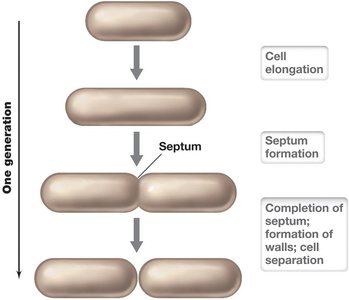
Bacterial growth is primarily achieved through binary fission, a process where a single prokaryotic cell divides into two genetically identical daughter cells. This process is exponential, with each generation doubling the population size. The division involves the formation of a septum, which partitions the cell and ensures each daughter cell receives a complete chromosome and sufficient cellular components to survive independently.
Binary Fission: The most common mode of prokaryotic cell division, resulting in equal products.
Generation Time: The time required for a population to double; varies among species.
Septum: The partition that forms between dividing cells, leading to separation.
Asexual Reproduction: Produces genetically identical clones.
Alternatives to Binary Fission
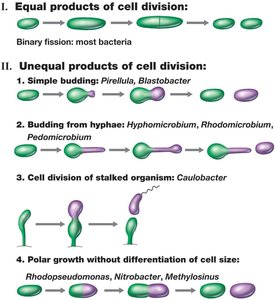
Some bacteria utilize alternative mechanisms for cell division, resulting in unequal products or specialized structures.
Budding: Unequal cell growth forms different daughter cells, sometimes with cytoplasmic extensions (e.g., stalks or appendages).
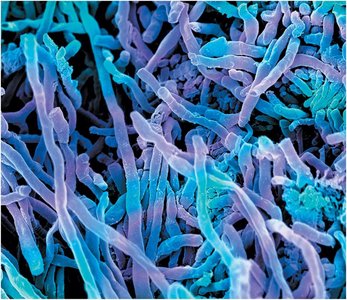
Hyphal Growth: Seen in actinomycetes (e.g., Streptomyces), where long filaments (hyphae) grow at the tip, forming mycelia. Cell division is not directly linked to growth, and survival structures called arthrospores may form.
Multiple Fission: Hyphal filaments form many septa simultaneously, producing multiple cells at once.
Elemental and Macromolecular Composition of Bacterial Cells
Major Elements and Their Functions
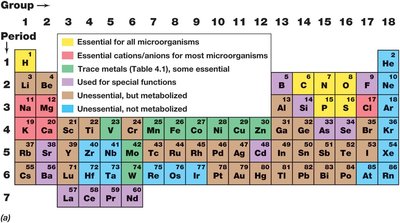
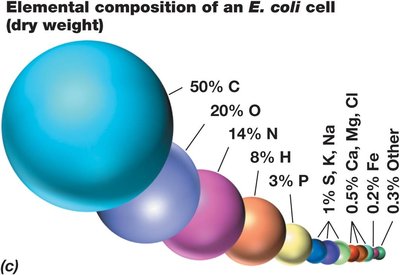
Bacterial cells are composed of a limited set of elements, with a handful dominating cellular structure and function. These elements are required in varying amounts and serve as building blocks for macromolecules.
Macronutrients: Required in large amounts (C, O, N, H, P, S, K, Na, Ca, Mg, Cl, Fe).
Micronutrients: Required in trace amounts (e.g., trace metals, growth factors).
Macromolecules: Proteins, lipids, polysaccharides, lipopolysaccharides, and nucleic acids make up most of the cell's dry weight.
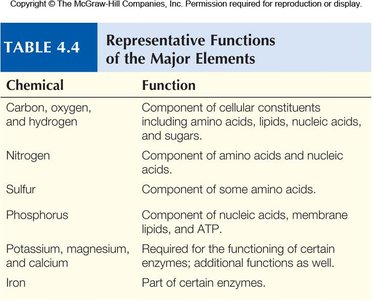
Representative Functions of Major Elements
Chemical | Function |
|---|---|
Carbon, oxygen, hydrogen | Components of cellular constituents (amino acids, lipids, nucleic acids, sugars) |
Nitrogen | Component of amino acids and nucleic acids |
Sulfur | Component of some amino acids |
Phosphorus | Component of nucleic acids, membrane lipids, ATP |
Potassium, magnesium, calcium | Required for functioning of certain enzymes; additional functions |
Iron | Part of certain enzymes |
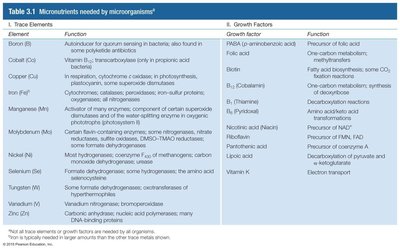
Microbial Nutrition: Macronutrients and Micronutrients
Macronutrients
Carbon: Essential for all macromolecules; heterotrophs obtain it from organic compounds, autotrophs from CO2.
Nitrogen: Found in proteins and nucleic acids; sources include ammonia (NH3), nitrate (NO3-), nitrogen gas (N2), and organic compounds.
Phosphorus: Required for nucleic acids and phospholipids; usually assimilated as inorganic phosphate (PO43-).
Sulfur: Found in certain amino acids and vitamins; assimilated as sulfate (SO42-), sulfide (H2S), or organics.
Potassium, Magnesium, Calcium, Sodium: Involved in enzyme function, membrane stability, and transport.
Micronutrients
Trace Metals: Required in small amounts, often as enzyme cofactors (e.g., Fe, Zn, Mn, Cu).
Growth Factors: Organic micronutrients such as vitamins, amino acids, purines, and pyrimidines; many function as coenzymes.
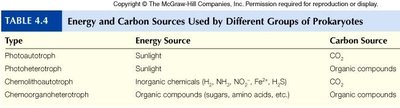
Energy and Carbon Sources in Microorganisms
Classification by Energy and Carbon Source
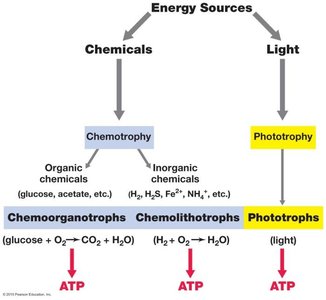
Microorganisms are classified based on their energy and carbon sources:
Type | Energy Source | Carbon Source |
|---|---|---|
Photoautotroph | Sunlight | CO2 |
Photoheterotroph | Sunlight | Organic compounds |
Chemolithoautotroph | Inorganic chemicals (H2, NH3, NO2-, Fe2+, H2S) | CO2 |
Chemoorganoheterotroph | Organic compounds (sugars, amino acids, etc.) | Organic compounds |
Physical Factors Affecting Microbial Growth
Temperature
Microorganisms are classified by their optimal growth temperatures:
Psychrophiles: -5°C to 15°C; found in Arctic and Antarctic regions.
Psychrotolerant: 20°C to 30°C; important in food spoilage.
Mesophiles: 25°C to 45°C; most common, includes human pathogens.
Thermophiles: 45°C to 70°C; common in hot springs.
Hyperthermophiles: 70°C to 110°C; usually Archaea, found in hydrothermal vents.
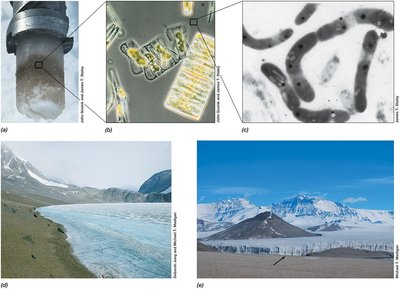
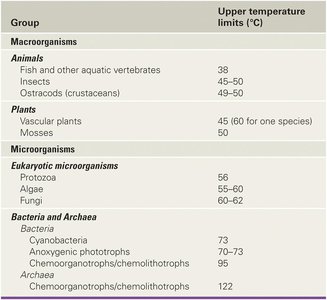
Molecular Adaptations to Temperature Extremes
Cold Adaptations: Enzymes with more α-helices, higher unsaturated fatty acid content in membranes, cold shock proteins, and cryoprotectants.
Heat Adaptations: Heat-stable enzymes (e.g., Taq polymerase), increased ionic bonding, highly hydrophobic protein interiors, and unique membrane lipids in Archaea (ether bonds, lipid monolayers).
pH
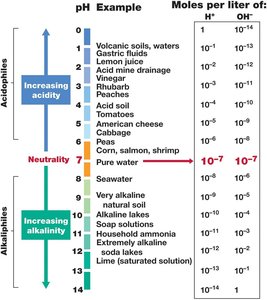
Microorganisms are also classified by their pH preferences:
Neutrophiles: pH 5–8; optimal near neutral (7).
Acidophiles: pH below 5.5; maintain neutral internal pH by pumping out protons.
Alkaliphiles: pH above 8.5; maintain neutral internal pH through sodium ion exchange.
Water Availability and Osmotic Stress
Osmolarity and Water Activity
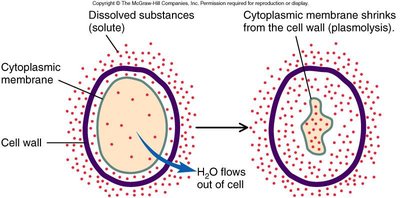
Water availability is crucial for microbial growth. High solute environments can cause plasmolysis, where water leaves the cell, shrinking the cytoplasmic membrane away from the cell wall.
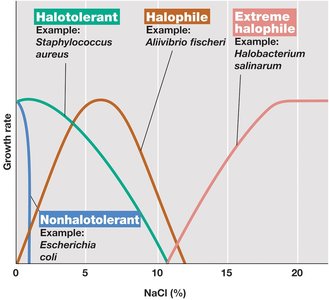
Halophiles: Require high salt concentrations for growth.
Halotolerant: Tolerate some salt but grow best without it.
Extreme Halophiles: Require very high salt concentrations (15–30% NaCl).
Osmophiles: Thrive in high sugar environments.
Xerophiles: Grow in very dry environments.
Compatible Solutes
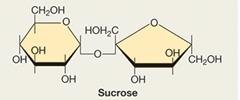
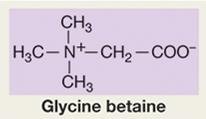
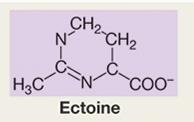
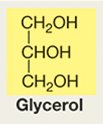
To maintain positive water balance, microbes accumulate or synthesize compatible solutes that do not interfere with cellular processes. Examples include amino acids (glutamate, proline), sugars (sucrose, trehalose), glycine betaine, ectoine, and glycerol.
Oxygen and Microbial Growth
Oxygen Requirements
Obligate Aerobes: Require O2 for growth (aerobic respiration).
Obligate Anaerobes: Cannot grow in the presence of O2; may be killed by it.
Facultative Anaerobes: Grow better with O2 but can grow without it (fermentation or anaerobic respiration).
Microaerophiles: Require O2 at lower concentrations than atmospheric levels.
Aerotolerant Anaerobes: Indifferent to O2; do not use it for energy production.
Toxic Forms of Oxygen and Detoxification
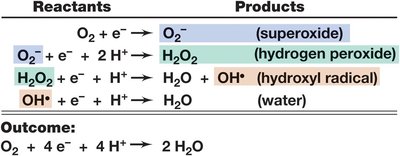
Although molecular oxygen (O2) itself is not toxic, its byproducts can be harmful. These include superoxide anion (O2-), hydrogen peroxide (H2O2), and hydroxyl radical (OH·). Microbes possess enzymes such as superoxide dismutase, catalase, and peroxidase to detoxify these reactive oxygen species.
Reactants | Products |
|---|---|
O2 + e- | O2- (superoxide) |
O2- + 2H+ + e- | H2O2 (hydrogen peroxide) |
H2O2 + e- | H2O + OH· (hydroxyl radical) |
OH· + e- + H+ | H2O (water) |
Microbial Growth Communities: Biofilms
Biofilm Formation and Significance
Microbes often live in complex, mixed communities called biofilms, which are polysaccharide-encased communities attached to surfaces. Biofilms provide protection from environmental stresses, immune responses, and antimicrobials, and are important in both natural and clinical settings.
Stages of Biofilm Development: Attachment (via flagella, fimbriae, pili), colonization (EPS production), development (metabolic changes), and dispersal.
Medical and Industrial Impact: Biofilms are implicated in chronic infections, device-related infections, and industrial fouling.
*Additional info: Some images and tables were inferred to provide a complete academic context for the topics discussed.*
