Back
BackMicrobial Metabolism and Growth: Study Notes
Study Guide - Smart Notes
 Tailored notes based on your materials, expanded with key definitions, examples, and context.
Microbial Metabolism
Chemical Composition of Cells
Microbial cells are primarily composed of water and biomolecules, with proteins being the most abundant. Approximately 96% of a cell's mass is made up of six key elements: carbon (C), hydrogen (H), oxygen (O), phosphorus (P), sulfur (S), and nitrogen (N). These elements are obtained from various sources, and a single source may provide multiple elements.
Water: Makes up about 70% of the cell.
Proteins: Most abundant biomolecules.
Major elements: C, H, O, P, S, N.
Gas Requirements and Oxygen Utilization
Oxygen is essential for many microbes but can also be toxic due to the formation of reactive oxygen species (ROS) such as superoxide ions, hydrogen peroxide (H2O2), and hydroxyl radicals (OH-). Most organisms have evolved enzymes like superoxide dismutase and catalase to neutralize these toxic products. Microbes that cannot detoxify ROS must live in oxygen-free environments.
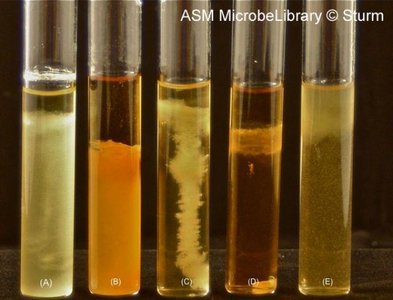
Aerobes: Require O2 and must detoxify ROS.
Obligate aerobes: Must have O2.
Facultative anaerobes: Prefer O2 but can grow without it.
Microaerophiles: Require small amounts of O2.
Anaerobes: Do not use O2.
Aerotolerant anaerobes: Can detoxify ROS but do not use O2.
Obligate anaerobes: Cannot handle toxic O2 products.
Nutritional Types of Microbes
The nutritional classification of microbes is based on their energy and carbon sources:
Phototrophs: Obtain energy from sunlight.
Chemotrophs: Obtain energy from chemical compounds.
Autotrophs: Use inorganic CO2 as their carbon source.
Heterotrophs: Use organic compounds as their carbon source.
Combinations include:
Photoautotrophs: Use light energy and CO2 (e.g., cyanobacteria, plants).
Photoheterotrophs: Use light energy but require organic carbon.
Chemoautotrophs: Use inorganic chemicals for energy and CO2 for carbon.
Chemoheterotrophs: Use organic molecules for both energy and carbon.
Adenosine Triphosphate (ATP)
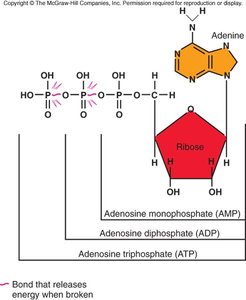
ATP is the primary energy currency of the cell. The removal of the terminal phosphate group releases energy, which is used to drive cellular processes such as protein synthesis. Cells constantly use and regenerate ATP.
ATP hydrolysis releases energy for cellular work.
Example: Protein synthesis uses about 5 ATP per amino acid added.
Overview of Energy Production Pathways
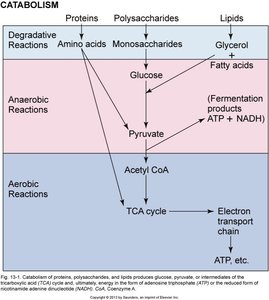
Microbes produce energy through catabolic pathways that break down carbohydrates, proteins, and lipids. The main pathways include glycolysis, the tricarboxylic acid (TCA) cycle, and the electron transport chain (ETC).
Catabolism: Degradation of macromolecules to produce ATP and reducing power (NADH, FADH2).
Anaerobic reactions: Lead to fermentation products.
Aerobic reactions: Lead to complete oxidation via TCA cycle and ETC.
Glycolysis (Embden-Meyerhof-Parnas Pathway)
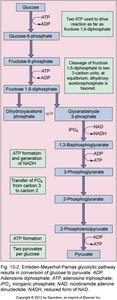
Glycolysis is the central pathway for glucose catabolism, converting one molecule of glucose into two molecules of pyruvate, with a net gain of 2 ATP and 2 NADH.
Occurs in the cytoplasm.
Does not require oxygen.
Key intermediates: Glucose-6-phosphate, fructose-1,6-bisphosphate, glyceraldehyde-3-phosphate.
Fermentation
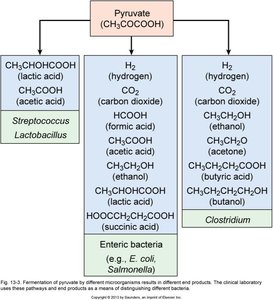
Fermentation is an anaerobic process where pyruvate is converted into various end products such as lactic acid, ethanol, and other organic acids. It regenerates NAD+ for glycolysis but yields less ATP than respiration.
Lactic acid fermentation: Streptococcus, Lactobacillus
Ethanol fermentation: Yeasts, some bacteria
Mixed acid fermentation: Enteric bacteria (e.g., E. coli)
Butyric acid fermentation: Clostridium
Aerobic Respiration
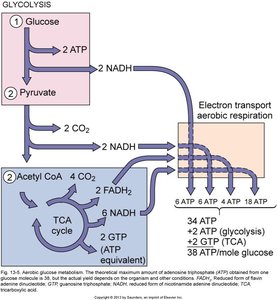
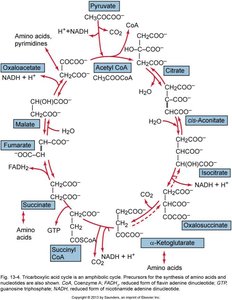
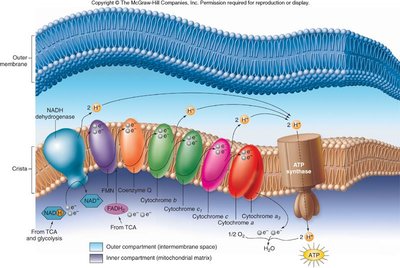
Aerobic respiration involves the complete oxidation of glucose to CO2 and H2O via glycolysis, the TCA cycle, and the electron transport chain. Oxygen serves as the final electron acceptor, and the process yields the highest amount of ATP.
Pyruvate dehydrogenase: Converts pyruvate to acetyl-CoA for entry into the TCA cycle.
TCA cycle: Generates NADH, FADH2, and GTP (ATP equivalent).
Electron transport chain: Produces ATP via oxidative phosphorylation.
Pentose Phosphate Pathway
This pathway operates alongside glycolysis and is important for generating NADPH and ribose-5-phosphate for biosynthetic reactions. It is not primarily used for energy production.
NADPH: Used in reductive biosynthesis.
Ribose-5-phosphate: Precursor for nucleotide synthesis.
Microbial Growth
Mechanisms of Microbial Growth
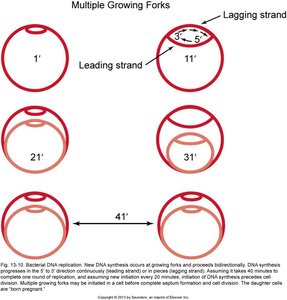
Microbial growth refers to an increase in cell number, primarily through binary fission. Before division, the cell must replicate its DNA.
Binary fission: Most common method of bacterial replication.
DNA replication: Involves multiple enzymes and starts at the origin of replication (Ori).
Population Growth and Generation Time
The time required for a microbial population to double is called the generation or doubling time. Microbial populations grow exponentially under optimal conditions.
Exponential growth: Population doubles at regular intervals.
Equation for population growth:
= final number of cells
= initial number of cells
= time of growth
= generation time
Methods of Analyzing Population Growth
Several methods are used to estimate microbial population size:
Turbidometry: Measures cloudiness of a culture.
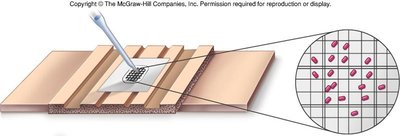
Direct cell count: Counts all cells, living or dead.
Viable colony count: Counts only living cells capable of forming colonies.
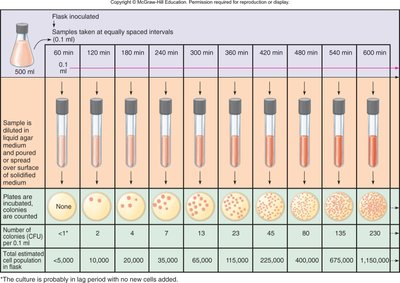
Population Growth Curve
Microbial populations in batch culture display a characteristic growth curve with four phases:
Lag phase: Adaptation, little growth.
Log (exponential) phase: Maximum growth rate.
Stationary phase: Growth rate equals death rate.
Death phase: Death rate exceeds growth rate.
Culture Media and Isolation Techniques
Types of Culture Media
Culture media are formulated to support the growth of microorganisms and can be classified as follows:
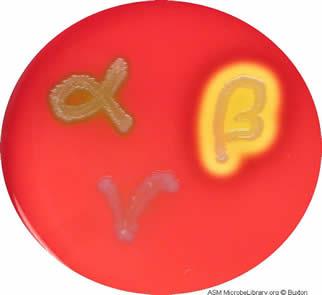
Enriched, nonselective media: Support growth of most organisms (e.g., blood agar).
Specialized media: For fastidious organisms, contain extra nutrients.
Selective media: Suppress growth of unwanted organisms (e.g., MacConkey agar).
Differential media: Distinguish between organisms based on metabolic properties (e.g., lactose fermentation).
Examples of Media
Blood agar: Nonselective, detects hemolysis patterns (α, β, γ).
Chocolate agar: RBCs lysed, supports fastidious organisms.
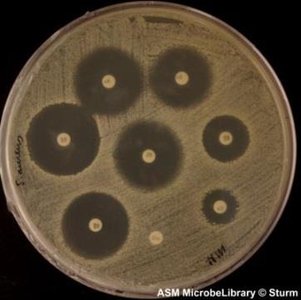
Mueller-Hinton agar: Used for antibiotic susceptibility testing.
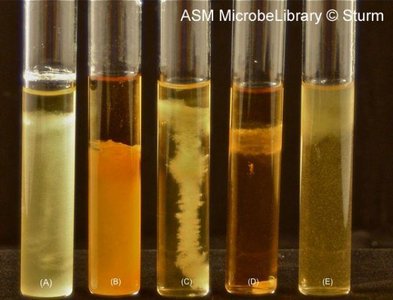
Thioglycolate broth: Supports growth of anaerobes by binding O2.
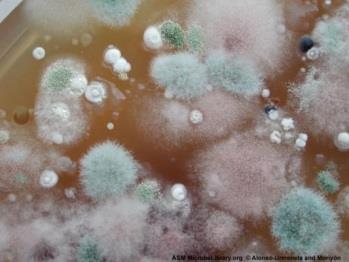
Sabouraud dextrose agar: Used for fungi; can be made selective with antibiotics and low pH.
Selective and Differential Media
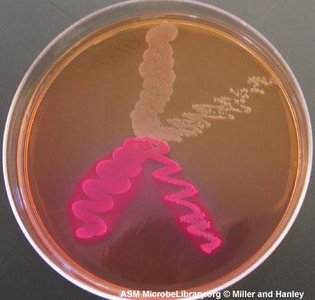
MacConkey agar: Selective against Gram-positive bacteria (bile salts), differential for lactose fermentation (pH indicator).
Mannitol salt agar: Selective for salt-tolerant organisms, differential for mannitol fermentation.
Xylose-lysine deoxycholate agar: Selective for Gram-negative bacteria, differential for xylose/lysine fermentation.
Lowenstein-Jensen and Middlebrook agar: Selective for Mycobacteria.
CHROMagar Candida: Differential for Candida species by color.
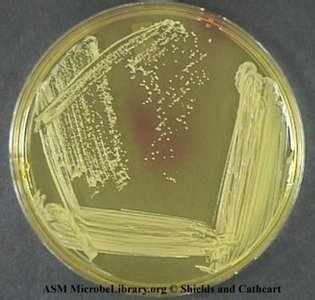
Cell Culture for Intracellular Microbes
Some bacteria and all viruses require living cells for growth. Cell cultures can be primary (from tissues) or continuous cell lines. Cytopathic effects (CPE) may be observed after viral infection.