 Back
BackMicrobial Metabolism and Nutrient Requirements: Structured Study Notes
Study Guide - Smart Notes
 Tailored notes based on your materials, expanded with key definitions, examples, and context.
Metabolism and Nutrient Requirements in Microorganisms
Macronutrients and Elemental Composition
Microorganisms require a variety of elements for growth and metabolism, which are classified as macronutrients and micronutrients. Macronutrients are needed in large amounts and are essential for cellular structure and function.
Macronutrients: Carbon, Oxygen, Nitrogen, Hydrogen, Phosphorus, Sulfur, Potassium, Magnesium, Calcium, Sodium
Functions: These elements are used to build amino acids, nucleic acids, fatty acids, sugars, and other cellular components.
Carbon Acquisition and Metabolic Pathways
Carbon is a fundamental element for microbial life, used to synthesize organic compounds. Microorganisms are classified based on their carbon source:
Autotrophs: Use CO2 as their carbon source and fix it into organic molecules via specialized pathways.
Heterotrophs: Obtain carbon from organic compounds and utilize portions of the same pathways as autotrophs, but with different entry points.
CO2 Fixation Pathways in Autotrophs
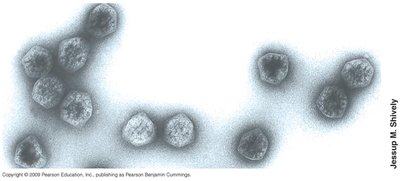
Calvin-Benson Cycle: Occurs in the chloroplast stroma of photoautotrophic eukaryotes and carboxysomes of autotrophic bacteria. Produces hexose sugars or storage polymers like glycogen or starch.
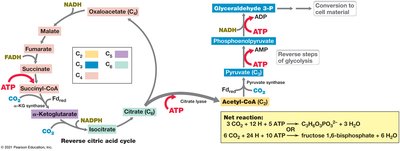
Reverse Citric Acid Cycle: Used by photosynthetic green sulfur bacteria and some chemolithotrophic Bacteria and Archaea.
Hydroxypropionate Pathway: Used by photosynthetic green nonsulfur bacteria and some Archaea.
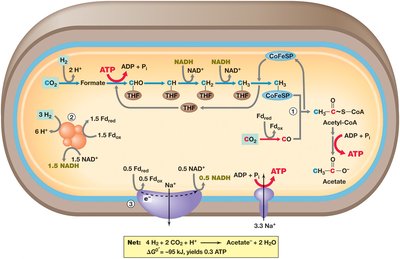
Acetyl-CoA Pathway: Used by certain anaerobic bacteria for acetogenesis.
Oxygen Relationships and Microbial Growth
Microorganisms exhibit diverse relationships with oxygen, which influences their metabolism and habitat preferences. Oxygen can be essential, tolerated, or toxic depending on the organism.
Aerobes: Require oxygen for aerobic respiration.
Facultative Anaerobes: Can grow with or without oxygen, using aerobic respiration, anaerobic respiration, or fermentation.
Microaerophiles: Require oxygen at lower concentrations than atmospheric levels.
Anaerobes: Do not require oxygen; may be aerotolerant or obligate anaerobes (oxygen is harmful or lethal).
Growth in Thioglycolate Broth
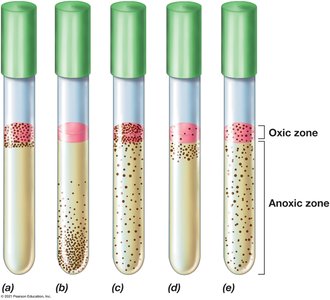
Thioglycolate broth is used to test oxygen requirements. The position of bacterial growth in the broth indicates their oxygen relationship.
Laboratory Cultivation of Aerobes and Anaerobes
Aerobes: Require oxygenated media; achieved by exposure to air, shaking, or bubbling sterile air.
Anaerobes: Require exclusion of oxygen; achieved by sealed containers, reducing agents, anoxic jars, or glove boxes.
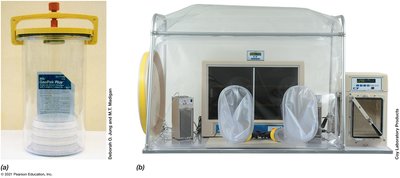
Toxic Forms of Oxygen and Detoxification
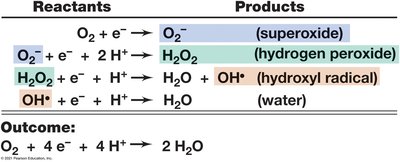
Oxygen can form toxic derivatives during metabolism, such as superoxide, hydrogen peroxide, and hydroxyl radicals. Microorganisms produce enzymes to neutralize these toxic species.
Singlet Oxygen (1O2): Produced by peroxidases and other enzymes.
Superoxide (O2-), Hydrogen Peroxide (H2O2), Hydroxyl Radical (OH.): Byproducts of respiration.
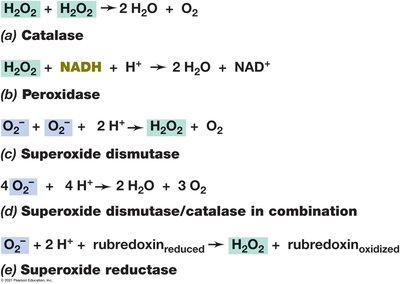
Enzymes That Destroy Toxic Oxygen Species
Catalase: Converts hydrogen peroxide to water and oxygen.
Peroxidase: Reduces hydrogen peroxide using NADH.
Superoxide Dismutase: Converts superoxide to hydrogen peroxide and oxygen.
Superoxide Reductase: Reduces superoxide to hydrogen peroxide.
Nitrogen Acquisition and Nitrogenase
Nitrogen is essential for amino acids and nucleic acids. Microorganisms acquire nitrogen through various mechanisms:
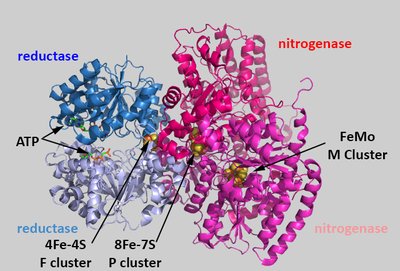
Nitrogen-fixing microorganisms: Use nitrogenase to convert atmospheric nitrogen (N2) into ammonia (NH3).
Non-nitrogen fixers: Use inorganic compounds like ammonia and nitrite for nitrification.
Structure and Function of Nitrogenase
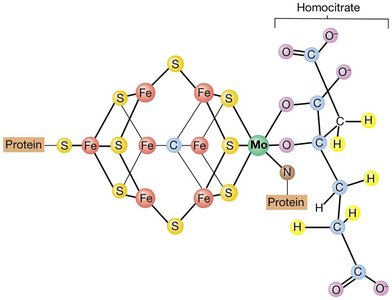
FeMo Cofactor: Essential for nitrogenase activity.
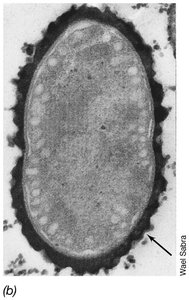
Oxygen Sensitivity: Nitrogenase is inhibited by oxygen; some bacteria use heterocysts or capsules to protect the enzyme.
Other Essential Elements
Phosphorus (P): Used in nucleic acids and phospholipids; sourced from phosphate minerals.
Sulfur (S): Used in amino acids and vitamins; sourced from sulfates or sulfides.
Potassium (K): Maintains solute concentration; sourced from free K+ or salts.
Magnesium (Mg): Stabilizes ribosomes, membranes, nucleic acids; required by many enzymes.
Calcium (Ca): Stabilizes cell walls and endospores.
Sodium (Na): Stabilizes cell walls in marine microorganisms; used by Na+-powered ATP synthase.
Micronutrients and Trace Elements
Micronutrients are required in very small amounts and serve as cofactors for enzymes and other cellular functions.
Element | Function |
|---|---|
Boron (B) | Autoinducer for quorum sensing; polyketide antibiotics |
Cobalt (Co) | Vitamin B12; transcarboxylase |
Copper (Cu) | Respiration, cytochrome c oxidase; photosynthesis |
Iron (Fe) | Cytochromes; catalases; peroxidases; iron–sulfur proteins; nitrogenases |
Manganese (Mn) | Activator of enzymes; superoxide dismutases; photosystem II |
Molybdenum (Mo) | Flavin-containing enzymes; nitrogenases; nitrate reductases |
Nickel (Ni) | Hydrogenases; coenzyme F430; urease |
Selenium (Se) | Formate dehydrogenase; selenocysteine |
Tungsten (W) | Formate dehydrogenases; oxotransferases |
Vanadium (V) | Vanadium nitrogenase; bromoperoxidase |
Zinc (Zn) | Carbonic anhydrase; nucleic acid polymerases; DNA-binding proteins |
Iron and Siderophores
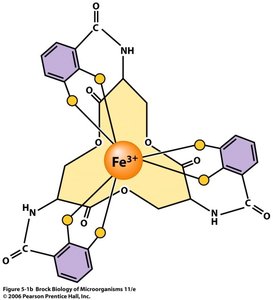
Iron is crucial for electron transport proteins. Siderophores are molecules that bind and transport iron into cells, aiding in infection and survival in iron-limited environments.
Growth Factors
Growth factors are organic compounds required in small amounts for microbial growth. They often serve as precursors for essential biomolecules or coenzymes.
Growth Factor | Function |
|---|---|
PABA (p-aminobenzoic acid) | Precursor of folic acid |
Folic acid | One-carbon metabolism; methyl transfers |
Biotin | Fatty acid biosynthesis; CO2 fixation |
B12 (Cobalamin) | One-carbon metabolism; deoxyribose synthesis |
B1 (Thiamine) | Decarboxylation reactions |
B6 (Pyridoxine) | Amino acid/keto acid transformations |
Nicotinic acid (Niacin) | Precursor of NAD+ |
Riboflavin | Precursor of FMN, FAD |
Pantothenic acid | Precursor of coenzyme A |
Lipoic acid | Decarboxylation of pyruvate and α-ketoglutarate |
Vitamin K | Electron transport |
Coenzymes M and B | Methanogenesis |
F420 and F430 | Methanogenesis |
Additional info: Not all trace elements or growth factors are needed by all organisms; many are biosynthesized and not required from the environment. Iron is typically needed in larger amounts than other trace metals. Methanogenesis is the production of methane (CH4) by methanogens (Archaea).
