 Back
BackMicrobial Metabolism: Catabolism, Anabolism, and Energy Production
Study Guide - Smart Notes
 Tailored notes based on your materials, expanded with key definitions, examples, and context.
Microbial Metabolism
Overview of Metabolism
Metabolism encompasses all controlled biochemical reactions occurring within a microbe. Its ultimate function is to enable cellular reproduction by transforming nutrients into energy and cellular building blocks.
Metabolism is guided by eight elementary statements, including nutrient acquisition, energy storage in ATP, catabolism to form precursor metabolites, and anabolic reactions for macromolecule synthesis.
Cells grow by assembling macromolecules and reproduce once they have doubled in size.
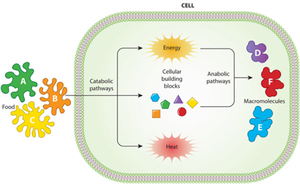
Catabolism and Anabolism
Metabolic reactions are divided into two major classes: catabolic and anabolic pathways. These pathways are interconnected and essential for cellular function.
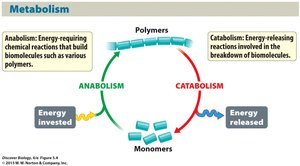
Catabolic pathways break larger molecules into smaller products and are exergonic (release energy).
Anabolic pathways synthesize large molecules from the products of catabolism and are endergonic (require energy).
Energy released from catabolism is used to drive anabolic reactions.
ATP Production and Energy Storage
ATP: The Energy Currency
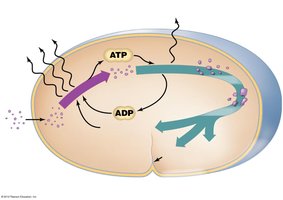
Organisms release energy from nutrients and store it in high-energy phosphate bonds of ATP. ATP is produced by phosphorylation, where a phosphate group is added to ADP.
Phosphorylation is the process of adding a phosphate group to a substrate.
Anabolic pathways use energy by breaking ATP's phosphate bonds.
Structure of ATP
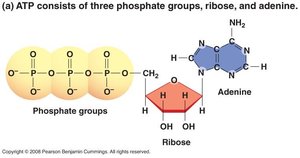
ATP consists of three phosphate groups, ribose, and adenine. The energy is stored in the bonds between the phosphate groups.
Breaking these bonds releases energy for cellular processes.
Phosphorylation Mechanisms
Cells phosphorylate ADP to ATP in three ways:
Substrate-level phosphorylation: Direct transfer of phosphate between substrates.
Oxidative phosphorylation: Uses energy from electron transport chain.
Photophosphorylation: Uses light energy (in photosynthetic organisms).
Oxidation and Reduction Reactions
Redox Reactions in Metabolism
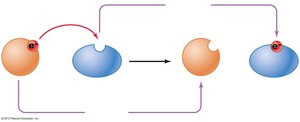
Oxidation and reduction reactions involve the transfer of electrons from an electron donor to an electron acceptor. These reactions always occur simultaneously and are fundamental to energy production.
LEO = Lose Electrons is Oxidation; GER = Gain Electrons is Reduction.
Cells use electron carriers (e.g., NAD+, NADP+, FAD) to transport electrons.
The Roles of Enzymes in Metabolism
Enzyme Function and Specificity
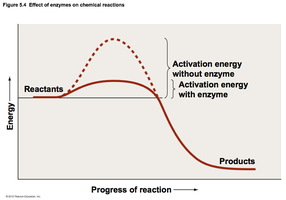
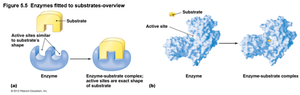
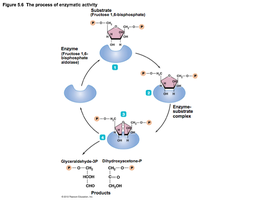
Enzymes are organic catalysts that increase the likelihood of a reaction by lowering the activation energy. They exhibit substrate specificity, with active sites complementary to the substrate's shape.
Enzymes work by forming an enzyme-substrate complex.
Some enzymes are RNA molecules called ribozymes.
Enzyme Components
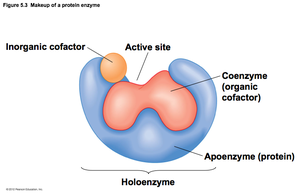
Enzymes may consist of protein (apoenzyme), organic cofactors (coenzymes), and inorganic cofactors. The complete, active enzyme is called a holoenzyme.
Categories of Enzymes
Enzymes are classified based on their mode of action:
Hydrolases: Catalyze hydrolysis reactions.
Isomerases: Rearrange molecules.
Ligases/Polymerases: Join molecules together.
Lyases: Break bonds without water.
Oxidoreductases: Catalyze oxidation-reduction reactions.
Transferases: Transfer functional groups.
Induced Fit Model
The induced fit model describes how enzymes change shape to fit their substrate, enhancing specificity and catalytic efficiency.
Factors Influencing Enzymatic Activity
Environmental and Chemical Factors
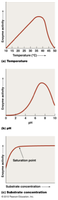
Enzyme activity is influenced by temperature, pH, enzyme and substrate concentrations, and the presence of inhibitors.
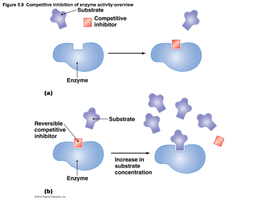
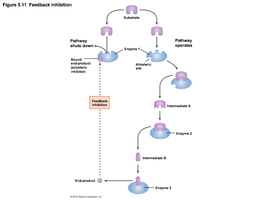
Inhibitors block enzyme activity but do not denature enzymes.
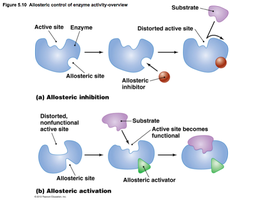
Types of inhibitors: Competitive, Noncompetitive (Allosteric), Feedback Inhibition.
Metabolic Pathways
Carbohydrate Catabolism
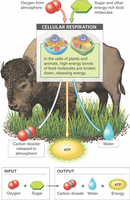
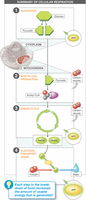
Carbohydrate catabolism is the breakdown of carbohydrates to release energy. The main pathway is glycolysis, followed by acetyl-CoA production, the Krebs cycle, and the electron transport chain.
Glucose is the most common carbohydrate used.
Catabolism can proceed via aerobic respiration (uses oxygen) or fermentation (does not use oxygen).
Glycolysis
Glycolysis is the oxidation of glucose to pyruvic acid, producing ATP and NADH. It occurs in the cytoplasm and involves splitting a six-carbon glucose into two three-carbon molecules.
Net gain: 2 ATP, 2 NADH, 2 pyruvic acid.
Divided into three stages: energy-investment, lysis, and energy-conserving.
Cellular Respiration
Cellular respiration completely oxidizes pyruvic acid to produce ATP via three stages: synthesis of acetyl-CoA, Krebs cycle, and electron transport chain.
Synthesis of Acetyl-CoA: Produces 2 acetyl-CoA, 2 CO2, 2 NADH.
Krebs Cycle: Occurs in cytosol (prokaryotes) or mitochondria (eukaryotes); produces 2 ATP, 2 FADH2, 6 NADH, 4 CO2.
Electron Transport Chain: Most significant ATP production; uses electron carriers to pump protons and generate ATP by chemiosmosis.
Summary Table: ATP, NADH, FADH2 Production
Step | ATP | NADH | FADH2 | CO2 |
|---|---|---|---|---|
Glycolysis | 2 | 2 | 0 | 0 |
Acetyl-CoA Formation | 0 | 2 | 0 | 2 |
Krebs Cycle | 2 | 6 | 2 | 4 |
ETC (Aerobic) | ~34 | 0 | 0 | 0 |
Fermentation
Fermentation occurs when cells cannot completely oxidize glucose by cellular respiration. It regenerates NAD+ and produces organic molecules as final electron acceptors.
Partial oxidation of sugar or other metabolites to release energy.
Produces products such as lactic acid, ethanol, and other organic acids.
Summary of Carbohydrate Catabolism
Track ATP, NADH, FADH2 production at each step.
Follow carbon atoms and note when they are released as CO2.
After glycolysis, pyruvic acid can enter aerobic respiration, anaerobic respiration, or fermentation.
Key Equations:
ATP hydrolysis:
Glucose oxidation (aerobic):
