 Back
BackMicrobial Metabolism: Catabolism, Anabolism, Enzymes, and Energy Production
Study Guide - Smart Notes
 Tailored notes based on your materials, expanded with key definitions, examples, and context.
Microbial Metabolism
Catabolism and Anabolism
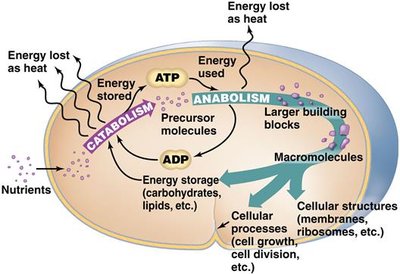
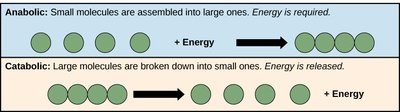
Microbial metabolism encompasses all chemical reactions that occur within a microorganism, divided into two main types: catabolic and anabolic pathways. These processes are essential for energy production, growth, and maintenance of cellular structures.
Catabolic Pathways: Break down larger molecules into smaller products, releasing energy (exergonic). Some energy is stored in ATP, and precursor metabolites are generated for biosynthesis.
Anabolic Pathways: Synthesize large molecules from precursor metabolites, requiring energy input (endergonic). These pathways build macromolecules and cellular structures.
Energy Transfer: ATP is the main energy currency, cycling between ATP and ADP as energy is used and stored.
Example: E. coli can synthesize all cellular components from precursor metabolites.
Redox Reactions in Metabolism
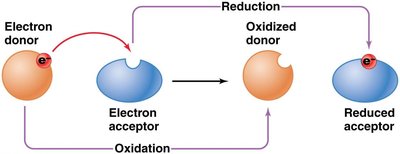
Redox (reduction-oxidation) reactions are fundamental to microbial metabolism, involving the transfer of electrons between molecules. These reactions are coupled, with one molecule being oxidized and another reduced.
Oxidation: Loss of electrons, hydrogen atoms, or gain of oxygen.
Reduction: Gain of electrons or hydrogen atoms.
Electron Carriers: NAD+, NADP+, and FAD are key carriers, shuttling electrons within cells.
Mnemonic: LEO says GER (Loss of Electrons is Oxidation, Gain of Electrons is Reduction); OIL RIG (Oxidation Is Loss, Reduction Is Gain).
ATP: The Energy Currency
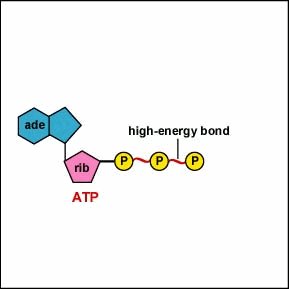
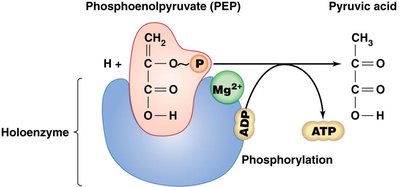
ATP (adenosine triphosphate) stores energy in high-energy phosphate bonds. Cells regenerate ATP from ADP through phosphorylation, which can occur via substrate-level, oxidative, or photophosphorylation.
Substrate-level phosphorylation: Direct transfer of phosphate from a substrate to ADP.
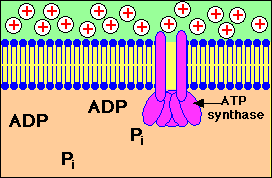
Oxidative phosphorylation: Uses energy from electron transport chain (ETC).
Photophosphorylation: Uses light energy (in photosynthetic organisms).
Enzymes in Microbial Metabolism
Role and Structure of Enzymes
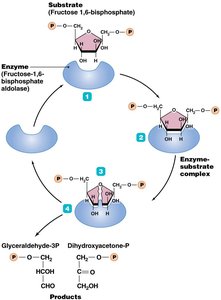
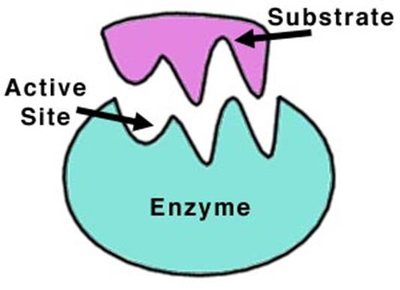
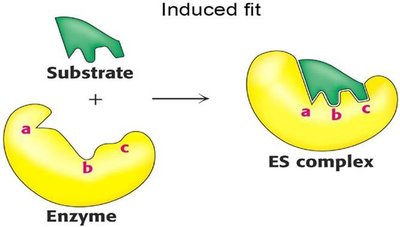
Enzymes are biological catalysts that speed up chemical reactions without being consumed. They exhibit substrate specificity, often described by the induced-fit model, where the enzyme's active site changes shape to fit the substrate.
Enzyme-Substrate Complex: The substrate binds to the enzyme's active site, forming a temporary complex.
Induced-Fit Model: The enzyme adjusts its shape for a perfect fit upon substrate binding.
Ribozymes: RNA molecules with catalytic activity, important in protein synthesis.
Enzyme Components: Apoenzyme, Cofactor, Holoenzyme
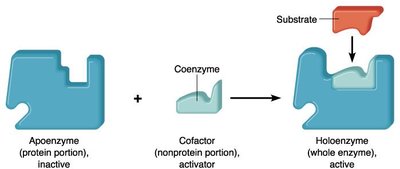
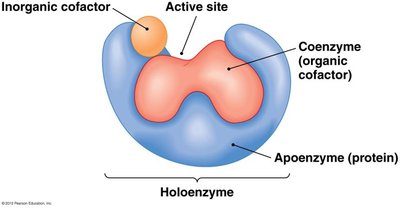
Enzymes may require additional non-protein components for activity. The protein portion is the apoenzyme, which becomes active when bound to cofactors (inorganic ions) or coenzymes (organic molecules).
Apoenzyme: Inactive protein portion.
Cofactor: Inorganic activator (e.g., Mg2+, Fe2+).
Coenzyme: Organic activator (often derived from vitamins).
Holoenzyme: Active enzyme formed by apoenzyme plus cofactor/coenzyme.
Classification of Enzymes
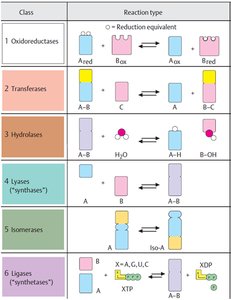
Enzymes are classified based on the type of reaction they catalyze. There are six major classes, each with specific functions in metabolism.
Ligases/Polymerases: Join molecules (anabolic).
Hydrolases: Break molecules by adding water (catabolic).
Isomerases: Rearrange atoms within a molecule.
Lyases: Split molecules without water.
Oxidoreductases: Transfer electrons.
Transferases: Move functional groups between molecules.
Class | Type of Reaction Catalyzed | Example |
|---|---|---|
Hydrolase | Hydrolysis (catabolic) | Lipase—breaks down lipid molecules |
Isomerase | Rearrangement of atoms within a molecule | Phosphoglucoisomerase—converts glucose 6-phosphate into fructose 6-phosphate during glycolysis |
Ligase/Polymerase | Joining two or more chemicals together (anabolic) | Acetyl-CoA synthetase—combines acetate and coenzyme A to form acetyl-CoA for the Krebs cycle |
Lyase | Splitting a chemical into smaller parts without water (catabolic) | Fructose 1,6-bisphosphate aldolase—splits fructose 1,6-bisphosphate into G3P and DHAP |
Oxidoreductase | Transfer of electrons or hydrogen atoms from one molecule to another | Lactic acid dehydrogenase—converts lactic acid to form pyruvic acid during fermentation |
Transferase | Moving a functional group from one molecule to another (may be anabolic) | Hexokinase—transfers phosphate from ATP to glucose in the first step of glycolysis |

Factors Affecting Enzyme Activity
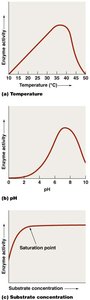
Enzyme activity is influenced by several factors, including temperature, pH, enzyme concentration, substrate concentration, and inhibitors. Each enzyme has optimal conditions for activity.
Temperature: Enzyme activity increases with temperature up to an optimum, then decreases due to denaturation.
pH: Each enzyme has an optimal pH; extreme pH can denature enzymes.
Substrate Concentration: Activity increases with substrate concentration until saturation is reached.
Inhibitors: Molecules that decrease enzyme activity, including competitive and allosteric inhibitors.

Enzyme Inhibition: Competitive and Allosteric
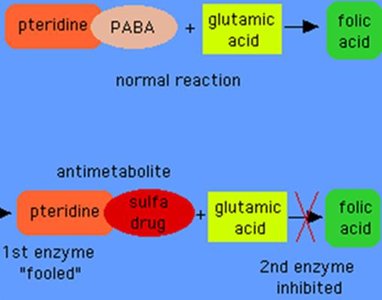
Enzyme inhibition regulates metabolic pathways. Competitive inhibitors bind to the active site, while allosteric inhibitors bind elsewhere, altering the active site.
Competitive Inhibition: Inhibitor resembles substrate and binds to active site, blocking substrate access.
Example: Sulfa drugs inhibit folic acid synthesis by outcompeting PABA.
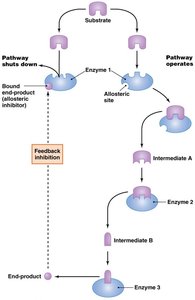
Allosteric Inhibition: Inhibitor binds to allosteric site, changing enzyme shape and rendering active site non-functional.
Allosteric Activation: Activator binds to allosteric site, making active site functional.


Feedback Inhibition
Feedback inhibition is a regulatory mechanism where the end product of a pathway inhibits an earlier enzyme, preventing overproduction and conserving energy.
Negative Feedback: End product acts as allosteric inhibitor.
Example: Isoleucine inhibits its own biosynthesis pathway in E. coli.
ATP Production and Energy Storage
Overview of Cellular Respiration
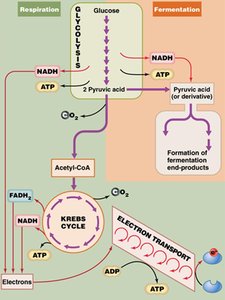
Cellular respiration is the aerobic process by which cells harvest energy from glucose to produce ATP. It consists of glycolysis, pyruvate decarboxylation, Krebs cycle, and electron transport chain (ETC).
Glycolysis: Occurs in cytoplasm, breaks glucose into two pyruvic acid molecules.
Pyruvate Decarboxylation: Converts pyruvic acid to acetyl-CoA.
Krebs Cycle: Acetyl-CoA enters cycle, producing ATP, NADH, FADH2, and CO2.
ETC: NADH and FADH2 donate electrons, generating ATP via oxidative phosphorylation.

Glycolysis: Steps and Energy Yield
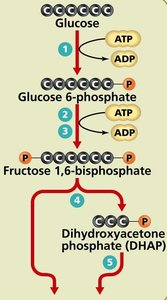
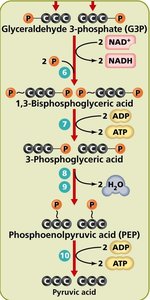
Glycolysis is a ten-step pathway that converts glucose to pyruvic acid, yielding ATP and NADH. It does not require oxygen and occurs in all cells.
Energy Investment: 2 ATP used to phosphorylate glucose.
Lysis Stage: Fructose 1,6-bisphosphate split into G3P and DHAP.
Energy Harvesting: G3P converted to pyruvic acid, producing 4 ATP (net gain 2 ATP) and 2 NADH.



Pyruvate Decarboxylation and Krebs Cycle
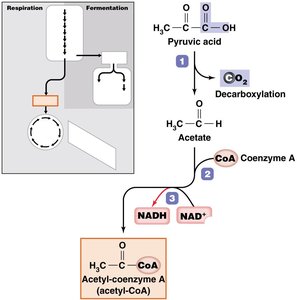
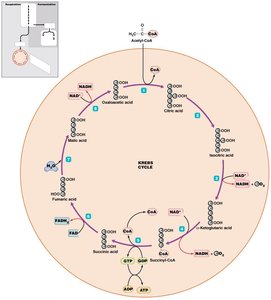
Pyruvate decarboxylation prepares pyruvic acid for entry into the Krebs cycle by converting it to acetyl-CoA. The Krebs cycle completes the oxidation of glucose, transferring energy to NADH and FADH2.
Pyruvate Decarboxylation: Produces acetyl-CoA, CO2, and NADH.
Krebs Cycle: Each acetyl-CoA yields ATP, NADH, FADH2, and CO2. Most energy is stored in electron carriers.



Electron Transport Chain (ETC) and Oxidative Phosphorylation
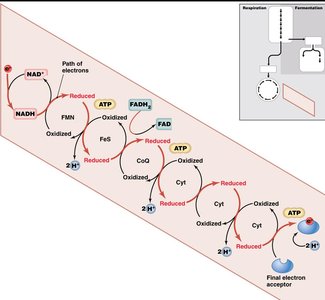
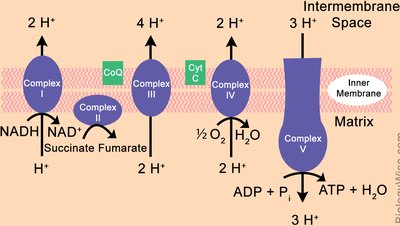
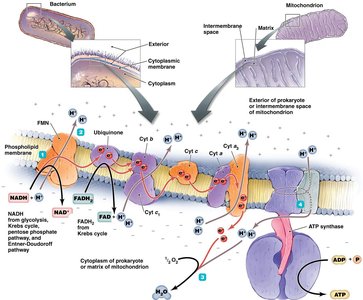
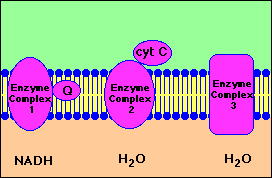
The ETC is a series of membrane-bound carriers that transfer electrons from NADH and FADH2 to a final electron acceptor, generating a proton gradient used by ATP synthase to produce ATP.
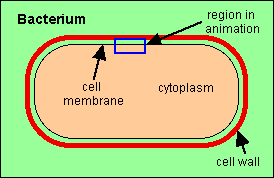
Location: Cell membrane in prokaryotes, inner mitochondrial membrane in eukaryotes.
Electron Carriers: Flavoproteins, ubiquinones, metal-containing proteins, cytochromes.
Final Electron Acceptors: O2 (aerobic), inorganic molecules (anaerobic).
ATP Yield: ~34 ATP from ETC per glucose.



Fermentation
Fermentation is an anaerobic process that regenerates NAD+ for glycolysis by using an organic molecule as the final electron acceptor. It produces various end products, useful in microbial identification and disease diagnostics.
Partial Oxidation: Releases energy without complete oxidation.
Diagnostic Use: Fermentation tests (e.g., lactose fermentation on McConkey agar).
Example: Clostridium perfringens produces fermentation products involved in gangrene.
Other Catabolic Pathways
Microbes can catabolize lipids and proteins when glucose is unavailable. Lipid catabolism involves beta oxidation, while protein catabolism involves deamination and protease activity.
Lipid Catabolism: Triglycerides broken into fatty acids and glycerol; fatty acids enter Krebs cycle as acetyl-CoA.
Protein Catabolism: Proteins broken into amino acids, which are deaminated and enter metabolic pathways.
Summary Table: Net ATP Yield from 1 Glucose
Pathway | ATP Yield (Prokaryotes) | ATP Yield (Eukaryotes) |
|---|---|---|
Glycolysis | 2 | 2 |
Krebs Cycle | 2 | 2 |
ETC | 34 | 32 |
Total | 38 | 36 |
Additional info: The notes include expanded explanations, definitions, and context for each topic to ensure completeness and academic quality for exam preparation.
