 Back
BackMicrobial Metabolism: Core Concepts and Pathways
Study Guide - Smart Notes
 Tailored notes based on your materials, expanded with key definitions, examples, and context.
Microbial Metabolism
Overview of Metabolism
Microbial metabolism encompasses all chemical reactions that occur within a microorganism, enabling it to grow, reproduce, maintain structures, and respond to environments. These reactions are broadly categorized into anabolism (biosynthesis) and catabolism (degradation).
Metabolism: The sum of all chemical reactions in an organism.
Anabolism: Synthesis of larger molecules from smaller ones; requires energy input.
Catabolism: Breakdown of larger molecules into smaller products; releases energy.
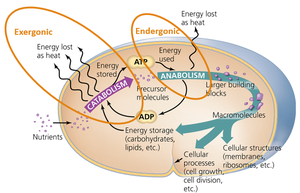
Goals of Metabolism:
Acquisition of nutrients for building blocks and energy.
Energy storage in ATP.
Catabolism of nutrients to precursor metabolites.
Anabolic construction of macromolecules and cellular structures.
Cell growth and division.
Oxidation and Reduction Reactions
Redox Reactions in Metabolism
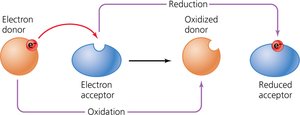
Oxidation-reduction (redox) reactions are central to energy transfer in cells. They involve the transfer of electrons from an electron donor (oxidized) to an electron acceptor (reduced).
Oxidation: Loss of electrons.
Reduction: Gain of electrons.
Mnemonic: OIL RIG (Oxidation Is Loss, Reduction Is Gain).
ATP Production and Energy Storage
ATP as the Energy Currency
ATP (adenosine triphosphate) is the primary energy carrier in cells. Energy is stored in its high-energy phosphate bonds and released through hydrolysis.
ATP is multifunctional, water-soluble, and can be used in RNA synthesis.
ATP can donate phosphate groups to other molecules.
ATP is produced by phosphorylation during catabolic reactions.
Types of ATP Phosphorylation
Substrate-level phosphorylation: Direct transfer of phosphate to ADP from a phosphorylated intermediate.
Oxidative phosphorylation: ATP generated by the transfer of electrons through the electron transport chain (ETC) to a final electron acceptor.
Photophosphorylation: ATP formed using light energy during photosynthesis.
Enzymes and Enzyme Activity
Structure and Function of Enzymes
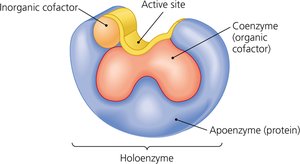
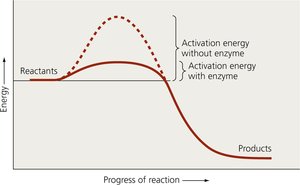
Enzymes are biological catalysts that speed up chemical reactions by lowering activation energy. Most enzymes are proteins, but some RNA molecules (ribozymes) also have catalytic activity.
Apoenzyme: Protein portion of an enzyme, inactive without cofactors.
Cofactor: Inorganic ion required for enzyme activity (e.g., Mg2+, Fe2+).
Coenzyme: Organic cofactor, often derived from vitamins (e.g., NAD+, FAD).
Holoenzyme: Active enzyme formed by the combination of apoenzyme and cofactors.
Activation Energy and Catalysis
Enzymes lower the activation energy required for reactions, allowing metabolic processes to occur rapidly at physiological temperatures.
Enzyme-Substrate Interaction
Enzyme activity depends on the specific fit between the enzyme's active site and its substrate. The induced-fit model describes how substrate binding induces a conformational change in the enzyme, enhancing catalysis.
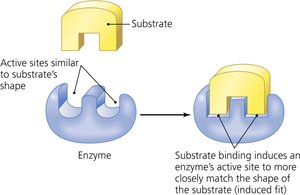
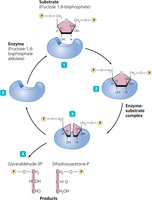
Enzyme Mechanism
Enzyme binds substrate to form an enzyme-substrate complex.
Chemical reaction occurs, converting substrate to product(s).
Enzyme releases product(s) and is free to catalyze another reaction.
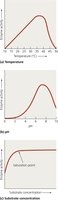
Factors Affecting Enzyme Activity
Temperature: Increases reaction rate up to an optimum; high temperatures cause denaturation.
pH: Each enzyme has an optimal pH; deviations can denature the enzyme.
Substrate concentration: Higher concentrations increase activity until saturation is reached.
Enzyme Inhibition and Regulation
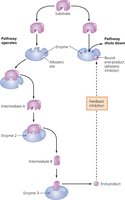
Allosteric inhibition: Inhibitor binds to an allosteric site, changing the enzyme's shape and reducing activity.
Allosteric activation: Activator binds to an allosteric site, enhancing enzyme activity.
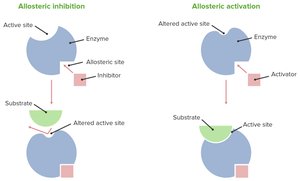
Competitive inhibition: Inhibitor competes with substrate for the active site; can be overcome by increasing substrate concentration.
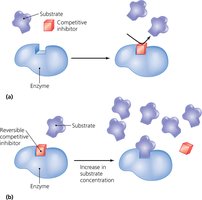
Feedback inhibition: End-product of a metabolic pathway inhibits an enzyme involved earlier in the pathway, regulating pathway activity.
Carbohydrate Catabolism
Overview of Glucose Catabolism
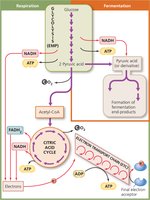
Microorganisms primarily use carbohydrates, especially glucose, as energy sources. Two main pathways are cellular respiration and fermentation.
Cellular respiration: Complete oxidation of glucose to CO2 and H2O, yielding up to 38 ATP per glucose.
Fermentation: Partial oxidation of glucose, yielding organic waste products and less ATP (2 ATP per glucose).
Glycolysis
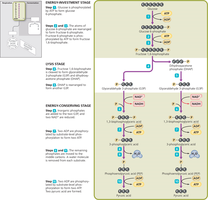
Glycolysis is the splitting of a six-carbon glucose into two three-carbon pyruvic acid molecules. It occurs in the cytosol and consists of three stages:
Energy-Investment Stage: 2 ATP are used to phosphorylate glucose and its intermediates.
Lysis Stage: 6-carbon intermediate is split into two 3-carbon molecules.
Energy-Conserving Stage: 4 ATP and 2 NADH are produced, resulting in a net gain of 2 ATP per glucose.
Cellular Respiration
Cellular respiration involves three main stages following glycolysis:
Synthesis of Acetyl-CoA: Pyruvic acid is decarboxylated and combined with coenzyme A to form acetyl-CoA, producing NADH and CO2.
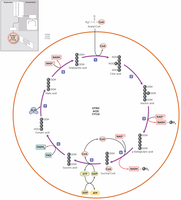
Krebs Cycle (Citric Acid Cycle): Acetyl-CoA is oxidized, generating ATP, NADH, FADH2, and CO2.
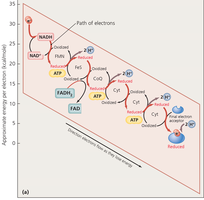
Electron Transport Chain (ETC): Electrons from NADH and FADH2 are transferred through a series of carriers, generating a proton gradient used to produce ATP via chemiosmosis.
Krebs Cycle Details
Occurs in the cytosol (prokaryotes) or mitochondrial matrix (eukaryotes).
Produces 2 ATP, 2 FADH2, 6 NADH, and 4 CO2 per glucose.
Electron Transport Chain and Chemiosmosis
Located in the inner mitochondrial membrane (eukaryotes) or cytoplasmic membrane (prokaryotes).
Major ATP production step (about 34 ATP per glucose).
Final electron acceptor is O2 (aerobic) or another molecule (anaerobic).
Fermentation
Fermentation is used when cells cannot completely oxidize glucose due to the absence of a final electron acceptor. It regenerates NAD+ for glycolysis and produces various organic end-products (e.g., lactic acid, ethanol).
Photosynthesis
Overview and Pigments
Photosynthesis is the process by which light energy is captured and used to synthesize carbohydrates from CO2 and H2O. Chlorophylls are the main pigments involved, differing in structure and light absorption properties.
Photosystems and Light-Dependent Reactions
Photosystem II (PS II) and Photosystem I (PS I): Protein complexes containing chlorophyll and other pigments, embedded in thylakoid membranes.
Light energy excites electrons, which are transferred through an ETC, generating ATP and NADPH.
Cyclic phosphorylation: Electrons return to the original chlorophyll, producing ATP only.
Noncyclic phosphorylation: Electrons are transferred to NADP+, producing both ATP and NADPH.
Light-Independent Reactions (Calvin-Benson Cycle)
These reactions use ATP and NADPH to fix CO2 into organic molecules. The Calvin-Benson cycle consists of three main steps:
Fixation of CO2: CO2 is attached to ribulose 1,5-bisphosphate (RuBP).
Reduction: 3-phosphoglyceric acid is reduced to glyceraldehyde 3-phosphate (G3P).
Regeneration of RuBP: Some G3P is used to regenerate RuBP, enabling the cycle to continue.
Summary Table: Six Basic Types of Enzymes
Enzyme Type | Activity | Example |
|---|---|---|
Oxidoreductase | Oxidation-reduction reactions | Lactate dehydrogenase |
Transferase | Transfer of functional groups | Hexokinase |
Hydrolase | Hydrolysis reactions | Lipase |
Lyase | Cleavage of bonds without hydrolysis or oxidation | Aldolase |
Isomerase | Isomerization (rearrangement of atoms) | Phosphoglucoisomerase |
Ligase | Joining of two molecules (usually with ATP hydrolysis) | DNA ligase |
