 Back
BackMicrobial Metabolism: Energy, Electron, and Carbon Sources
Study Guide - Smart Notes
 Tailored notes based on your materials, expanded with key definitions, examples, and context.
Microbial Metabolism: Energy, Electron, and Carbon Sources
Overview of Microbial Nutritional Types
Microorganisms are classified based on their sources of energy, electrons (reducing equivalents), and carbon. These classifications help in understanding their metabolic diversity and ecological roles.
Energy Source: Light (phototrophs) or chemical compounds (chemotrophs)
Electron Source: Organic (organotrophs) or inorganic (lithotrophs) molecules
Carbon Source: Organic compounds (heterotrophs) or carbon dioxide (autotrophs)
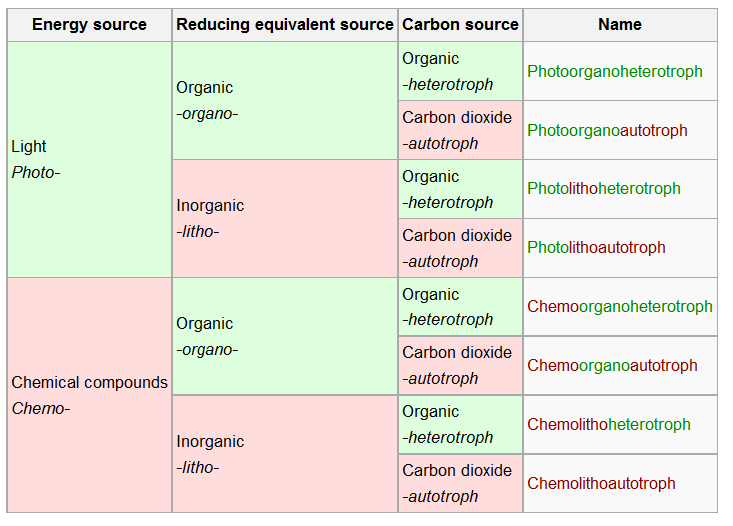
Table Purpose: This table classifies microorganisms by their energy, electron, and carbon sources, providing the basis for terms such as photoorganoheterotroph, chemolithoautotroph, etc.
Integration of Energy, Electron, and Carbon Sources in Microbial Metabolism
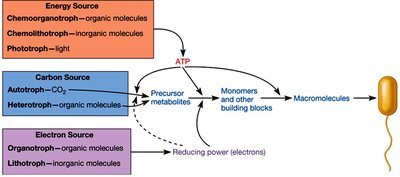
Microbial cells integrate energy, electron, and carbon sources to generate precursor metabolites, monomers, and macromolecules necessary for growth and maintenance. ATP and reducing power are central to these processes.
ATP: The universal energy currency, produced by catabolic reactions and used in anabolic reactions.
Reducing Power: Electrons (often carried by NADH, NADPH, FADH2) are required for biosynthetic reactions.
Precursor Metabolites: Serve as building blocks for macromolecule synthesis.
Catabolism and Anabolism
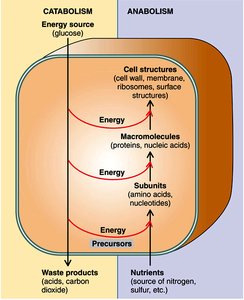
Microbial metabolism is divided into two major processes: catabolism (breakdown of molecules to release energy) and anabolism (biosynthesis of cell components).
Catabolism: Degradation of complex molecules (e.g., glucose) to produce energy, reducing power, and precursor metabolites.
Anabolism: Synthesis of cell structures and macromolecules from simpler precursors, requiring energy and reducing power.
ATP: The Energy Currency of the Cell
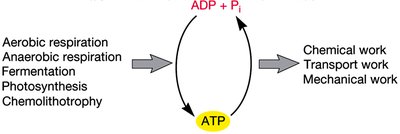
ATP (adenosine triphosphate) is generated by various catabolic processes and used to drive cellular work, including biosynthesis, transport, and motility.
ATP Generation: Aerobic/anaerobic respiration, fermentation, photosynthesis, chemolithotrophy
ATP Utilization: Chemical, transport, and mechanical work
ATP Cycle and High-Energy Bonds
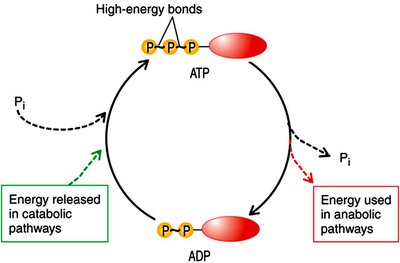
The ATP cycle involves the continuous conversion between ATP and ADP + Pi. Energy released from catabolic pathways is used to synthesize ATP, which is then hydrolyzed to power anabolic reactions.
High-Energy Bonds: The terminal phosphate bonds in ATP are high-energy and release energy upon hydrolysis.
Catabolic Pathways: Release energy to form ATP.
Anabolic Pathways: Consume ATP to drive biosynthesis.
Major Types of Microbial Metabolism
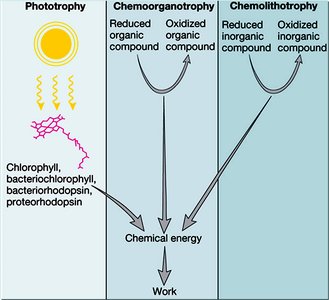
Microbes utilize different strategies to obtain energy and reducing power:
Phototrophy: Light energy is converted to chemical energy (e.g., photosynthesis).
Chemoorganotrophy: Organic compounds are oxidized for energy and electrons.
Chemolithotrophy: Inorganic compounds are oxidized for energy and electrons.
Respiration and Fermentation
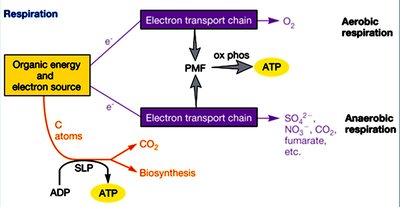
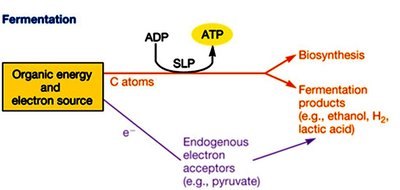
Microbes can generate ATP through respiration or fermentation, depending on the availability of electron acceptors and the nature of their metabolism.
Respiration: Involves an electron transport chain (ETC) and an exogenous terminal electron acceptor (e.g., O2 for aerobic, NO3- or SO42- for anaerobic).
Fermentation: Uses endogenous electron acceptors (e.g., pyruvate) and does not involve an ETC.
Substrate-Level Phosphorylation (SLP): ATP is generated directly in catabolic pathways.
Oxidative Phosphorylation (Ox Phos): ATP is generated via the ETC and proton motive force (PMF).
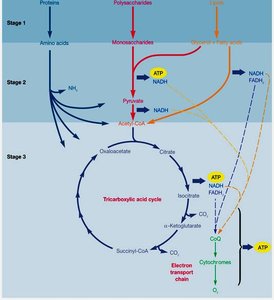
Stages of Aerobic Respiration
Aerobic respiration involves three main stages:
Breakdown of large nutrients: Proteins, polysaccharides, and lipids are degraded to amino acids, monosaccharides, and fatty acids/glycerol.
Further oxidation: These intermediates are converted to pyruvate and acetyl-CoA.
Complete oxidation: Acetyl-CoA enters the tricarboxylic acid (TCA) cycle, producing CO2, NADH, FADH2, and ATP/GTP.
ATP Yield in Different Metabolic Pathways
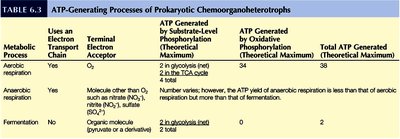
The amount of ATP generated varies depending on the metabolic pathway:
Metabolic Process | Electron Transport Chain | Terminal Electron Acceptor | ATP by SLP | ATP by Ox Phos | Total ATP |
|---|---|---|---|---|---|
Aerobic respiration | Yes | O2 | 4 | 34 | 38 |
Anaerobic respiration | Yes | Other than O2 | Variable | Variable | <38 |
Fermentation | No | Organic molecule | 2 | 0 | 2 |
Electron Transport Chain and Proton Motive Force
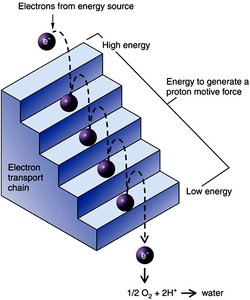
The electron transport chain (ETC) is a series of membrane-bound carriers that transfer electrons from NADH and FADH2 to a terminal electron acceptor, generating a proton motive force (PMF) used to synthesize ATP.
Electrons flow from carriers with more negative E0 to more positive E0.
PMF: Drives ATP synthesis, flagellar rotation, and active transport.
Summary Table: Microbial Nutritional Types
The following table summarizes the main nutritional types of microorganisms based on their energy, electron, and carbon sources:
Energy Source | Electron Source | Carbon Source | Name |
|---|---|---|---|
Light | Organic | Organic | Photoorganoheterotroph |
Light | Organic | CO2 | Photoorganoautotroph |
Light | Inorganic | Organic | Photolithoheterotroph |
Light | Inorganic | CO2 | Photolithoautotroph |
Chemical | Organic | Organic | Chemoorganoheterotroph |
Chemical | Organic | CO2 | Chemoorganoautotroph |
Chemical | Inorganic | Organic | Chemolithoheterotroph |
Chemical | Inorganic | CO2 | Chemolithoautotroph |
Additional info: These categories are foundational for understanding microbial ecology, physiology, and their roles in biogeochemical cycles.
