 Back
BackMicrobial Metabolism: Enzymes, Catabolism, and Energy Production
Study Guide - Smart Notes
 Tailored notes based on your materials, expanded with key definitions, examples, and context.
Microbial Metabolism
Overview of Metabolism
Metabolism encompasses all controlled biochemical reactions that occur within cells, enabling life by managing energy and molecular transformations. It is divided into two main processes: catabolism (breaking down molecules to release energy) and anabolism (building complex molecules, requiring energy input).
Catabolism: Exergonic reactions that break down molecules, releasing energy.
Anabolism: Endergonic reactions that synthesize complex molecules from simpler ones, consuming energy.
Energy Storage: Energy from catabolic reactions is stored in adenosine triphosphate (ATP).
Enzymes: Biological catalysts that facilitate metabolic reactions by lowering activation energy.
Figure: Metabolism is composed of catabolic and anabolic reactions, with energy transfer mediated by ATP and enzymes.
Enzymes and Their Roles in Metabolism
Structure and Function of Enzymes
Enzymes are primarily proteins that catalyze chemical reactions in cells without being consumed or permanently altered. They function by reducing the activation energy required for reactions, thus increasing reaction rates.
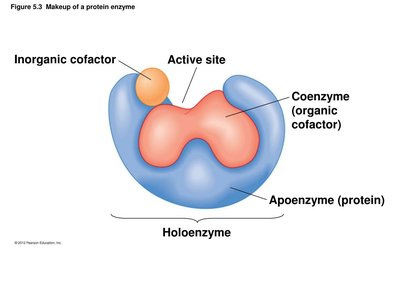
Active Site: The region on the enzyme where substrates bind and reactions occur.
Cofactors and Coenzymes: Some enzymes require non-protein helpers for activity. Cofactors are inorganic ions, while coenzymes are organic molecules.
Holoenzyme: The complete, active enzyme with its cofactor(s) or coenzyme(s).
Enzyme Activity and Regulation
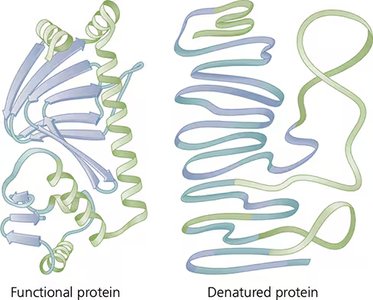
Enzyme activity is influenced by several factors, including temperature, pH, ionic concentration, substrate concentration, and the presence of inhibitors. Extreme changes can lead to denaturation, rendering the enzyme nonfunctional.
Competitive Inhibitors: Molecules that bind to the active site, blocking substrate access.
Noncompetitive Inhibitors: Molecules that bind elsewhere (allosteric site), altering the enzyme's shape and function.
Denaturation: Loss of protein structure and function due to environmental changes.
Mechanism of Enzyme Action
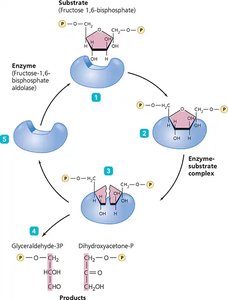
Enzymes bind substrates to form an enzyme-substrate complex, facilitating the conversion to products and releasing the enzyme for reuse.
Oxidation-Reduction (Redox) Reactions
Redox Reactions in Metabolism
Redox reactions involve the transfer of electrons between molecules, essential for energy extraction in cells. Oxidation is the loss of electrons (or hydrogen), while reduction is the gain of electrons (or hydrogen).
Electron Carriers: Molecules such as NAD+, NADP+, and FAD shuttle electrons during metabolic reactions.
Key Electron Carriers:
Nicotinamide adenine dinucleotide: NAD+ → NADH
Nicotinamide adenine dinucleotide phosphate: NADP+ → NADPH
Flavin adenine dinucleotide: FAD → FADH2
ATP Production and Phosphorylation
Mechanisms of ATP Synthesis
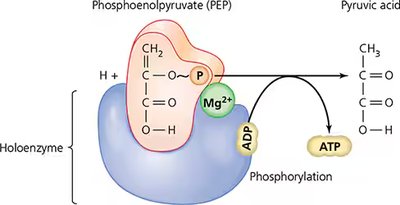
ATP is synthesized by adding a phosphate group to ADP, a process known as phosphorylation. There are three main types:
Substrate-level phosphorylation: Direct transfer of phosphate from a substrate to ADP.
Oxidative phosphorylation: ATP synthesis powered by the electron transport chain and chemiosmosis.
Photophosphorylation: ATP synthesis using light energy (in photosynthetic organisms).
Carbohydrate Catabolism
Overview of Glucose Catabolism
Carbohydrates, especially glucose, are primary energy sources for most organisms. Glucose catabolism occurs via two main pathways: cellular respiration and fermentation.
Cellular Respiration: Complete oxidation of glucose to CO2 and H2O, involving glycolysis, the Krebs cycle, and the electron transport chain (ETC).
Fermentation: Partial oxidation of glucose, producing organic end products (e.g., lactate, ethanol) and regenerating NAD+ for glycolysis.
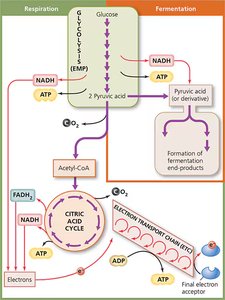
Glycolysis
Glycolysis is the metabolic pathway that converts glucose (6 carbons) into two molecules of pyruvate (3 carbons each), generating a net gain of ATP and NADH.
Occurs in the cytoplasm of nearly all cells.
Net products: 2 ATP (substrate-level phosphorylation), 2 NADH, 2 pyruvate.
Cellular Respiration: Krebs Cycle and Electron Transport Chain
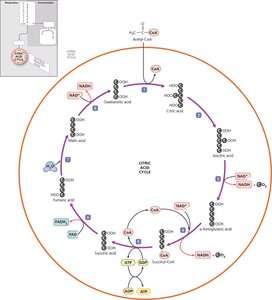
After glycolysis, pyruvate is converted to acetyl-CoA, which enters the Krebs cycle. The cycle generates NADH and FADH2, which donate electrons to the ETC, driving ATP synthesis via oxidative phosphorylation.
Krebs Cycle: Occurs in the cytosol (prokaryotes) or mitochondrial matrix (eukaryotes). Produces ATP, NADH, FADH2, and CO2.
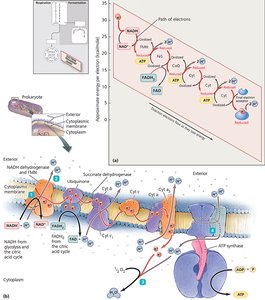
Electron Transport Chain (ETC): Located in the inner mitochondrial membrane (eukaryotes) or cytoplasmic membrane (prokaryotes). Electrons from NADH and FADH2 are transferred through a series of carriers, creating a proton gradient used by ATP synthase to generate ATP.
ATP Yield from Aerobic Respiration
The total ATP yield from one molecule of glucose in prokaryotes is approximately 38 ATP, including contributions from glycolysis, the Krebs cycle, and the ETC.
Pathway | ATP Produced | ATP Used | NADH Produced | FADH2 Produced |
|---|---|---|---|---|
Glycolysis | 4 | 2 | 2 | 0 |
Synthesis of acetyl-CoA and the citric acid cycle | 2 | 0 | 8 | 2 |
Electron transport chain | 34 | 0 | 0 | 0 |
Total | 40 | 2 | ||
Net Total | 38 |

Fermentation
Fermentation allows cells to regenerate NAD+ in the absence of an electron transport chain, enabling glycolysis to continue. It is less efficient than respiration and produces various organic end products.
Common products: lactic acid, ethanol, propionic acid, acetone.
Fermentation products are often useful in food and industrial processes.
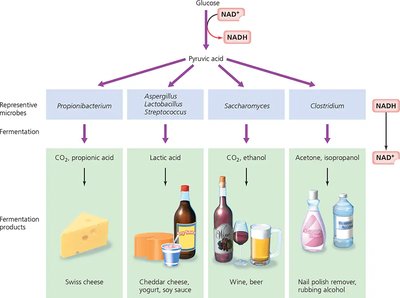
Comparison of Aerobic Respiration, Anaerobic Respiration, and Fermentation
Aerobic Respiration | Anaerobic Respiration | Fermentation | |
|---|---|---|---|
Oxygen Required | Yes | No | No |
Type of Phosphorylation | Substrate-level and oxidative | Substrate-level and oxidative | Substrate-level |
Final Electron (Hydrogen) Acceptor | Oxygen | NO3-, SO42-, CO32-, or externally acquired organic molecules | Cellular organic molecules |
Potential Molecules of ATP Produced per Molecule of Glucose | ~38 in prokaryotes, ~36 in eukaryotes | 2-36 | 2 |

Integration and Regulation of Metabolism
Metabolic Pathways and Regulation
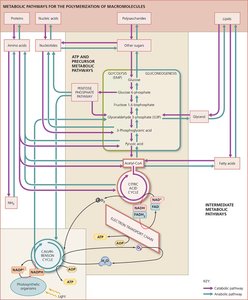
Cells regulate metabolism by controlling enzyme synthesis and activity. Catabolic enzymes are produced only when substrates are available, and anabolic pathways are suppressed if end products are present in the environment. Many metabolic pathways are amphibolic, serving both catabolic and anabolic roles.
Key Terms and Concepts
Activation Energy: The minimum energy required to initiate a chemical reaction.
Peptide Bond: Covalent bond linking amino acids in proteins.
Oligosaccharide: Short-chain carbohydrate composed of 3-10 monosaccharide units.
Amphibolic Pathway: A metabolic pathway that functions in both anabolism and catabolism.
