 Back
Microbial Metabolism: Enzymes, Energy, and Pathways
Study Guide - Smart Notes
 Tailored notes based on your materials, expanded with key definitions, examples, and context.
Microbial Metabolism
Overview of Metabolism
Metabolism is the sum of all chemical reactions occurring within a cell. These reactions are organized into metabolic pathways, which are sequences of enzymatically catalyzed reactions. Metabolism is divided into two main types: catabolism (breakdown of molecules to release energy) and anabolism (synthesis of complex molecules using energy).
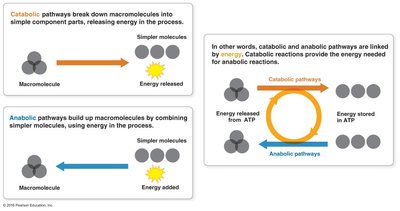
Catabolic pathways break down macromolecules into simpler components, releasing energy.
Anabolic pathways build up macromolecules from simpler molecules, consuming energy.
Catabolic and anabolic pathways are linked by energy, typically in the form of ATP.
Metabolic Pathways and Enzymes
Metabolic pathways are determined by enzymes, which are proteins encoded by genes. Each step in a pathway is catalyzed by a specific enzyme, ensuring the proper transformation of substrates to products.

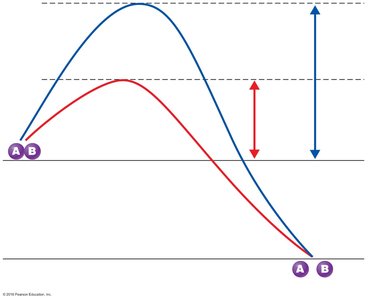
Enzymes lower the activation energy required for reactions, increasing reaction rates without being consumed.
Enzyme specificity ensures that only particular substrates are transformed.
Energy and Reaction Rates
Chemical reactions require a certain amount of energy to proceed, known as activation energy. Enzymes accelerate reactions by lowering this energy barrier.
Factors influencing reaction rates include temperature, pH, substrate concentration, and the presence of inhibitors.
Enzymes: Structure and Function
Mechanism of Enzyme Action
Enzymes function by binding substrates at their active sites, forming an enzyme-substrate complex. The substrate is converted to product, and the enzyme is released unchanged.
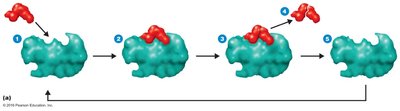
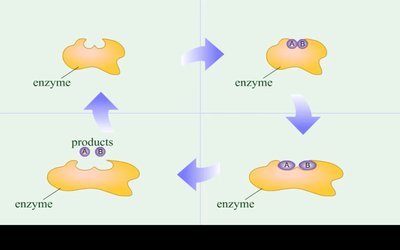
Enzyme specificity is due to the unique shape of the active site.
Turnover number refers to the number of substrate molecules converted per second.
Enzyme Components
Enzymes may consist of a protein portion (apoenzyme) and a nonprotein component (cofactor or coenzyme). The active enzyme (holoenzyme) is the combination of both.
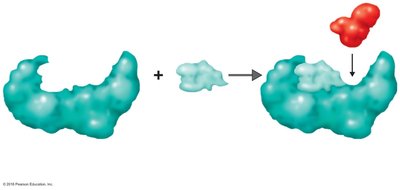
Cofactor: Inorganic ions (e.g., Mg2+, Fe2+).
Coenzyme: Organic molecules, often derived from vitamins.
Enzyme Classification
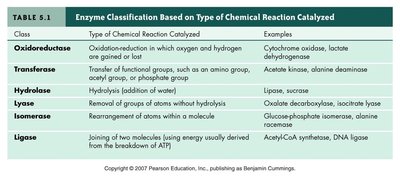
Enzymes are classified based on the type of reaction they catalyze.
Class | Type of Reaction Catalyzed | Examples |
|---|---|---|
Oxidoreductase | Oxidation-reduction | Cytochrome oxidase, lactate dehydrogenase |
Transferase | Transfer of functional groups | Acetate kinase, alanine deaminase |
Hydrolase | Hydrolysis | Lipase, sucrase |
Lyase | Removal of groups without hydrolysis | Oxalate decarboxylase, isocitrate lyase |
Isomerase | Rearrangement within a molecule | Glucose-phosphate isomerase, alanine racemase |
Ligase | Joining of molecules (using ATP) | Acetyl-CoA synthetase, DNA ligase |
Vitamins as Coenzymes
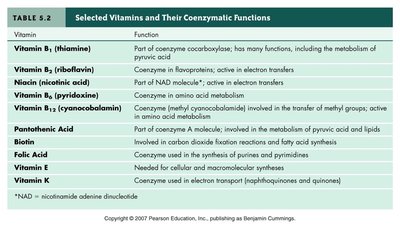
Many vitamins serve as coenzymes or their precursors, playing essential roles in metabolism.
Vitamin | Function |
|---|---|
Vitamin B1 (thiamine) | Part of coenzyme for metabolism of pyruvic acid |
Vitamin B2 (riboflavin) | Coenzyme in electron transfers |
Niacin (nicotinic acid) | Part of NAD molecule |
Vitamin B6 (pyridoxine) | Coenzyme in amino acid metabolism |
Vitamin B12 (cyanocobalamin) | Coenzyme in methyl group transfer |
Pantothenic Acid | Part of coenzyme A, involved in metabolism of pyruvic acid and lipids |
Biotin | Involved in carbon dioxide fixation reactions |
Folic Acid | Coenzyme used in synthesis of purines and pyrimidines |
Vitamin E | Needed for cellular and macromolecular synthesis |
Vitamin K | Coenzyme in electron transport |
Factors Influencing Enzyme Activity
Enzyme activity is affected by temperature, pH, substrate concentration, and inhibitors. Extreme conditions can denature enzymes, rendering them inactive.
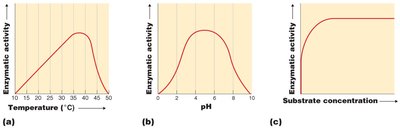
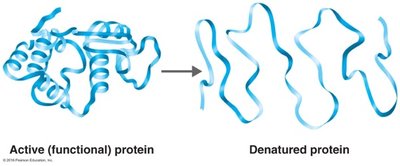
Optimal temperature and pH maximize enzyme activity.
Increasing substrate concentration increases activity until saturation is reached.
Enzyme Inhibition
Enzyme inhibitors can be competitive (compete with substrate for active site) or noncompetitive (bind elsewhere, altering enzyme shape).
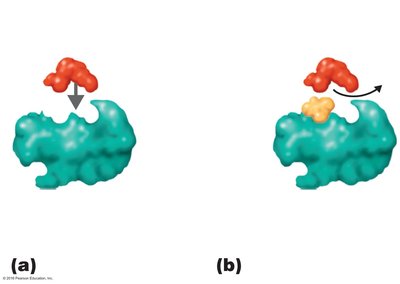
Competitive inhibitors resemble the substrate and block the active site.
Noncompetitive inhibitors bind to an allosteric site, changing the enzyme's conformation.
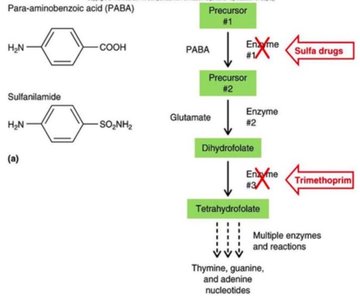
Example: Sulfa drugs act as competitive inhibitors of the enzyme involved in folic acid synthesis in bacteria.
Feedback Inhibition
Feedback inhibition is a regulatory mechanism where the end product of a pathway inhibits an earlier enzyme, preventing overproduction.
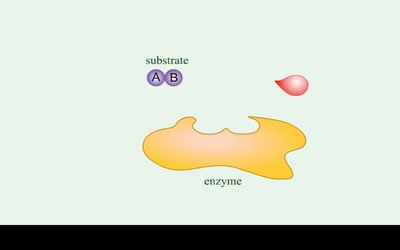
Helps maintain metabolic balance within the cell.
Oxidation-Reduction (Redox) Reactions
Redox Basics
Oxidation is the loss of electrons, while reduction is the gain of electrons. In biological systems, these reactions often involve the transfer of hydrogen atoms.
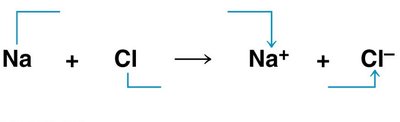
Redox reactions are essential for energy extraction from nutrients.
NAD+ and FAD are common electron carriers.
ATP: The Energy Currency
ATP Structure and Synthesis
ATP (adenosine triphosphate) stores and transfers energy in cells. It is generated by phosphorylation of ADP.
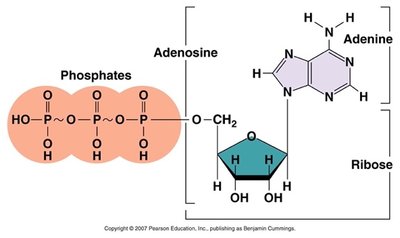
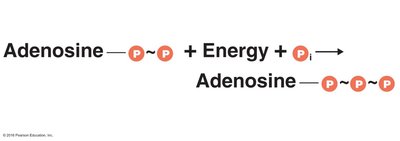
ATP is produced by substrate-level phosphorylation, oxidative phosphorylation, and photophosphorylation.
Carbohydrate Catabolism
Overview of Respiration and Fermentation
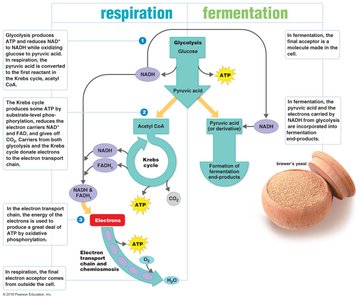
Cells extract energy from glucose through a series of enzymatic reactions. The main pathways are glycolysis, the Krebs cycle, and the electron transport chain (ETC). Fermentation is an alternative pathway used when oxygen is absent.
Glycolysis
Glycolysis is the oxidation of glucose to pyruvate, producing ATP and NADH. It occurs in the cytoplasm and does not require oxygen.
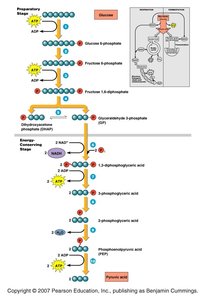
Net gain: 2 ATP, 2 NADH, and 2 pyruvate per glucose molecule.
First half: energy investment; second half: energy payoff.
Preparatory Step and Krebs Cycle
Before entering the Krebs cycle, pyruvate is converted to acetyl CoA. The Krebs cycle (citric acid cycle) completes the oxidation of acetyl CoA, generating NADH, FADH2, ATP, and CO2.
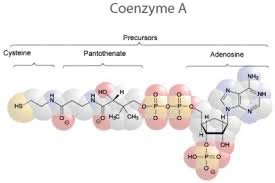
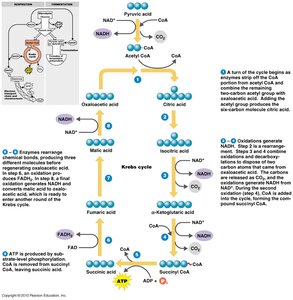
Each glucose yields 6 NADH, 2 FADH2, 2 ATP, and 4 CO2 (from two turns of the cycle).
Electron Transport Chain and Chemiosmosis
The ETC is a series of membrane-bound carriers that transfer electrons from NADH and FADH2 to oxygen (in aerobic respiration), generating a proton gradient used to synthesize ATP via ATP synthase.
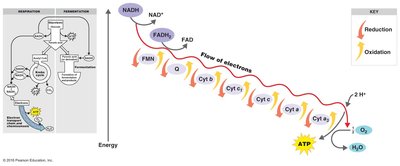
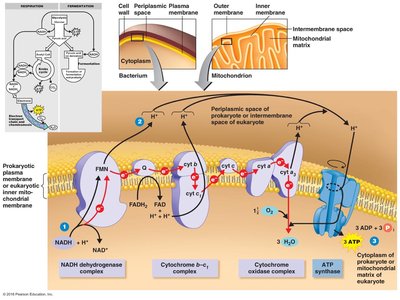
Proton-motive force drives ATP synthesis as protons flow through ATP synthase.
Each NADH yields about 3 ATP; each FADH2 yields about 2 ATP.
Anaerobic Respiration
Some microbes use electron acceptors other than oxygen (e.g., nitrate, sulfate, carbonate) in the ETC, producing less ATP than aerobic respiration.
Electron Acceptor | Products |
|---|---|
NO3– | NO2–, N2 + H2O |
SO42– | H2S + H2O |
CO32– | CH4 + H2O |
Fermentation
Fermentation allows ATP production in the absence of oxygen by using organic molecules as final electron acceptors. It regenerates NAD+ for glycolysis and produces various end products.
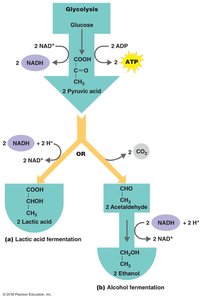
Lactic acid fermentation: Pyruvate is reduced to lactic acid (e.g., in Lactobacillus).
Alcohol fermentation: Pyruvate is converted to ethanol and CO2 (e.g., in yeast).
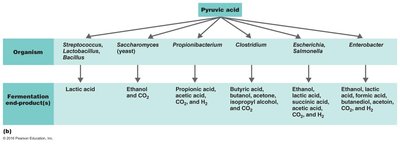
Organism | Fermentation End-Product(s) |
|---|---|
Streptococcus, Lactobacillus, Bacillus | Lactic acid |
Saccharomyces (yeast) | Ethanol and CO2 |
Propionibacterium | Propionic acid, acetic acid, CO2, and H2 |
Clostridium | Butyric acid, butanol, acetone, isopropyl alcohol, CO2, and H2 |
Escherichia, Salmonella | Ethanol, lactic acid, succinic acid, acetic acid, CO2, and H2 |
Enterobacter | Ethanol, lactic acid, formic acid, butanediol, acetoin, CO2, and H2 |
Applications and Examples
Cheese production: Lactic acid bacteria ferment milk sugars, producing lactic acid and curdling milk.
Sauerkraut and pickles: Anaerobic fermentation by Lactobacillus and Leuconostoc produces acids and gases.
Poi: Fermentative succession by various microbes, with acid byproducts accumulating over time.
