 Back
BackMicrobial Metabolism: Fermentation, Catabolism, and Photosynthesis
Study Guide - Smart Notes
 Tailored notes based on your materials, expanded with key definitions, examples, and context.
Microbial Metabolism
Fermentation
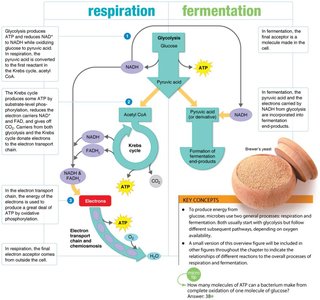
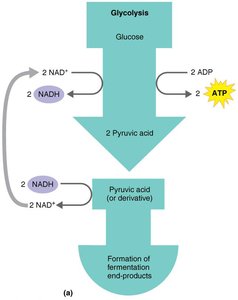
Fermentation is a metabolic process that enables microorganisms to generate energy in the absence of oxygen. It involves the conversion of glucose to pyruvic acid via glycolysis, followed by the reduction of pyruvic acid to various end-products. This process regenerates NAD+ for glycolysis and produces a limited amount of ATP.
Definition: Fermentation is the anaerobic breakdown of organic substrates, typically glucose, to generate ATP and fermentation end-products.
Key Steps: Glycolysis produces pyruvic acid and ATP; NADH is oxidized back to NAD+ as pyruvic acid is reduced to end-products.
ATP Yield: Only 2 ATP molecules are produced per glucose molecule.
Examples: Lactic acid fermentation (produces lactic acid), alcohol fermentation (produces ethanol and CO2).
Fermentation End-Products and Microbial Diversity
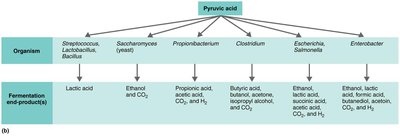
Different microorganisms produce distinct fermentation end-products from pyruvic acid, which can be used for identification and industrial applications.
Organisms: Streptococcus, Bacillus, Saccharomyces (yeast), Propionibacterium, Clostridium, Escherichia, Salmonella, Enterobacter.
End-Products: Lactic acid, ethanol, CO2, propionic acid, butyric acid, acetic acid, H2, formic acid, succinic acid, acetoin.
Organism | Fermentation End-Products |
|---|---|
Streptococcus, Lactobacillus, Bacillus | Lactic acid |
Saccharomyces (yeast) | Ethanol and CO2 |
Propionibacterium | Propionic acid, acetic acid, CO2, H2 |
Clostridium | Butyric acid, butanol, acetone, CO2, H2 |
Escherichia, Salmonella | Ethanol, lactic acid, acetic acid, CO2, H2 |
Enterobacter | Ethanol, lactic acid, formic acid, butanediol, acetoin, CO2, H2 |
Lactic Acid and Alcohol Fermentation Pathways
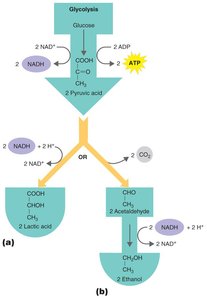
Lactic acid fermentation and alcohol fermentation are two major types of fermentation, each with distinct pathways and end-products.
Lactic Acid Fermentation: Pyruvic acid is reduced directly to lactic acid by NADH.
Alcohol Fermentation: Pyruvic acid is first converted to acetaldehyde and CO2, then reduced to ethanol by NADH.
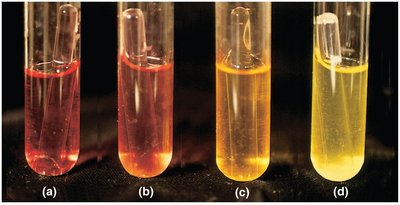
Fermentation Test
Fermentation tests are used in microbiology to identify bacteria based on their ability to ferment specific carbohydrates and produce acid and gas.
Principle: A pH indicator changes color in response to acid production; gas production is detected in a Durham tube.
Applications: Used for bacterial identification in clinical and environmental samples.
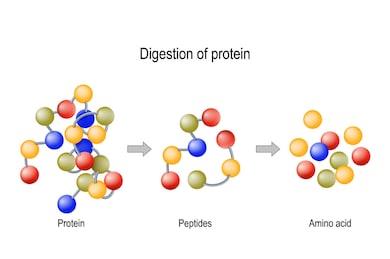
Protein Catabolism
Microorganisms can utilize proteins as energy sources by breaking them down into amino acids, which are then deaminated and enter metabolic pathways.
Process: Proteins are hydrolyzed to peptides and amino acids, which are further catabolized.
Entry into Metabolism: Amino acids can enter glycolysis or the Krebs cycle after deamination.
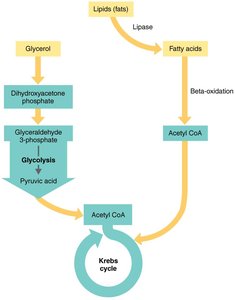
Lipid Catabolism
Lipids are broken down by lipases into glycerol and fatty acids. Glycerol enters glycolysis, while fatty acids undergo beta-oxidation to form acetyl-CoA, which enters the Krebs cycle.
Enzymes: Lipases hydrolyze lipids.
Pathways: Glycerol is converted to dihydroxyacetone phosphate; fatty acids are converted to acetyl-CoA.
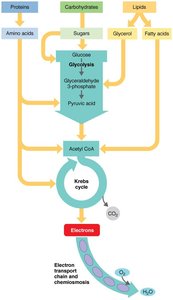
Other Ways into the Krebs Cycle
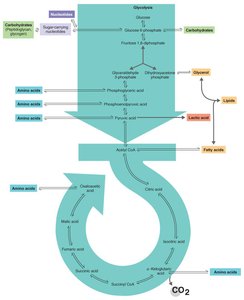
Various metabolic intermediates from carbohydrates, proteins, and lipids can enter the Krebs cycle, highlighting the interconnectedness of metabolic pathways.
Carbohydrates: Enter as glucose or intermediates.
Proteins: Amino acids enter after deamination.
Lipids: Fatty acids enter as acetyl-CoA.
Photosynthesis
Light-Dependent and Light-Independent Reactions
Photosynthesis is the process by which phototrophic organisms convert light energy into chemical energy. It consists of light-dependent reactions (photophosphorylation) and light-independent reactions (Calvin-Benson cycle).
Light-Dependent Reactions: Occur in the thylakoid membrane; produce ATP and NADPH.
Light-Independent Reactions: Calvin-Benson cycle; fix carbon dioxide into organic molecules.
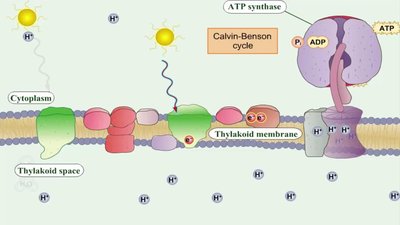
Photosystem I: Cyclic Photophosphorylation
In cyclic photophosphorylation, electrons excited by light in Photosystem I return to the same photosystem, generating ATP but not NADPH or O2.
Electron Flow: Electrons cycle back to Photosystem I.
ATP Production: ATP is generated via chemiosmosis.
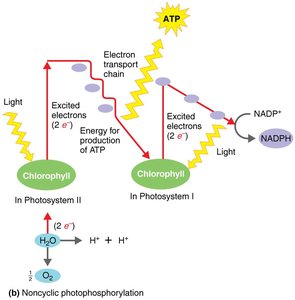
Photosystem II: Non-Cyclic Photophosphorylation
Non-cyclic photophosphorylation involves both Photosystem II and Photosystem I. Electrons are transferred from water to NADP+, producing NADPH, ATP, and O2.
Electron Flow: Electrons move from water through Photosystem II and I to NADP+.
Products: ATP, NADPH, and O2.
Energy and Carbon Sources in Microbial Metabolism
Classification of Microbes by Energy and Carbon Source
Microorganisms are classified based on their energy and carbon sources. This classification is fundamental to understanding microbial ecology and physiology.
Phototrophs: Use light as an energy source.
Chemotrophs: Use redox reactions (e.g., Krebs cycle) as an energy source.
Autotrophs: Use CO2 as a carbon source.
Heterotrophs: Use organic compounds as a carbon source.
Chemoheterotrophs: Use organic compounds for both energy and carbon.
Integrated Metabolism: The Big Picture
Overview of Metabolic Pathways
Microbial metabolism integrates catabolic and anabolic pathways, allowing cells to utilize carbohydrates, proteins, and lipids for energy and biosynthesis. The central metabolic pathways include glycolysis, the Krebs cycle, and the electron transport chain.
Catabolism: Breakdown of molecules to release energy.
Anabolism: Synthesis of cellular components.
Key Pathways: Glycolysis, Krebs cycle, electron transport chain, photosynthesis.
Summary Table: Microbial Metabolic Pathways
Pathway | Substrate | Products | ATP Yield |
|---|---|---|---|
Glycolysis | Glucose | Pyruvic acid, ATP, NADH | 2 ATP |
Fermentation | Pyruvic acid | Lactic acid, ethanol, CO2, etc. | 2 ATP (from glycolysis) |
Krebs Cycle | Acetyl-CoA | CO2, NADH, FADH2, ATP | 2 ATP |
Electron Transport Chain | NADH, FADH2 | H2O, ATP | ~34 ATP |
Photosynthesis | Light, CO2 | ATP, NADPH, O2, organic molecules | Variable |
Key Equations
Glycolysis:
Lactic Acid Fermentation:
Alcohol Fermentation:
Photosynthesis (overall):
