 Back
BackMicrobial Metabolism: Foundations, Pathways, and Regulation
Study Guide - Smart Notes
 Tailored notes based on your materials, expanded with key definitions, examples, and context.
Microbial Metabolism
Defining Metabolism
Metabolism encompasses all chemical reactions that occur within a living organism, including those that break down substances to release energy (catabolism) and those that use energy to build new substances (anabolism). These reactions are organized into metabolic pathways, where each step is catalyzed by a specific enzyme.
Catabolic pathways: Break down complex molecules into simpler ones, releasing energy.
Anabolic pathways: Use energy to build complex molecules from simpler ones.
Amphibolic pathways: Function in both catabolism and anabolism.
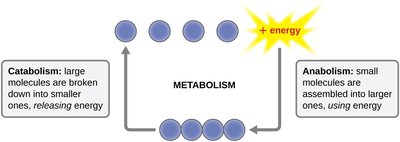
Example: Glycolysis is a catabolic pathway that breaks down glucose, while protein synthesis is an anabolic pathway.
ATP: The Energy Currency of the Cell
Adenosine triphosphate (ATP) is the primary energy carrier in cells. It is composed of adenine, ribose, and three phosphate groups. The energy stored in ATP is released when it is hydrolyzed to adenosine diphosphate (ADP) and inorganic phosphate (Pi), a process called dephosphorylation. Cells regenerate ATP from ADP through phosphorylation reactions.
Phosphorylation: Addition of a phosphate group to a molecule, requiring energy.
Dephosphorylation: Removal of a phosphate group, releasing energy.

Equation:
Example: Muscle contraction and active transport across membranes require ATP.
Enzymes: Catalysts of Metabolic Reactions
Enzymes are biological catalysts, usually proteins, that speed up chemical reactions by lowering the activation energy required. They are highly specific for their substrates and are not consumed in the reaction. Enzyme activity can be regulated by various factors, including cofactors, temperature, pH, and inhibitors.
Active site: The region on the enzyme where the substrate binds.
Induced fit model: The enzyme changes shape slightly to accommodate the substrate.

Example: Sucrase catalyzes the breakdown of sucrose into glucose and fructose.
Enzyme Regulation and Inhibition
Enzyme activity can be modulated by several mechanisms:
Competitive inhibition: Inhibitor competes with the substrate for the active site.
Noncompetitive inhibition: Inhibitor binds to a site other than the active site, altering enzyme function.
Feedback inhibition: End product of a pathway inhibits an enzyme involved earlier in the pathway.

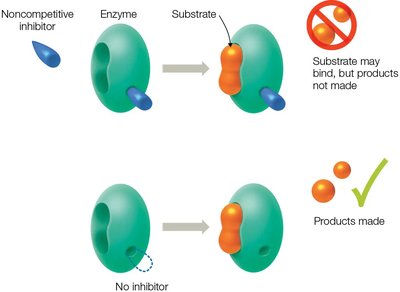
Example: Statin drugs act as competitive inhibitors of HMG-CoA reductase, reducing cholesterol synthesis.
Enzyme Cofactors and Coenzymes
Some enzymes require nonprotein helpers called cofactors to function. Cofactors can be inorganic ions (e.g., Mg2+, Fe2+) or organic molecules called coenzymes (often derived from vitamins).
Apoenzyme: Inactive enzyme without its cofactor.
Holoenzyme: Active enzyme with its cofactor.
Common coenzymes: NAD+, NADP+, FAD, Coenzyme A.
Example: NAD+ and FAD act as electron carriers in cellular respiration.
Redox Reactions and Energy Harvesting
Cells extract energy from nutrients through oxidation-reduction (redox) reactions. In these reactions, electrons are transferred from one molecule (the reducing agent) to another (the oxidizing agent). Redox reactions are central to cellular respiration and fermentation.
Oxidation: Loss of electrons.
Reduction: Gain of electrons.
Example: During glycolysis, glucose is oxidized and NAD+ is reduced to NADH.
Mechanisms of ATP Production
Cells use three main mechanisms to regenerate ATP from ADP:
Mechanism | Description | Used In |
|---|---|---|
Substrate-level phosphorylation | Direct transfer of a phosphate group to ADP from a high-energy intermediate | Glycolysis, Krebs cycle, fermentation |
Oxidative phosphorylation | ATP synthesis powered by electron transport chains and chemiosmosis | Aerobic and anaerobic respiration |
Photophosphorylation | ATP synthesis powered by light-driven electron transport chains | Photosynthetic cells |
Overview of Cellular Respiration
Cellular respiration is a multi-step process by which cells extract energy from carbohydrates. It consists of glycolysis, the intermediate step, the Krebs cycle, and the electron transport chain.
Glycolysis: Splits glucose into two molecules of pyruvic acid, producing a net gain of 2 ATP and 2 NADH.
Intermediate step: Converts pyruvic acid to acetyl-CoA, releasing CO2.
Krebs cycle: Oxidizes acetyl-CoA, generating ATP, NADH, FADH2, and CO2.
Electron transport chain: Uses electrons from NADH and FADH2 to generate a proton gradient, driving ATP synthesis via chemiosmosis.
Equation for aerobic respiration:
Fermentation
Fermentation allows cells to generate ATP in the absence of a functional electron transport chain. It regenerates NAD+ by transferring electrons from NADH to an organic molecule, such as pyruvic acid. Fermentation yields much less ATP than respiration.
Process | Oxygen Needed? | Final Electron Acceptor | ATP Yield |
|---|---|---|---|
Fermentation | No | Organic molecule (e.g., pyruvic acid) | 2–3 ATP |
Aerobic Respiration | Yes | Oxygen | Up to 38 ATP |
Anaerobic Respiration | No | Inorganic molecule (e.g., nitrate, sulfate) | Less than 38 ATP |
Types of fermentation: Lactic acid fermentation, alcohol fermentation, mixed acid fermentation, butanediol fermentation.
Catabolism of Other Macromolecules
Cells can also break down lipids, proteins, and nucleic acids for energy:
Lipids: Broken down by lipases into glycerol (enters glycolysis) and fatty acids (enter Krebs cycle via beta-oxidation).
Proteins: Broken down by proteases into amino acids, which are deaminated and enter the Krebs cycle.
Nucleic acids: Broken down by nucleases into nucleotides, which are usually salvaged rather than catabolized for energy.
Anabolic Pathways: Biosynthesis
Anabolic reactions use ATP and reducing power (e.g., NADPH) to build complex molecules from simpler ones. Examples include:
Polysaccharide biosynthesis: Gluconeogenesis and glycogenesis build glucose and glycogen from non-sugar precursors.
Lipid biosynthesis: Fatty acids are synthesized from acetyl-CoA; glycerol from glycolysis intermediates.
Amino acid biosynthesis: Nonessential amino acids are made by amination; essential amino acids must be obtained from the environment.
Nucleotide biosynthesis: Purines and pyrimidines are synthesized de novo or recycled.
Amphibolic Pathways and Metabolic Regulation
Amphibolic pathways serve both catabolic and anabolic functions, allowing cells to efficiently balance energy production and biosynthesis. Regulation occurs through enzyme activity, cofactor availability, and feedback inhibition.
Catabolic Pathways | Anabolic Pathways |
|---|---|
Breakdown molecules, release energy, rely on NAD+ | Build molecules, consume energy, rely on NADPH |
Metabolic Diversity Among Microbes
Microbes are classified based on their carbon and energy sources:
Autotrophs: Fix inorganic carbon (CO2) into organic molecules.
Heterotrophs: Require organic carbon sources.
Phototrophs: Use light energy to make ATP.
Chemotrophs: Use chemical energy from nutrients.
Mixotrophs: Can switch between metabolic modes.
Biochemical Tests in Microbial Identification
Biochemical tests are essential for identifying bacteria based on their metabolic properties. These tests detect specific enzymes, metabolic end products, or intermediates.
Amino acid catabolism tests: Detect deaminases, decarboxylases, or sulfur reduction.
Fermentation tests: Detect acid and gas production from carbohydrate fermentation.
MR-VP test: Distinguishes between mixed acid and butanediol fermentation.
Oxidase and catalase tests: Detect presence of cytochrome c oxidase and catalase enzymes.
Rapid identification systems: Use panels of biochemical tests to generate a metabolic fingerprint for species identification.
Example: The API® system provides a numerical code based on test results to identify bacterial species.
