 Back
BackMicrobial Metabolism: Fundamentals, Pathways, and Energy Conservation
Study Guide - Smart Notes
 Tailored notes based on your materials, expanded with key definitions, examples, and context.
Microbial Metabolism: Fundamentals and Overview
Introduction to Metabolism
Metabolism encompasses all biochemical reactions that occur within a microbial cell to sustain life. These reactions are divided into two main categories: catabolism and anabolism.
Catabolism: The breakdown of complex molecules to release energy, often in the form of ATP.
Anabolism: The synthesis of cellular materials from simpler precursors, requiring energy input.
Reducing Power: Cells require reducing power (e.g., NADH, NADPH) as electron donors for both anabolic and catabolic reactions.

Classification of Microbial Metabolic Types
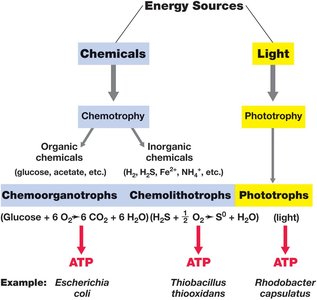
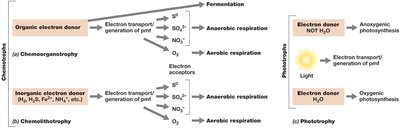
Microorganisms are classified based on their energy and electron sources:
Chemoorganotrophs: Obtain energy from organic chemicals (e.g., Escherichia coli).
Chemolithotrophs: Obtain energy from inorganic chemicals (e.g., Thiobacillus thiooxidans).
Phototrophs: Obtain energy from light (e.g., Rhodobacter capsulatus).
Energy Conservation in Microbial Cells
Mechanisms of ATP Generation
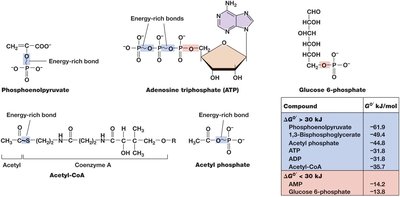
Microbial cells conserve energy primarily by synthesizing ATP through three mechanisms:
Substrate-level phosphorylation: Direct transfer of a phosphate group to ADP from a phosphorylated intermediate (common in fermentation).
Oxidative phosphorylation: ATP synthesis driven by a proton motive force generated by electron transport chains (common in respiration).
Photophosphorylation: ATP synthesis using a proton motive force generated by light-driven electron transport (in phototrophs).
The proton motive force (pmf) is an electrochemical gradient across the cytoplasmic membrane, essential for ATP synthesis, active transport, and motility.
Activation Energy and Enzyme Catalysis
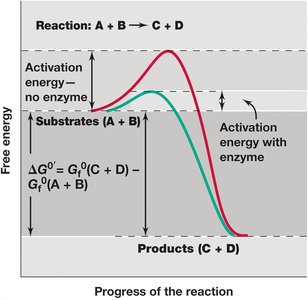
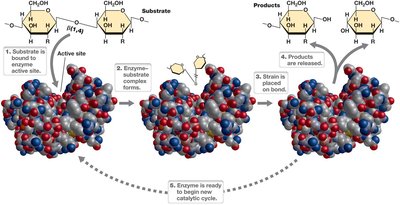
Enzymes lower the activation energy required for biochemical reactions, increasing reaction rates without being consumed.
Activation Energy (Ea): The energy barrier that must be overcome for a reaction to proceed.
Enzyme-Substrate Complex: Enzymes bind substrates at their active sites, facilitating the conversion to products.
Major Catabolic Pathways
Glycolysis (Embden–Meyerhof–Parnas Pathway)
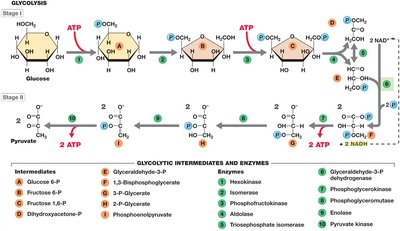
Glycolysis is the central pathway for glucose catabolism, converting glucose to pyruvate with the net production of ATP and NADH.
Net yield per glucose: 2 ATP, 2 NADH, 2 pyruvate.
Occurs in the cytoplasm of most cells.
The Citric Acid Cycle (TCA/Krebs Cycle)
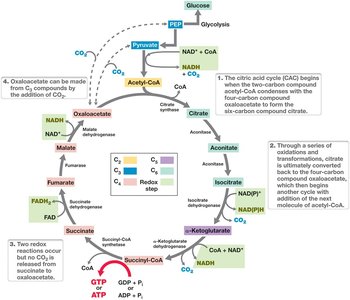
The citric acid cycle completes the oxidation of organic molecules, generating NADH, FADH2, and GTP/ATP, and releasing CO2.
Each pyruvate yields: 1 ATP (or GTP), 4 NADH/NADPH, 1 FADH2, 3 CO2.
Provides intermediates for biosynthetic pathways.
Fermentation
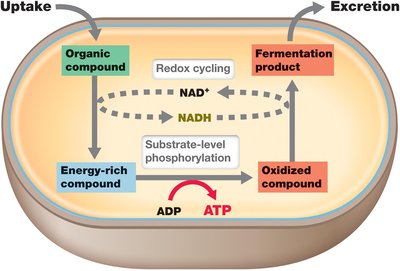
Fermentation is an anaerobic process where organic compounds serve as both electron donors and acceptors. ATP is generated by substrate-level phosphorylation.
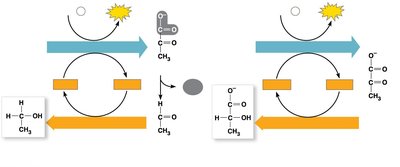
Alcohol fermentation: Produces ethanol and CO2 (e.g., yeast).
Lactic acid fermentation: Produces lactate (e.g., lactic acid bacteria).
Regenerates NAD+ for glycolysis.
Respiration and Electron Transport
Principles of Respiration
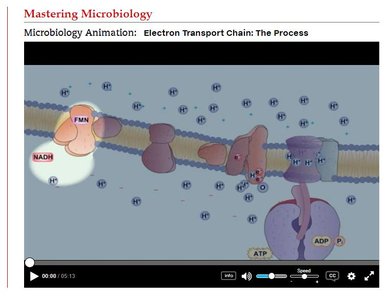
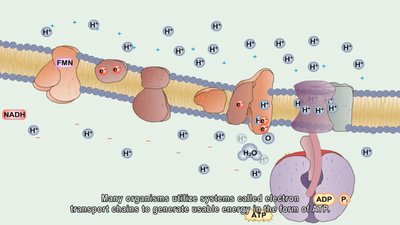
Respiration involves the transfer of electrons from reduced electron donors (e.g., NADH, FADH2) to external electron acceptors via an electron transport chain (ETC), generating a proton motive force for ATP synthesis.
Aerobic respiration: O2 is the terminal electron acceptor.
Anaerobic respiration: Other molecules (e.g., NO3-, SO42-) serve as terminal electron acceptors.
Electron transport occurs in the cytoplasmic membrane (bacteria/archaea) or mitochondrial membrane (eukaryotes).
Proton Motive Force and ATP Synthase
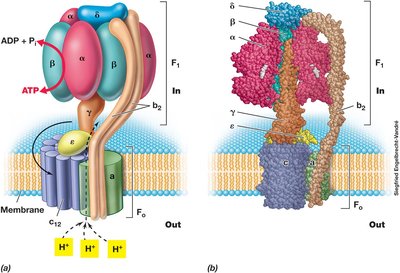
The ETC pumps protons across the membrane, creating an electrochemical gradient (pmf). ATP synthase (ATPase) uses this gradient to synthesize ATP from ADP and inorganic phosphate.
F1 component: Catalyzes ATP synthesis in the cytoplasm.
Fo component: Translocates protons across the membrane.
Approximately 3.3 H+ are required per ATP in E. coli.
Energetics: Fermentation vs. Respiration
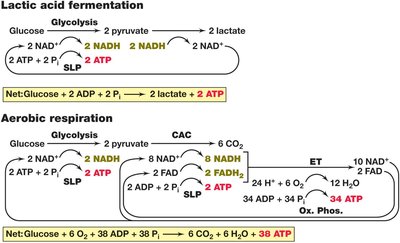
Respiration conserves more energy than fermentation because substrates are fully oxidized. For example, aerobic respiration of glucose yields up to 38 ATP, while lactic acid fermentation yields only 2 ATP per glucose.
Metabolic Diversity and Anaerobic Respiration
Anaerobic Respiration and Metabolic Modularity
Microbes can respire in the absence of oxygen by using alternative terminal electron acceptors such as nitrate (NO3-), sulfate (SO42-), or others. This process is widespread in anoxic environments (e.g., wetlands, sediments, animal guts).
Aerobic respiration: O2 as terminal electron acceptor.
Anaerobic respiration: Alternative acceptors (e.g., NO3-, SO42-).
Fermentation: No external electron acceptor; ATP by substrate-level phosphorylation.
Respiration in Escherichia coli
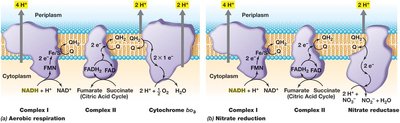
E. coli is a versatile chemoorganotroph capable of aerobic respiration, fermentation, and anaerobic respiration (e.g., nitrate respiration). It can adjust its electron transport chain components based on environmental conditions.
Can use different electron donors and acceptors.
Switches between aerobic and anaerobic pathways as needed.
Uses nitrate reductase as terminal reductase during anaerobic respiration with nitrate.
Summary Table: Comparison of Metabolic Pathways
Pathway | Electron Donor | Electron Acceptor | ATP Generation | Example Organism |
|---|---|---|---|---|
Aerobic Respiration | Organic/Inorganic | O2 | Oxidative phosphorylation | Paracoccus denitrificans |
Anaerobic Respiration | Organic/Inorganic | NO3-, SO42-, etc. | Oxidative phosphorylation | Escherichia coli |
Fermentation | Organic | Organic (internal) | Substrate-level phosphorylation | Lactic acid bacteria, yeast |
Key Terms and Concepts
Catabolism: Energy-yielding breakdown of molecules.
Anabolism: Energy-consuming synthesis of cell components.
ATP: Adenosine triphosphate, universal energy currency.
Proton Motive Force (pmf): Electrochemical gradient used for ATP synthesis.
Electron Transport Chain (ETC): Series of membrane proteins transferring electrons and pumping protons.
Terminal Electron Acceptor: Final molecule reduced in respiration (e.g., O2, NO3-).
Example Equations
Glycolysis (overall):
Aerobic Respiration (overall):
Alcohol Fermentation:
Lactic Acid Fermentation:
Additional info: This guide integrates foundational concepts from microbial metabolism, including energy conservation, catabolic and anabolic pathways, and the diversity of microbial respiratory strategies, as outlined in standard microbiology textbooks.
