 Back
BackMicrobial Metabolism: Glycolysis, Respiration, Fermentation, and Photosynthesis
Study Guide - Smart Notes
 Tailored notes based on your materials, expanded with key definitions, examples, and context.
Microbial Metabolism Overview
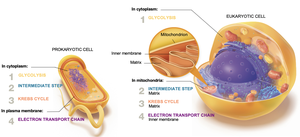
Cellular Locations of Metabolic Pathways
Microbial metabolism encompasses a series of biochemical reactions that allow cells to extract energy from nutrients. The location of these pathways differs between prokaryotic and eukaryotic cells:
Glycolysis: Occurs in the cytoplasm of both prokaryotes and eukaryotes.
Intermediate (Transition) Step: In prokaryotes, occurs in the cytoplasm; in eukaryotes, in the mitochondrial matrix.
Krebs Cycle: In prokaryotes, occurs in the cytoplasm; in eukaryotes, in the mitochondrial matrix.
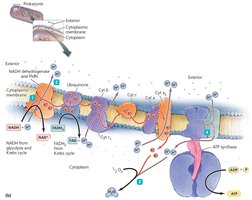
Electron Transport Chain (ETC): In prokaryotes, located in the plasma membrane; in eukaryotes, in the inner mitochondrial membrane.
Glycolysis
Definition and Features
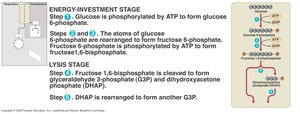
Glycolysis is the process of breaking down glucose (a 6-carbon sugar) into two molecules of pyruvic acid (3-carbon each). It is a fundamental pathway for energy extraction in cells.
Series of 10 reactions divided into energy investment and energy payoff stages.
ATP is required in the first and third steps (energy investment).
No oxygen required (anaerobic process).
Energy-Conserving Stage
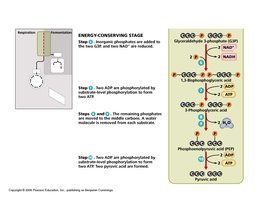
During glycolysis, ATP and NADH are produced through substrate-level phosphorylation and reduction reactions.
4 ATP generated (2 net ATP per glucose after subtracting 2 used).
2 NADH produced per glucose molecule.
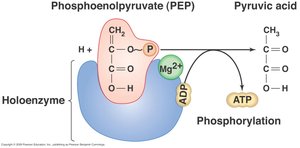
Substrate-level phosphorylation occurs in steps 7 and 10.
Transition Step (Intermediate Step)
Conversion of Pyruvate to Acetyl-CoA
Before entering the Krebs cycle, pyruvate undergoes decarboxylation to form acetyl coenzyme A (acetyl-CoA), releasing carbon dioxide.
NAD+ is reduced to NADH (2 NADH per glucose).
Reducing power is generated in this step.
Krebs Cycle (Citric Acid Cycle, TCA Cycle)
Features and Steps
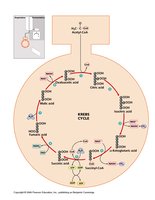
The Krebs cycle is a cyclic series of 8 reactions that regenerate oxaloacetic acid (OAA). Acetyl-CoA combines with OAA to form citric acid in the first step.
Produces reducing power: 6 NADH and 2 FADH2 per glucose.
Produces ATP: 2 ATP per glucose.
Electron Transport Chain (ETC)
Structure and Function
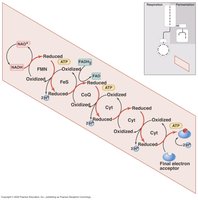
The ETC is a series of electron carriers embedded in membranes (inner mitochondrial membrane in eukaryotes, plasma membrane in prokaryotes) that transfer electrons to the final electron acceptor.
Carriers include: flavoproteins (FMN), cytochromes (cyta, cytb, cytc), and ubiquinones (coenzyme Q).
Electrons from NADH and FADH2 are passed through the chain, ultimately reducing O2 to water.
ATP yield: Each NADH yields 3 ATP; each FADH2 yields 2 ATP.
Chemiosmosis and Proton Motive Force (PMF)
ATP is produced via chemiosmosis, where the ETC creates a proton gradient (PMF) across the membrane. ATP synthase uses this gradient to synthesize ATP.
PMF: Movement of H+ to the outside of the membrane creates an electrochemical gradient.
ATP synthase: Enzyme that uses PMF to generate ATP.
ATP Yield from Aerobic Respiration
Summary Table
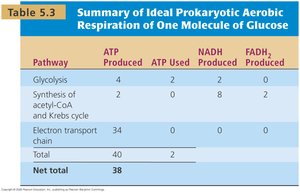
The total ATP yield from aerobic respiration in prokaryotes is 38 ATP per glucose. In eukaryotes, it is closer to 36 ATP due to transport costs.
Pathway | ATP Produced | ATP Used | NADH Produced | FADH2 Produced |
|---|---|---|---|---|
Glycolysis | 4 | 2 | 2 | 0 |
Synthesis of acetyl-CoA and Krebs cycle | 2 | 0 | 8 | 2 |
Electron transport chain | 34 | 0 | 0 | 0 |
Total | 40 | 2 | 8 | 2 |
Net total | 38 |
Anaerobic Respiration
Alternative Electron Acceptors
Some bacteria use molecules other than oxygen as the final electron acceptor in the ETC, such as nitrate, sulfate, or carbonate. The ATP yield is lower than aerobic respiration.
Nitrate reduction: Pseudomonas and Bacillus convert nitrate to nitrite, nitrous oxide, or nitrogen gas.
Sulfate reduction: Some obligate anaerobes convert sulfate to hydrogen sulfide.
Carbonate reduction: Conversion to methane.
Fermentation
Features and Types
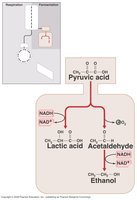
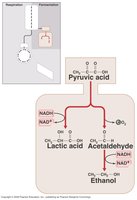
Fermentation is an anaerobic process where an organic molecule (often pyruvate) is the final electron acceptor. It does not require the Krebs cycle or ETC, and only produces ATP via glycolysis.
Restores NAD+ for glycolysis.
Produces 2 ATP per glucose.
Lactic Acid Fermentation
Pyruvic acid is converted to lactic acid by oxidation of NADH. This process is used by Streptococcus, Bacillus, and Lactobacillus, and is important in food production (yogurt, sourdough bread, sauerkraut, pickles).
Alcohol Fermentation
Pyruvic acid is converted to acetaldehyde (releasing CO2), then NADH is oxidized to produce ethanol. Saccharomyces (yeast) is a key organism for this process, used in bread and alcoholic beverages.
Biochemical Tests in Microbiology
Metabolic Pathways for Identification
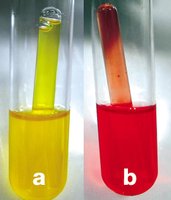
Microbial species can be identified by their metabolic capabilities, such as fermentation of specific carbohydrates. Acid and gas production are common indicators.
Fermentation tests: Detect acid and gas production from sugar fermentation.
Photosynthesis
Definition and Importance
Photosynthesis is the conversion of solar energy into chemical energy, with carbon fixation as a key step. Photosynthetic organisms include plants, algae, and bacteria.
Overall reaction:
Carbon fixation: Conversion of CO2 into organic carbon usable by other organisms.
