 Back
BackMicrobial Metabolism, Growth, and Control: Exam 2 Study Guide
Study Guide - Smart Notes
 Tailored notes based on your materials, expanded with key definitions, examples, and context.
Microbial Metabolism
Metabolism, Catabolism, and Anabolism
Metabolism encompasses all chemical reactions within a cell, divided into catabolic (energy-releasing) and anabolic (energy-consuming) pathways. Catabolic reactions break down molecules and release energy, which is stored in ATP and used for anabolic reactions that build cellular components.
Catabolism: Breakdown of complex molecules, releasing energy.
Anabolism: Synthesis of complex molecules, requiring energy input.
ATP: Serves as the energy currency, linking catabolic and anabolic pathways.
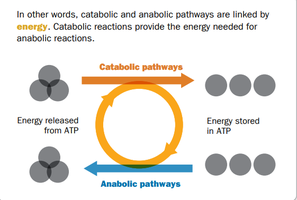
Example: Glucose breakdown (catabolism) releases energy stored in ATP, which is then used for protein synthesis (anabolism). 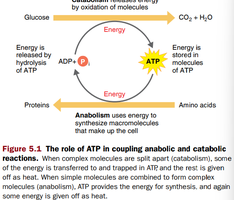
Enzyme Structure and Function
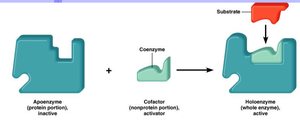
Enzymes are biological catalysts composed of an apoenzyme (protein portion) and a cofactor (nonprotein portion, which may be a metal ion or coenzyme). The holoenzyme is the active form, capable of binding substrates and catalyzing reactions.
Apoenzyme: Inactive protein component.
Cofactor: Activator, can be a metal ion or coenzyme.
Holoenzyme: Active enzyme formed by apoenzyme and cofactor.
Substrate: Reactant molecule that binds to the enzyme.
Factors Influencing Enzyme Activity
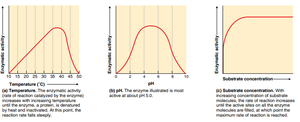
Enzyme activity is affected by temperature, pH, and substrate concentration. Each enzyme has optimal conditions for activity; deviations can lead to denaturation or reduced efficiency.
Temperature: Activity increases with temperature up to a point, then declines due to denaturation.
pH: Each enzyme has an optimal pH; extreme pH can denature the enzyme.
Substrate Concentration: Activity increases with substrate concentration until saturation is reached.
Enzyme Inhibition
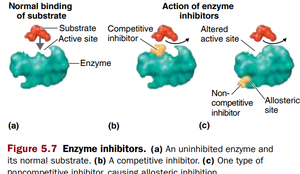
Enzyme inhibitors regulate activity.
Competitive Inhibitors: Bind to the active site, blocking substrate access.
Noncompetitive Inhibitors: Bind elsewhere, altering enzyme shape and function.
Feedback Inhibition: End product inhibits pathway, maintaining homeostasis.
Oxidation-Reduction (Redox) Reactions
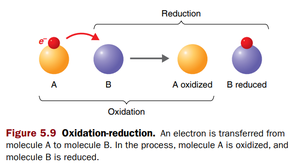
Redox reactions involve electron transfer.
Oxidation: Loss of electrons.
Reduction: Gain of electrons.
Redox reactions are always coupled; one molecule is oxidized, another is reduced.
ATP Generation: Types of Phosphorylation
ATP is generated by three mechanisms:
Substrate-level phosphorylation: Direct transfer of phosphate to ADP.
Oxidative phosphorylation: Uses electron transport chain and chemiosmosis.
Photophosphorylation: Uses light energy in photosynthetic organisms.
Carbohydrate Metabolism: Glycolysis, Krebs Cycle, and ETC
Glycolysis: Glucose (6C) → 2 pyruvate, 2 ATP, 2 NADH (anaerobic).
Krebs Cycle: 2 Acetyl-CoA → 4 CO2, 6 NADH, 2 FADH2, 2 ATP.
Electron Transport Chain (ETC): NADH/FADH2 → ATP via proton gradient.
Oxidative Phosphorylation and Chemiosmosis
Energetic electrons from NADH pass through the ETC, pumping protons across the membrane, creating a proton motive force. ATP synthase uses this gradient to synthesize ATP. Equation:
Cellular Locations of Metabolic Pathways
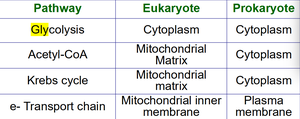
Glycolysis: Cytoplasm (both prokaryotes and eukaryotes).
Krebs Cycle: Cytoplasm (prokaryotes), mitochondrial matrix (eukaryotes).
ETC: Plasma membrane (prokaryotes), mitochondrial inner membrane (eukaryotes).
Pathway | Eukaryote | Prokaryote |
|---|---|---|
Glycolysis | Cytoplasm | Cytoplasm |
Acetyl-CoA | Mitochondrial Matrix | Cytoplasm |
Krebs cycle | Mitochondrial matrix | Cytoplasm |
e- Transport chain | Mitochondrial inner membrane | Plasma membrane |
Aerobic Respiration, Anaerobic Respiration, and Fermentation
Aerobic Respiration: Terminal electron acceptor is O2; high ATP yield.
Anaerobic Respiration: Terminal electron acceptor is inorganic (not O2); lower ATP yield.
Fermentation: Organic molecule as electron acceptor; ATP only from glycolysis.
Biochemical Tests for Bacterial Identification
Protein Test: Detects amino acid metabolism.
Fermentation Test: Detects carbohydrate fermentation.
H2S Production: Detects sulfur metabolism.
Photosynthesis: Light and Dark Reactions
Light Reactions: Use light energy to produce ATP and NADPH.
Calvin Cycle (Dark Reactions): Use ATP and NADPH to reduce CO2 to sugar.
Amphibolic Pathways
Amphibolic pathways function in both anabolism and catabolism, bridging breakdown and synthesis of biomolecules.
Microbial Growth
Classification by Temperature
Microorganisms are classified by their preferred growth temperature:
Psychrophiles: -5°C to 15°C
Mesophiles: 25°C to 45°C
Thermophiles: 45°C to 70°C
Hyperthermophiles: 70°C to 110°C
Osmotic Pressure and Microbial Growth
Osmotic pressure affects cell water balance. High salt or sugar concentrations cause plasmolysis, inhibiting growth.
Classification by Oxygen Requirements
Aerobes: Require oxygen.
Facultative Anaerobes: Can grow with or without oxygen.
Aerotolerant Anaerobes: Tolerate oxygen but do not use it.
Microaerophiles: Require low oxygen concentrations.
Culture Media Types
Chemically Defined: Exact composition known.
Complex: Composition varies.
Selective: Inhibits unwanted organisms.
Differential: Distinguishes among organisms.
Enrichment: Encourages growth of specific microbes.
Colony, CFU, and Pure Culture
Colony: Population from a single cell.
CFU: Colony-forming unit.
Pure Culture: Clones of bacteria.
Bacterial Growth and Binary Fission
Bacterial growth is an increase in cell number via binary fission, an exponential process.
Binary Fission: Cell elongates, DNA replicates, plasma membrane constricts, cross-wall forms, cells separate.
Generation Time: Time required for population to double.
Equation: where n = number of generations 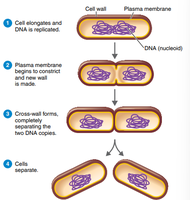
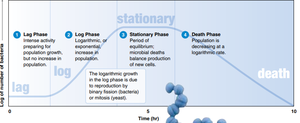
Phases of Microbial Growth
Lag Phase: Preparation, no increase in population.
Log Phase: Exponential growth.
Stationary Phase: Equilibrium, cell division equals cell death.
Death Phase: Population declines.
Measuring Microbial Growth
Direct Methods: Plate count, filtration, MPN, microscopic count.
Indirect Methods: Turbidity, metabolic activity, dry weight.
Standard Plate Count Method
Serial dilution and plating are used to estimate viable cell numbers. Calculation: Number of colonies × reciprocal of dilution × volume plated = bacteria/ml 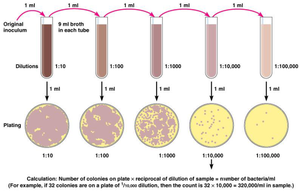
Control of Microbial Growth
Definitions in Microbial Control
Sterilization: Removal of all microorganisms.
Disinfection: Destruction of harmful microorganisms.
Antisepsis: Disinfection of living tissue.
Degerming: Mechanical removal of microbes.
Sanitization: Lowering microbial counts to safe levels.
Biocide/Germicide: Kills microorganisms.
Bacteriostasis: Inhibits growth without killing.
Asepsis: Absence of pathogens.
Factors Influencing Microbial Death
Microbial Load: Initial number of organisms.
Time, concentration, environment, and resistance.
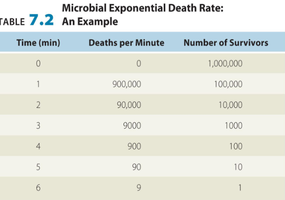
Time (min) | Deaths per Minute | Number of Survivors |
|---|---|---|
0 | 0 | 1,000,000 |
1 | 900,000 | 100,000 |
2 | 90,000 | 10,000 |
3 | 9,000 | 1,000 |
4 | 900 | 100 |
5 | 90 | 10 |
6 | 9 | 1 |
Mechanisms of Antibiotic Resistance
Bacteria acquire resistance through mutation and horizontal gene transfer. Mechanisms include blocking entry, inactivation by enzymes, alteration of target molecules, and efflux of antibiotics. 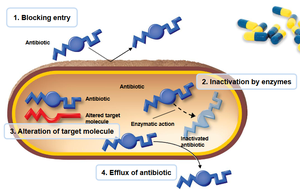
Antimicrobial Drugs
Problems of Chemotherapy for Eukaryotic Pathogens and Viruses
Eukaryotic pathogens and viruses are similar to human cells, making selective toxicity difficult and increasing risk of host damage.
Key Terms
Spectrum of Activity: Range of bacteria affected by a drug.
Broad-spectrum: Effective against many groups.
Superinfection: Overgrowth of drug-resistant microbes.
Selective Toxicity: Kills microbes without harming host.
Antibiotic: Microbe-produced substance inhibiting other microbes.
Synthetic Drug: Chemically synthesized agent.
Modes of Action of Antimicrobial Drugs
Inhibition of cell wall synthesis
Inhibition of protein synthesis
Inhibition of nucleic acid replication and transcription
Injury to plasma membrane
Inhibition of essential metabolite synthesis
Antibiotic Resistance: Public Health Concerns
Misuse and overuse of antibiotics select for resistant mutants, which spread via horizontal gene transfer. This is a serious public health and ecological problem. Strategies to reverse resistance:
Develop new antibiotics
Track resistance data
Restrict antimicrobial use
Use narrow-spectrum antibiotics
Use antimicrobial cocktails
----------------------------------------
