 Back
BackMicrobial Metabolism: Oxidation-Reduction, ATP Generation, and Carbohydrate Catabolism
Study Guide - Smart Notes
 Tailored notes based on your materials, expanded with key definitions, examples, and context.
Microbial Metabolism
Oxidation-Reduction Reactions
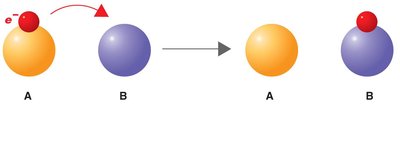
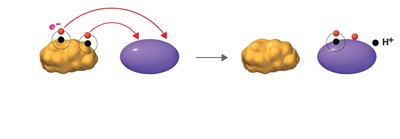
Oxidation-reduction (redox) reactions are fundamental to microbial metabolism, involving the transfer of electrons between molecules. These reactions are paired: one molecule is oxidized (loses electrons), while another is reduced (gains electrons). In biological systems, electrons are often transferred along with hydrogen atoms, and biological oxidations are frequently dehydrogenations.
Oxidation: Removal of electrons from a molecule.
Reduction: Addition of electrons to a molecule.
Redox Reaction: An oxidation reaction paired with a reduction reaction.
Dehydrogenation: Removal of hydrogen atoms (and their electrons) from a molecule.
Electron Carriers and NAD+/NADH
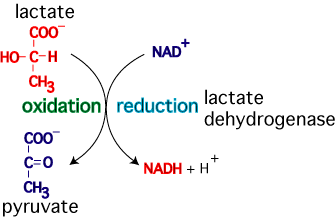
Electron carriers such as NAD+ (nicotinamide adenine dinucleotide) play a crucial role in redox reactions. NAD+ accepts electrons (and a proton) to become NADH, which can then donate electrons in other metabolic pathways.
NAD+: Oxidized form, accepts electrons.
NADH: Reduced form, donates electrons.
Example: In the conversion of lactate to pyruvate, NAD+ is reduced to NADH.
ATP Generation and Phosphorylation
ATP: The Energy Currency
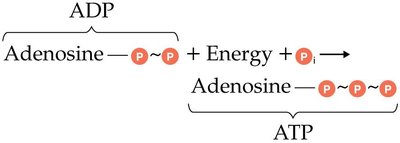
ATP (adenosine triphosphate) is the primary molecule for energy storage and transfer in cells. It is generated by the phosphorylation of ADP (adenosine diphosphate) with the input of energy.
ATP Formation: ADP + Pi + Energy → ATP
Phosphorylation: Addition of a phosphate group to ADP.
Equation:
Types of Phosphorylation
Substrate-level phosphorylation: ATP is generated when a high-energy phosphate group is directly transferred from a substrate to ADP.
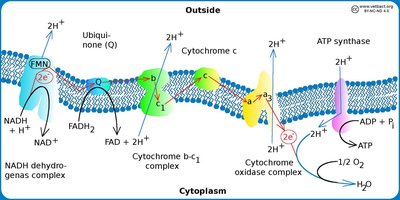
Oxidative phosphorylation: Electrons are transferred through an electron transport chain, releasing energy to generate ATP.
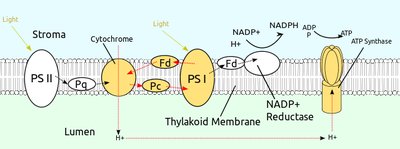
Photophosphorylation: Occurs in photosynthetic cells; light energy is used to generate ATP.
Carbohydrate Catabolism: Respiration and Fermentation
Overview of Metabolic Pathways
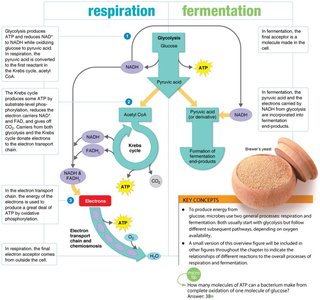
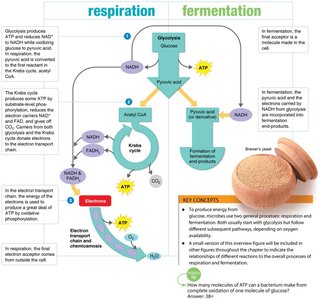
The breakdown of carbohydrates to release energy occurs in three principal stages: glycolysis, the Krebs cycle, and the electron transport chain. These pathways are central to both respiration and fermentation.
Glycolysis: Oxidation of glucose to pyruvic acid, producing ATP and NADH.
Krebs Cycle: Further oxidation of pyruvic acid, generating more NADH, FADH2, and ATP.
Electron Transport Chain: Electrons from NADH and FADH2 are transferred through a series of carriers, resulting in ATP production.
Glycolysis
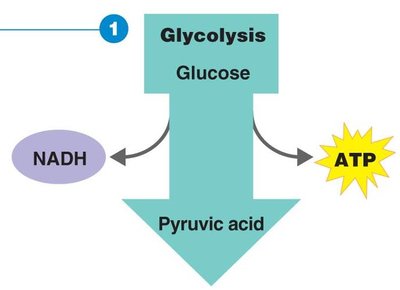
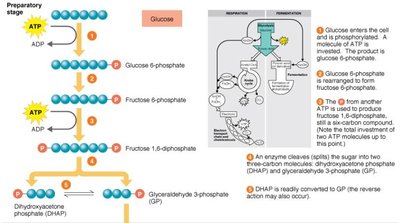
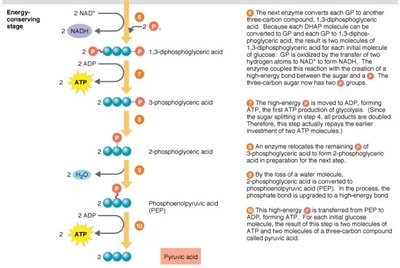
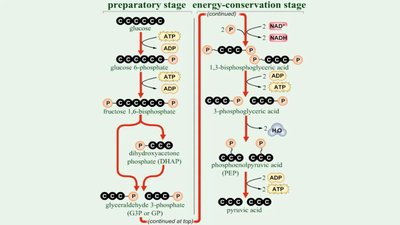
Glycolysis is the first stage of carbohydrate catabolism, converting glucose into pyruvic acid. It consists of two main phases: the preparatory stage and the energy-conserving stage.
Preparatory Stage: 2 ATP are used to split glucose into two 3-carbon molecules.
Energy-Conserving Stage: The 3-carbon molecules are oxidized, producing 4 ATP and 2 NADH, resulting in a net gain of 2 ATP per glucose.
Krebs Cycle (Citric Acid Cycle)
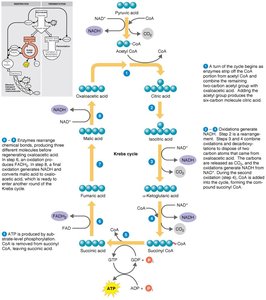
The Krebs cycle, also known as the citric acid cycle or tricarboxylic acid cycle (TCA), is a series of reactions that further oxidize pyruvic acid, producing NADH, FADH2, ATP, and CO2.
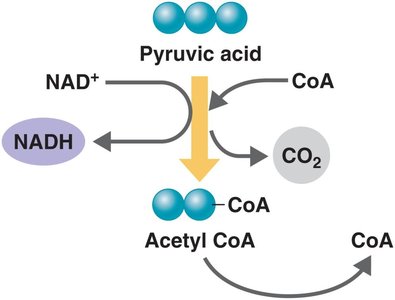
Acetyl-CoA Formation: Pyruvic acid is converted to acetyl-CoA, releasing NADH and CO2.
Cycle Reactions: Acetyl-CoA enters the cycle, generating NADH, FADH2, ATP, and CO2 through a series of enzyme-catalyzed steps.
Electron Transport Chain (ETC)
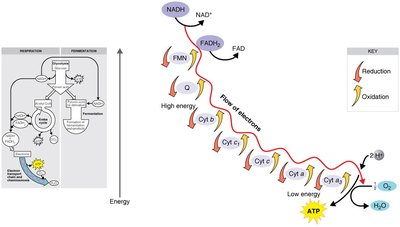
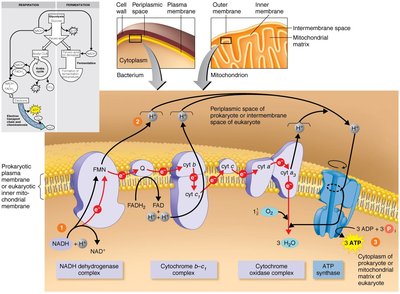
The electron transport chain is a series of membrane-bound carriers that transfer electrons from NADH and FADH2 to a final electron acceptor, generating ATP through oxidative phosphorylation.
Electron Flow: Electrons move from high-energy carriers to lower-energy carriers, releasing energy.
ATP Synthesis: Energy released is used to pump protons across the membrane, creating a gradient that drives ATP synthesis.
Final Electron Acceptor: In aerobic respiration, O2 is the final acceptor; in anaerobic respiration, other molecules are used.
ATP Yield from Respiration
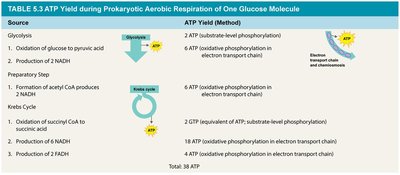
The total ATP yield from aerobic respiration of one glucose molecule in prokaryotes is typically 38 ATP. Each NADH can produce 3 ATP, and each FADH2 can produce 2 ATP via the electron transport chain.
Glycolysis: 2 ATP (substrate-level), 6 ATP (oxidative phosphorylation).
Krebs Cycle: 2 ATP (substrate-level), 22 ATP (oxidative phosphorylation).
Total: 38 ATP per glucose.
Source | ATP Yield (Method) |
|---|---|
Glycolysis | 2 ATP (substrate-level), 6 ATP (oxidative phosphorylation) |
Preparatory Step | 6 ATP (oxidative phosphorylation) |
Krebs Cycle | 2 ATP (substrate-level), 18 ATP (oxidative phosphorylation), 4 ATP (oxidative phosphorylation) |
Total | 38 ATP |
Aerobic vs Anaerobic Respiration
Aerobic respiration uses molecular oxygen (O2) as the final electron acceptor in the electron transport chain, yielding more energy. Anaerobic respiration uses other molecules as the final electron acceptor and yields less energy, as only part of the Krebs cycle operates under anaerobic conditions.
Aerobic Respiration: Final electron acceptor is O2.
Anaerobic Respiration: Final electron acceptor is not O2 (e.g., nitrate, sulfate).
Energy Yield: Anaerobic respiration yields less ATP than aerobic respiration.
Example: Facultative anaerobes can switch between aerobic and anaerobic respiration depending on oxygen availability.
