 Back
BackChapter Three and Four
Study Guide - Smart Notes
 Tailored notes based on your materials, expanded with key definitions, examples, and context.
Microbial Metabolism
Overview of Metabolism
Microbial metabolism encompasses all the chemical reactions that occur within a microorganism, enabling it to grow, reproduce, maintain its structures, and respond to environments. Metabolism is divided into two main processes: catabolism and anabolism.
Catabolism: The breakdown of complex molecules into simpler ones, releasing energy that is captured in the form of ATP.
Anabolism: The synthesis of complex molecules from simpler ones, requiring an input of energy, usually from ATP.
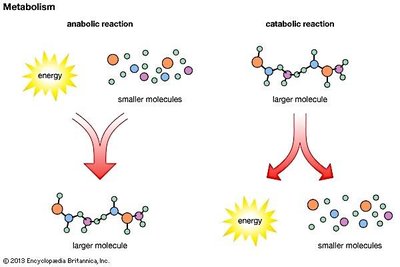
Key requirements for metabolism:
Water
Carbon and other nutrients
Free energy (energy available to do work)
Reducing power (source of electrons)
Metabolic Types by Energy Source
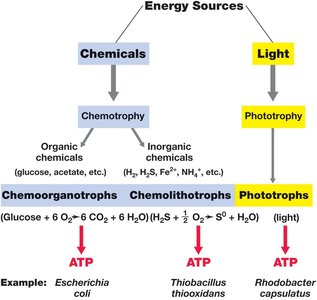
Microorganisms are classified based on their energy and carbon sources:
Chemotrophs: Obtain energy from chemicals.
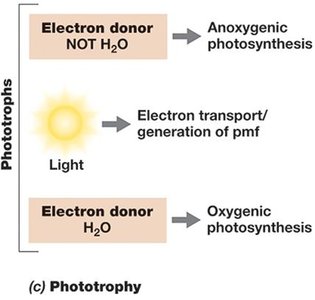
Phototrophs: Obtain energy from light.
Chemoorganotrophs: Use organic chemicals as energy sources (e.g., Escherichia coli).
Chemolithotrophs: Use inorganic chemicals (e.g., Thiobacillus thiooxidans).
Phototrophs: Use light (e.g., Rhodobacter capsulatus).
Redox Reactions and Energy Conservation
Reducing Power and Electron Flow
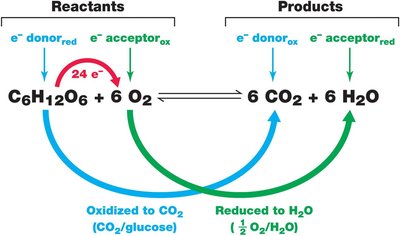
Energy generation in cells is closely tied to the transfer of electrons in oxidation-reduction (redox) reactions. These reactions involve:
Electron donor: The molecule that loses electrons (is oxidized).
Electron acceptor: The molecule that gains electrons (is reduced).
OIL RIG: Oxidation Is Loss, Reduction Is Gain (of electrons).
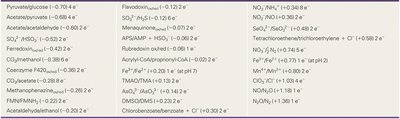
The Redox Tower
The redox tower is a visual representation of the reduction potentials of various redox couples. The further electrons fall down the tower, the more energy is released.
Strongest electron donors are at the top (most negative E0').
Strongest electron acceptors are at the bottom (most positive E0').
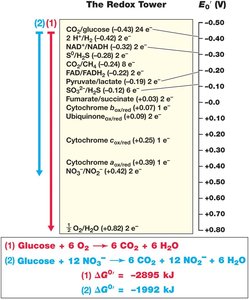
Example reactions and their free energy changes are shown at the bottom of the tower.
Electron Carriers
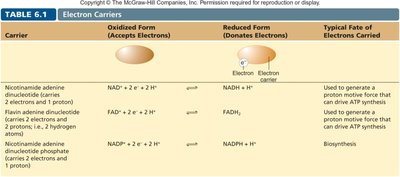
Electron carriers are molecules that shuttle electrons during metabolic reactions, representing reducing power. Common carriers include:
NAD+/NADH
NADP+/NADPH
FAD/FADH2
Precursor Metabolites
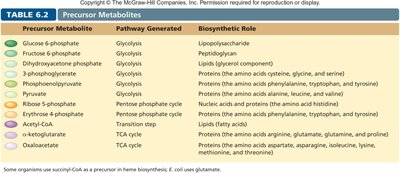
Precursor metabolites are intermediates in catabolic pathways that serve as building blocks for biosynthesis (anabolism). For example, pyruvate can be converted into amino acids such as alanine, leucine, or valine.
ATP Generation and Enzyme Function
Mechanisms of ATP Generation
ATP is generated in cells by three main mechanisms:
Substrate-level phosphorylation: Direct transfer of a phosphate group to ADP from a high-energy substrate.
Oxidative phosphorylation: ATP synthesis driven by the proton motive force generated by electron transport chains.
Photophosphorylation: Light energy is used to generate a proton motive force for ATP synthesis.
Role of Enzymes
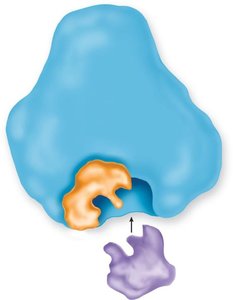
Enzymes are biological catalysts that accelerate chemical reactions by lowering the activation energy. They are highly specific and typically proteins (some are RNAs).
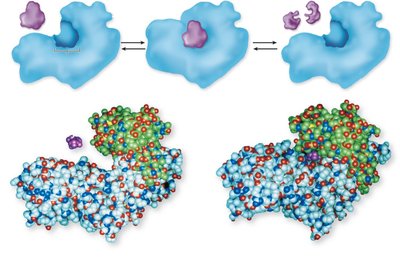
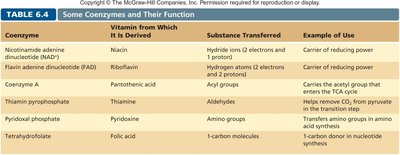
Enzymes may require cofactors (inorganic ions like Mg2+, Zn2+) or coenzymes (organic molecules, often derived from vitamins) to function.
Central Metabolic Pathways
Overview of Catabolism
Central metabolic pathways include glycolysis, the pentose phosphate pathway, and the tricarboxylic acid (TCA) cycle. These pathways generate ATP, reducing power, and precursor metabolites.


Comparison of Central Metabolic Pathways
Pathway | Characteristics |
|---|---|
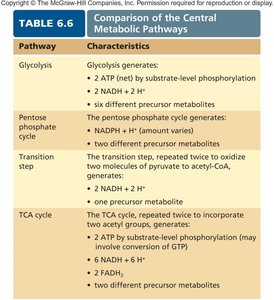
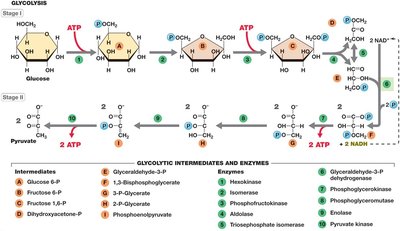
Glycolysis | 2 ATP (net) by substrate-level phosphorylation, 2 NADH + 2 H+, six different precursor metabolites |
Pentose phosphate cycle | NADPH + H+ (amount varies), two different precursor metabolites |
Transition step | 2 NADH + 2 H+, one precursor metabolite |
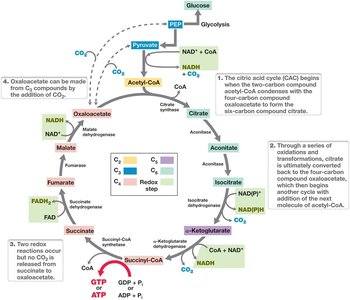
TCA cycle | 2 ATP (or GTP), 6 NADH + 6 H+, 2 FADH2, two different precursor metabolites |
Respiration and Fermentation
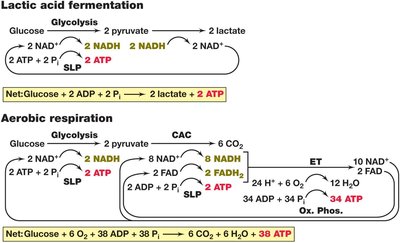
Respiration involves transferring electrons from glucose to an electron transport chain, generating a proton motive force for ATP synthesis. If cells cannot respire, fermentation regenerates NAD+ by reducing pyruvate or its derivatives, allowing glycolysis to continue.
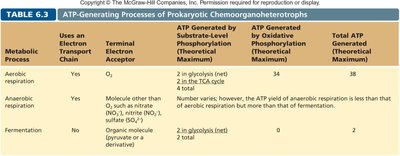
ATP Yield in Different Pathways
Metabolic Process | Uses Electron Transport Chain | Terminal Electron Acceptor | ATP by Substrate-Level Phosphorylation | ATP by Oxidative Phosphorylation | Total ATP (Theoretical Maximum) |
|---|---|---|---|---|---|
Aerobic respiration | Yes | O2 | 2 in glycolysis (net), 2 in TCA cycle | 34 | 38 |
Anaerobic respiration | Yes | Molecule other than O2 | Varies | Varies | <38 |
Fermentation | No | Organic molecule | 2 in glycolysis (net) | 0 | 2 |
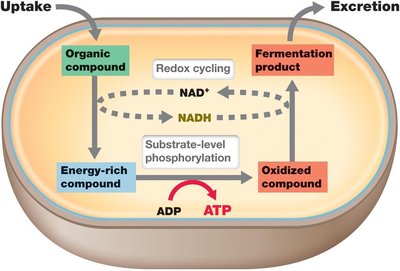
Fermentation Pathways and Products
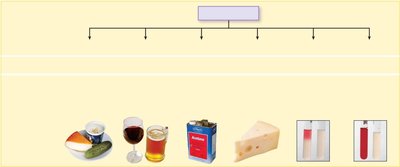
Fermentation end products are diverse and useful for microbial identification and industrial applications. Examples include lactic acid, ethanol, butyric acid, and propionic acid.
Citric Acid Cycle and Glyoxylate Cycle
Citric Acid Cycle (TCA/Krebs Cycle)
The TCA cycle oxidizes pyruvate to CO2, regenerates oxaloacetate, and provides intermediates for biosynthesis.
Glyoxylate Cycle
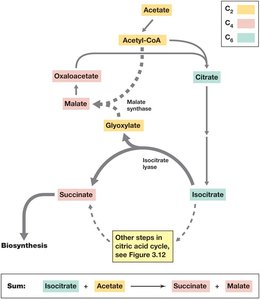
The glyoxylate cycle enables the catabolism of C2 compounds like acetate, regenerating oxaloacetate for biosynthesis.
Electron Transport Chain and Proton Motive Force
Electron Transport Chain (ETC)
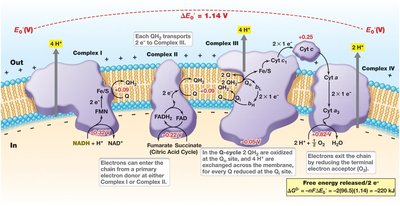
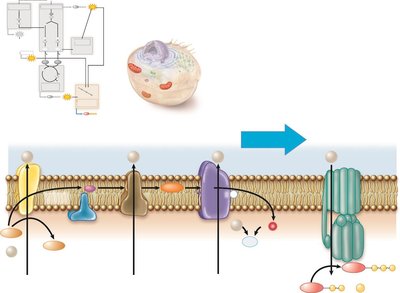
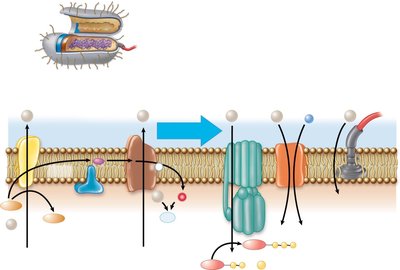
The ETC is a series of protein complexes that transfer electrons from NADH and FADH2 to a terminal electron acceptor, generating a proton gradient across the membrane (proton motive force).
ATP Synthase
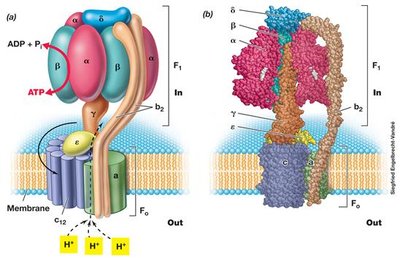
ATP synthase uses the proton motive force to synthesize ATP from ADP and inorganic phosphate.
Metabolic Diversity and Oxygen Relationships
Metabolic Diversity
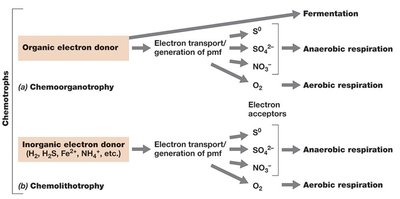
Microorganisms display a wide range of metabolic strategies, including aerobic and anaerobic respiration, fermentation, chemolithotrophy, and phototrophy.
Respiration in E. coli
Escherichia coli can perform aerobic respiration, anaerobic respiration, and fermentation, depending on environmental conditions and available electron acceptors.
Anabolism: Biosynthesis of Cellular Macromolecules
CO2 and N2 Fixation
Cells require carbon and nitrogen for biosynthesis. Atmospheric CO2 and N2 must be chemically reduced for assimilation, processes that require ATP and reducing power.
CO2 fixation: Incorporation of CO2 into organic molecules (e.g., Calvin cycle).
N2 fixation: Conversion of atmospheric nitrogen to ammonia by nitrogenase.
Example equation for ATP generation by substrate-level phosphorylation:
Example equation for aerobic respiration:
