 Back
Microbial Metabolism: Pathways, Enzymes, and Energy Production
Study Guide - Smart Notes
 Tailored notes based on your materials, expanded with key definitions, examples, and context.
Microbial Metabolism
Introduction to Metabolism
Metabolism encompasses all chemical reactions occurring within a cell, divided into two main types: catabolic (exergonic) and anabolic (endergonic) reactions. Catabolic reactions release energy by breaking down molecules, while anabolic reactions require energy to build complex molecules. These reactions are coupled in the cell, with energy released from catabolic processes used to drive anabolic processes via energy-carrier molecules.
Catabolic (Exergonic) Reactions: Release energy; spontaneous. Example: breakdown of glucose.
Anabolic (Endergonic) Reactions: Require energy input; build cellular molecules.
Energy Coupling: Energy from exergonic reactions is stored in carrier molecules and used for endergonic reactions.
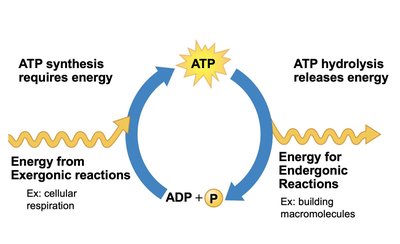
Energy-Carrier Molecules
Energy-carrier molecules, such as ATP and electron carriers, are synthesized at the site of exergonic reactions and store energy for later use in endergonic reactions.
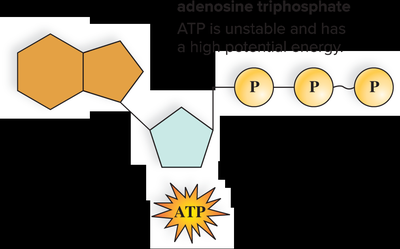
ATP (Adenosine Triphosphate): The primary energy currency of the cell. ATP is generated from ADP by the addition of a phosphate group, storing energy. Hydrolysis of ATP releases energy for cellular work.
Electron Carriers: Molecules like NAD+, NADP+, and FAD accept electrons (and H+) during catabolic reactions, becoming NADH, NADPH, and FADH2 (high-energy forms).
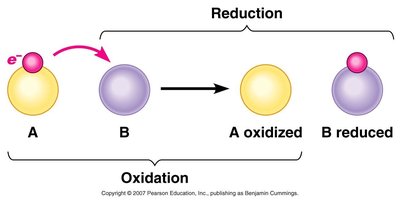
Oxidation-Reduction (Redox) Reactions
Redox reactions involve the transfer of electrons and hydrogen ions. Oxidation is the loss of electrons/H+, while reduction is the gain of electrons/H+. These reactions are essential for energy transfer in metabolism.
Oxidized Forms: NAD+, NADP+, FAD (low energy)
Reduced Forms: NADH, NADPH, FADH2 (high energy)
Enzymes and Metabolic Pathways
Enzyme Structure and Function
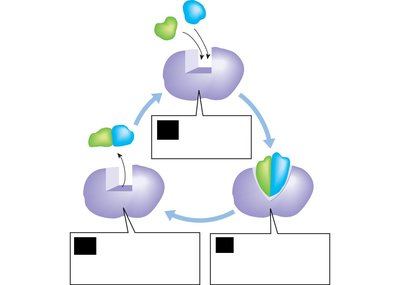
Enzymes are biological catalysts, usually proteins, that speed up chemical reactions by lowering activation energy. They are highly specific for their substrates and reactions, and their activity is regulated by the cell.
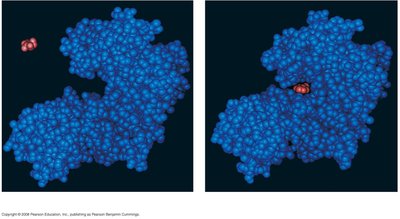
Active Site: The region on the enzyme where substrates bind and reactions occur.
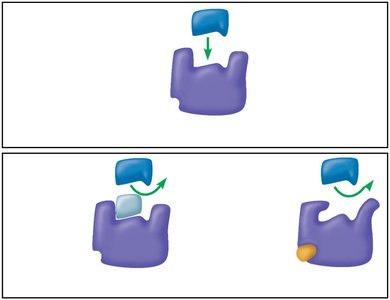
Induced Fit Model: Substrate binding induces a conformational change in the enzyme, facilitating the reaction.
Cofactors and Coenzymes: Non-protein helpers required by some enzymes for activity.
Metabolic Pathways
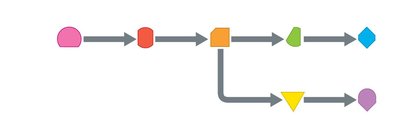
Metabolic pathways are sequences of enzyme-catalyzed reactions where the product of one reaction becomes the substrate for the next. This organization allows for efficient regulation and energy extraction.
Pathway Regulation: Cells regulate enzyme synthesis and activity to control metabolic flow.
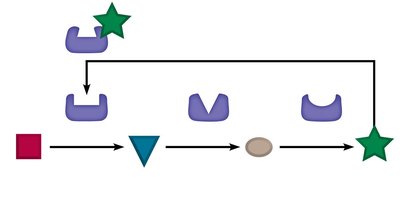
Feedback Inhibition: End products of a pathway inhibit an earlier enzyme, preventing overproduction.
Factors Affecting Enzyme Activity
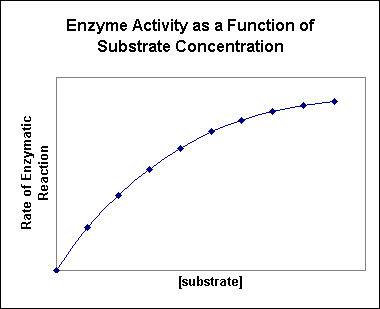
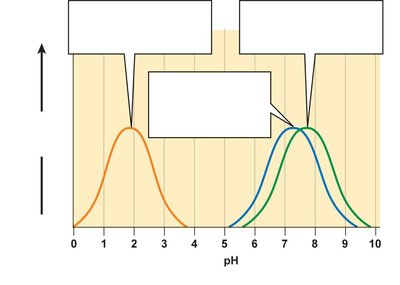
Enzyme activity is influenced by substrate concentration, pH, temperature, and the presence of inhibitors or cofactors.
Substrate Concentration: Activity increases with substrate concentration until saturation is reached.
pH: Each enzyme has an optimal pH; deviations can denature the enzyme.
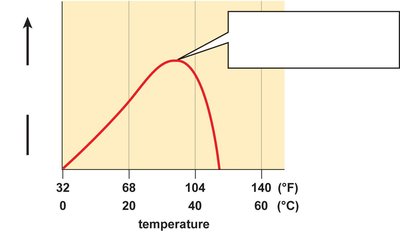
Temperature: Each enzyme has an optimal temperature; high temperatures denature enzymes, low temperatures slow reactions.
Inhibitors: Competitive inhibitors bind the active site; non-competitive inhibitors bind elsewhere, altering enzyme function.
Carbohydrate Catabolism
Overview of Cellular Respiration and Fermentation
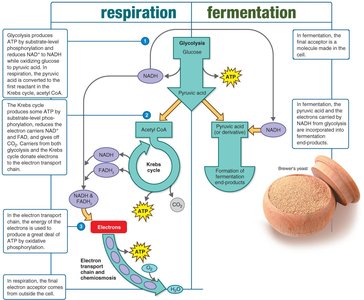
Microorganisms extract energy from carbohydrates, primarily glucose, through cellular respiration or fermentation. Cellular respiration includes glycolysis, the Krebs cycle, and the electron transport chain, while fermentation is an anaerobic process that yields less ATP.
Cellular Respiration: Aerobic process; final electron acceptor is oxygen.
Fermentation: Anaerobic; final electron acceptor is an organic molecule.
Stages of Cellular Respiration
Glycolysis: Occurs in the cytoplasm; glucose is split into 2 pyruvate, yielding 2 ATP and 2 NADH.
Does not require oxygen (anaerobic).
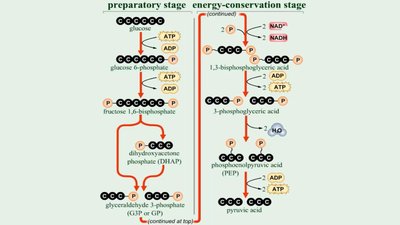
Pyruvate Oxidation (Transition Step): Pyruvate is converted to Acetyl CoA, producing NADH and CO2.
Citric Acid Cycle (Krebs Cycle): Acetyl CoA is oxidized, generating NADH, FADH2, ATP, and CO2.
Occurs in the mitochondrial matrix (eukaryotes) or cytoplasm (prokaryotes).
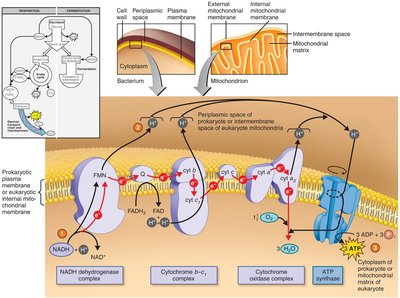
Oxidative Phosphorylation: NADH and FADH2 donate electrons to the electron transport chain, driving ATP synthesis via chemiosmosis. Oxygen is the final electron acceptor, forming water.
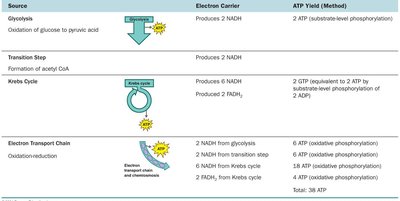
ATP Yield in Prokaryotic Aerobic Respiration
Source | Electron Carrier | ATP Yield (Method) |
|---|---|---|
Glycolysis | 2 NADH | 2 ATP (substrate-level phosphorylation) |
Transition Step | 2 NADH | |
Krebs Cycle | 6 NADH, 2 FADH2 | 2 GTP (equivalent to 2 ATP by substrate-level phosphorylation) |
Electron Transport Chain | All NADH and FADH2 | 34 ATP (oxidative phosphorylation) |
Total | ~38 ATP |
Anaerobic Respiration
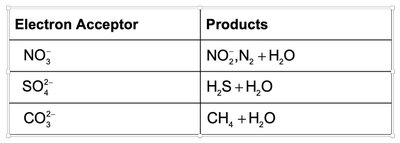
In anaerobic respiration, the final electron acceptor is not oxygen but another inorganic molecule, such as nitrate, sulfate, or carbonate. This process yields less ATP than aerobic respiration.
Electron Acceptor | Products |
|---|---|
NO3- | NO2-, N2, H2O |
SO42- | H2S, H2O |
CO32- | CH4, H2O |
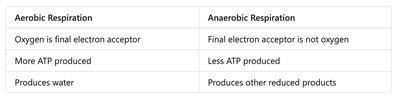
Aerobic Respiration | Anaerobic Respiration |
|---|---|
Oxygen is final electron acceptor | Final electron acceptor is not oxygen |
More ATP produced | Less ATP produced |
Produces water | Produces other reduced products |
Fermentation
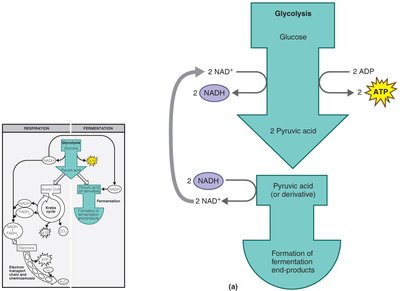
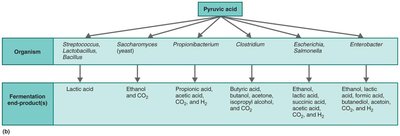
Fermentation is an anaerobic process where cells only perform glycolysis, followed by conversion of pyruvate to various end products. It regenerates NAD+ for glycolysis but produces only small amounts of ATP.
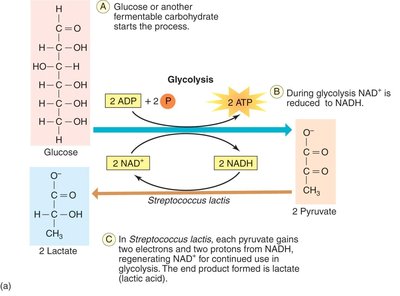
Lactic Acid Fermentation: Pyruvate is reduced to lactic acid. Occurs in animals (muscle cells) and some bacteria (e.g., yogurt production).
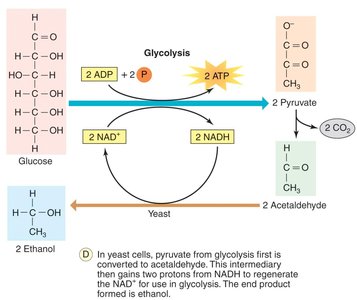
Ethanol Fermentation: Pyruvate is converted to ethanol and CO2. Occurs in yeast (bread, alcoholic beverages).
Industrial Uses of Fermentation
Fermentation End-product(s) | Industrial or Commercial Use | Starting Material | Microorganism |
|---|---|---|---|
Ethanol | Beer, Wine | Starch, sugar | Saccharomyces cerevisiae |
Acetic Acid | Vinegar | Ethanol | Acetobacter |
Lactic Acid | Cheese, yogurt | Milk | Lactobacillus, Streptococcus |
Propionic Acid and CO2 | Swiss cheese | Lactic acid | Propionibacterium freudenreichii |
Acetone and Butanol | Pharmaceutical, industrial uses | Molasses | Clostridium acetobutylicum |
Methane | Fuel | Acetic acid | Methanosarcina |
Biochemical Tests and Bacterial Identification
Metabolic Activities as Diagnostic Tools
Different bacteria produce unique enzymes, allowing microbiologists to identify species by testing for specific metabolic activities. Common tests include:
Fermentation Tests: Detect acid and gas production from carbohydrates.
Oxidase Test: Detects cytochrome oxidase enzyme.
H2S Test: Detects hydrogen sulfide production.
These tests are essential for distinguishing bacterial species in clinical and research settings.
