 Back
Microbial Metabolism: Pathways of Energy Production and Catabolism
Study Guide - Smart Notes
 Tailored notes based on your materials, expanded with key definitions, examples, and context.
Carbohydrate Catabolism
Overview of Glucose Metabolism
Microorganisms primarily oxidize carbohydrates, especially glucose, to generate energy for anabolic reactions. Glucose catabolism occurs via two main pathways: cellular respiration and fermentation. Cellular respiration involves glycolysis, the Krebs cycle, and the electron transport chain, resulting in the complete oxidation of glucose to carbon dioxide and water. Fermentation, in contrast, involves glycolysis followed by the conversion of pyruvic acid into various organic waste products.
Cellular Respiration: Complete oxidation of glucose, high ATP yield.
Fermentation: Partial oxidation, lower ATP yield, regenerates NAD+ for glycolysis.
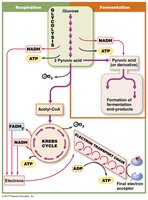
Glycolysis
Pathway and Energy Yield
Glycolysis is a universal pathway occurring in the cytoplasm of most cells. It splits one six-carbon glucose molecule into two three-carbon pyruvic acid molecules. The process involves substrate-level phosphorylation, resulting in a net gain of 2 ATP, 2 NADH, and 2 pyruvic acid molecules per glucose.
Location: Cytoplasm
Net Products (per glucose): 2 ATP, 2 NADH, 2 pyruvic acid
Purpose: Generate ATP and NADH, provide intermediates for further metabolism
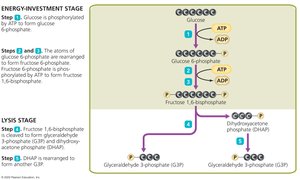
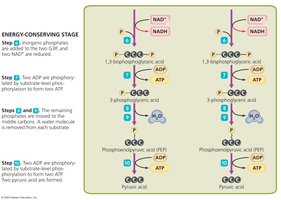
Substrate-Level Phosphorylation
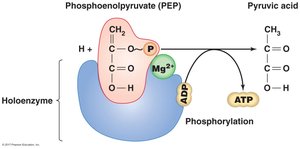
Substrate-level phosphorylation is the direct transfer of a phosphate group from a substrate to ADP, forming ATP. This occurs at two steps in glycolysis and is catalyzed by specific enzymes such as pyruvate kinase.
Key Enzyme: Pyruvate kinase
Significance: Direct ATP generation without the electron transport chain
Fermentation
Purpose and Mechanism
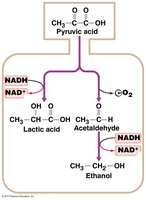
Fermentation occurs when cells cannot completely oxidize glucose due to the absence of a functional electron transport chain or oxygen. Its essential function is to regenerate NAD+ from NADH, allowing glycolysis to continue. Fermentation results in the partial oxidation of sugar, producing organic waste products such as lactic acid or ethanol.
Regenerates NAD+: Essential for continued glycolysis
Less efficient: Most energy remains in fermentation products
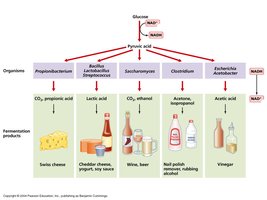
Products: Lactic acid, ethanol, acetic acid, etc.
Examples of Fermentation
Lactic Acid Fermentation: Pyruvic acid is reduced to lactic acid (e.g., in muscle cells, Lactobacillus species).
Ethanol Fermentation: Pyruvic acid is decarboxylated to acetaldehyde, then reduced to ethanol (e.g., in yeast).
Cellular Respiration
Intermediate Step: Synthesis of Acetyl-CoA
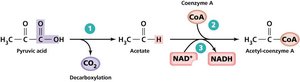
Before entering the Krebs cycle, pyruvic acid is converted to acetyl-CoA in the mitochondria (eukaryotes) or cytoplasm (prokaryotes). This step produces NADH and releases CO2.
Products (per glucose): 2 acetyl-CoA, 2 NADH, 2 CO2
The Krebs Cycle (Citric Acid Cycle, TCA Cycle)
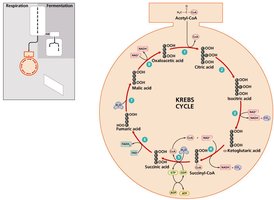
The Krebs cycle completes the oxidation of acetyl-CoA, transferring energy to NAD+ and FAD as NADH and FADH2. It occurs in the cytoplasm of prokaryotes and the mitochondrial matrix of eukaryotes.
Inputs: Acetyl-CoA
Outputs (per turn): 1 GTP (ATP equivalent), 3 NADH, 1 FADH2, 2 CO2
Total ATP equivalents per turn: 12
Electron Transport Chain (ETC) and Chemiosmosis
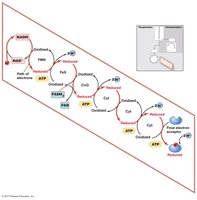
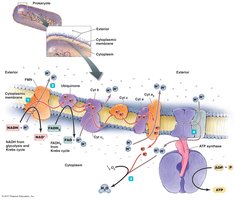
The ETC is a series of membrane-bound carriers that transfer electrons from NADH and FADH2 to a final electron acceptor (O2 in aerobic respiration). The energy released pumps protons across the membrane, creating a proton gradient (proton motive force) used by ATP synthase to generate ATP (oxidative phosphorylation).
Location: Mitochondrial cristae (eukaryotes), cytoplasmic membrane (prokaryotes)
Final electron acceptor: O2 (aerobic), other molecules (anaerobic)
ATP yield: ~36 ATP (eukaryotes), ~38 ATP (prokaryotes) per glucose (theoretical maximum)
Inhibitors and Uncouplers of Oxidative Phosphorylation
Metabolic poisons have been used to study chemiosmosis:
Inhibitors: Block electron flow (e.g., cyanide, azide, carbon monoxide, antimycin A).
Uncouplers: Disrupt the proton gradient, preventing ATP synthesis without affecting electron flow (e.g., dinitrophenol, dicumarol, salicylanilide).
Type | Mechanism | Examples |
|---|---|---|
Inhibitor | Stops electron flow | Cyanide, azide, CO, antimycin A |
Uncoupler | Dissipates proton gradient | Dinitrophenol, dicumarol |
Catabolism of Other Molecules
Protein Catabolism
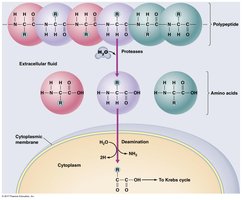
Proteins are hydrolyzed into amino acids, which are then deaminated and funneled into central metabolic pathways such as the Krebs cycle.
Lipid Catabolism (Beta Oxidation)
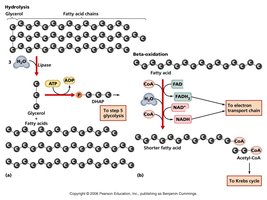
Lipids are hydrolyzed into glycerol and fatty acids. Glycerol enters glycolysis, while fatty acids undergo beta oxidation to generate acetyl-CoA, NADH, and FADH2, which feed into the Krebs cycle and ETC.
Beta oxidation: Sequential removal of two-carbon units from fatty acids as acetyl-CoA
High ATP yield: Complete oxidation of fatty acids yields significantly more ATP than glucose
Energy Yield Calculations
Krebs cycle (per acetyl-CoA): 12 ATP equivalents
Krebs cycle (per pyruvate): 15 ATP equivalents
Substrate-level phosphorylation (per glucose): 4 ATP
Complete oxidation of one palmitic acid (C-16): 129 ATP per fatty acid, 387 ATP per triglyceride (plus glycerol contribution)
Complete oxidation of one lauric acid (C-12): 95 ATP
Note: Actual ATP yields may vary due to shuttle mechanisms and transport costs in eukaryotic cells.
