 Back
BackMicrobial Metabolism: Photosynthesis, Energy Production, and Metabolic Pathways
Study Guide - Smart Notes
 Tailored notes based on your materials, expanded with key definitions, examples, and context.
Metabolism: Catabolism and Anabolism
Overview of Metabolic Pathways
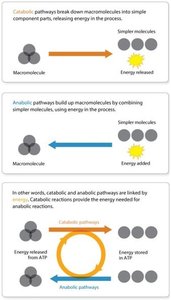
Metabolism encompasses all chemical reactions within a cell, divided into catabolic and anabolic pathways. Catabolic pathways break down macromolecules, releasing energy, while anabolic pathways build macromolecules, consuming energy. These pathways are interconnected, with catabolic reactions providing the energy required for anabolic processes.
Catabolic Pathways: Decompose complex molecules into simpler ones, releasing energy (often captured as ATP).
Anabolic Pathways: Synthesize complex molecules from simpler ones, requiring energy input (usually from ATP).
Energy Coupling: Catabolic and anabolic pathways are linked by energy transfer, primarily through ATP.
Photosynthesis: Retinal-Based and Chlorophyll-Based Systems
Retinal-Based Proton Pumps
While most photosynthesis relies on chlorophyll, some prokaryotes utilize retinal-based proton pumps, such as bacteriorhodopsin in halophilic archaea. These systems are simpler and do not produce oxygen, representing an ancient form of phototrophy.
Bacteriorhodopsin: A single-protein, light-driven proton pump found in halophilic archaea.
Proteorhodopsin: Homologous protein found in marine proteobacteria.
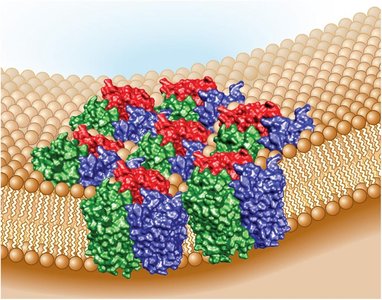
Purple Membrane: Halobacterium salinarium packs its membrane with bacteriorhodopsin trimers in hexagonal arrays for efficient light absorption.
Chlorophyll-Based Photosynthesis
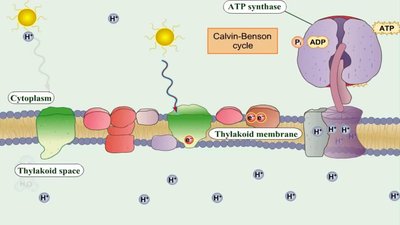
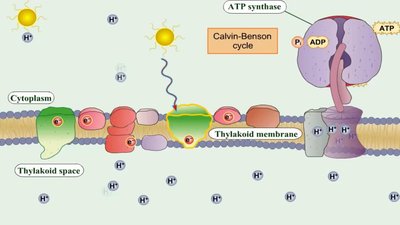
Chlorophyll-based photosynthesis involves photoexcitation and photolysis, leading to electron transfer through an electron transport system (ETS). This process generates a proton gradient used to synthesize ATP and NADPH, which are essential for carbon fixation.
Photoexcitation: Light absorption by chlorophyll excites electrons.
Photolysis: Light-driven separation of electrons from donor molecules (e.g., H2O or H2S).
Electron Transport System (ETS): Transfers electrons, generating proton potential and NADPH.
ATP Synthesis: Proton potential drives ATP production via ATP synthase.
Photosystems and Photophosphorylation
Photosystem I (PSI): Cyclic Photophosphorylation
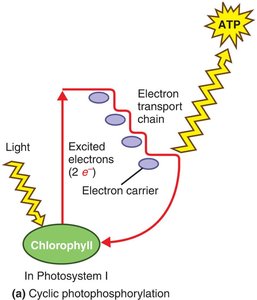
Photosystem I operates via cyclic photophosphorylation, where electrons return to chlorophyll after passing through the electron transport chain. This process produces ATP but not NADPH.
Cyclic Electron Flow: Electrons excited by light return to chlorophyll, generating ATP.
ATP Production: No NADPH is produced in this cycle.
Photosystem II (PSII): Noncyclic Photophosphorylation
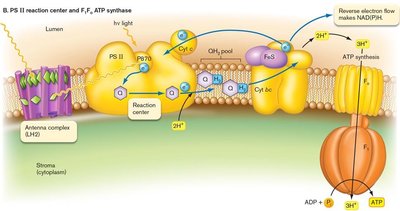
Photosystem II can operate independently in some bacteria, producing both ATP and NAD(P)H. Electrons are derived from water, resulting in oxygen production in oxygenic photosynthesis.
Noncyclic Electron Flow: Electrons do not return to chlorophyll; instead, they are transferred to NADP+ to form NADPH.
ATP and NADPH Production: Both are generated, supporting carbon fixation.
Oxygenic Photolysis: Water is split, releasing O2.
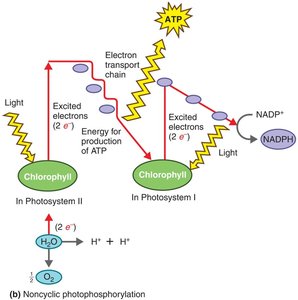
Z-Pathway (Oxygenic Photosynthesis)
The Z-pathway, found in cyanobacteria and chloroplasts, combines homologs of PSI and PSII. It absorbs eight photons, removes four protons and four electrons from two water molecules, and produces oxygen. The resulting ATP and NADPH are used in the Calvin-Benson cycle for carbon fixation.
Photon Absorption: Eight photons are required for the process.
Oxygen Production: Four electrons from two H2O molecules yield O2.
ATP and NADPH Yield: 3 ATP and 2 NADPH per 2 H2O photolyzed.
Calvin-Benson Cycle: Light-Independent Reactions
Carbon Fixation via Calvin-Benson Cycle
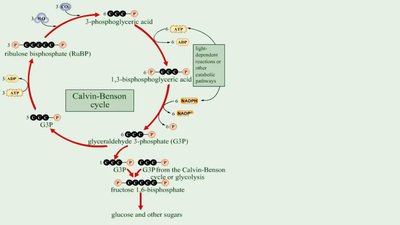
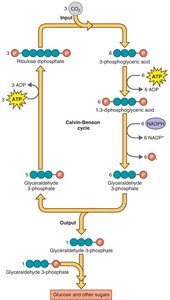
The Calvin-Benson cycle uses ATP and NADPH from light-dependent reactions to fix CO2 into sugars. This cycle is central to autotrophic growth in plants, algae, and cyanobacteria.
Input: 3 CO2 molecules combine with ribulose diphosphate (RuBP).
ATP and NADPH Consumption: Used to convert 3-phosphoglyceric acid to glyceraldehyde 3-phosphate (G3P).
Output: G3P is used to synthesize glucose and other sugars.
Energy Production in Cells
Requirements for ATP Production
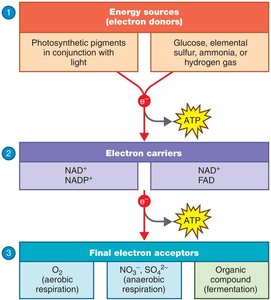
ATP production in cells requires energy sources, electron carriers, and final electron acceptors. These components vary depending on the metabolic pathway (photosynthesis, respiration, fermentation).
Energy Sources: Light (phototrophs) or chemicals (chemotrophs).
Electron Carriers: NAD+, NADP+, FAD.
Final Electron Acceptors: O2 (aerobic), NO3-, SO42- (anaerobic), organic compounds (fermentation).
Nutritional Classification and Metabolic Diversity
Nutritional Types Among Organisms
Organisms are classified based on their energy and carbon sources, as well as their mechanisms for ATP generation. This classification is fundamental to understanding microbial ecology and physiology.
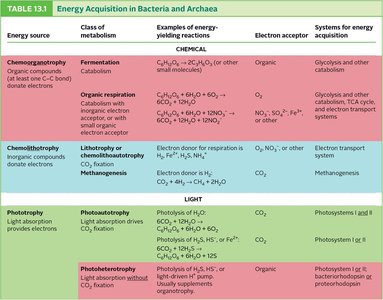
Photoautotrophs: Use light energy and CO2 as a carbon source (e.g., cyanobacteria, plants).
Photoheterotrophs: Use light energy and organic compounds as a carbon source (e.g., green bacteria, purple nonsulfur bacteria).
Chemoautotrophs: Use inorganic chemicals for energy and CO2 as a carbon source (e.g., iron-oxidizing bacteria).
Chemoheterotrophs: Use organic chemicals for both energy and carbon (e.g., animals, fungi, fermentative bacteria).
Nutritional Type | Energy Source | Carbon Source | Example |
|---|---|---|---|
Photoautotroph | Light | CO2 | Cyanobacteria, plants |
Photoheterotroph | Light | Organic compounds | Green bacteria, purple nonsulfur bacteria |
Chemoautotroph | Inorganic chemical | CO2 | Iron-oxidizing bacteria |
Chemoheterotroph | Chemical | Organic compounds | Animals, fungi, fermentative bacteria |
Anabolism: Biosynthesis of Macromolecules
Biosynthesis of Polysaccharides
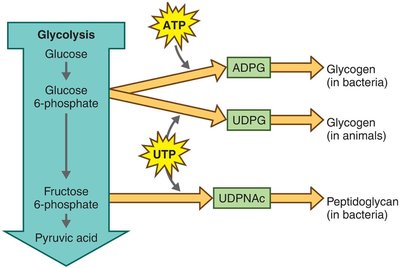
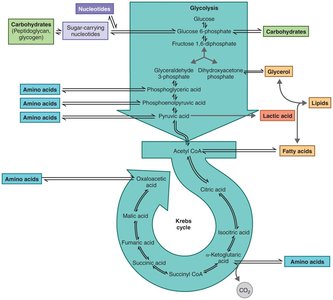
Bacteria synthesize sugars and polysaccharides from intermediates produced during glycolysis and the Krebs cycle. These sugars can be used directly or assembled into complex polysaccharides.
Glycolysis Intermediates: Serve as precursors for sugar biosynthesis.
Polysaccharide Assembly: Sugars are linked to form glycogen, peptidoglycan, etc.
Biosynthesis of Simple Lipids
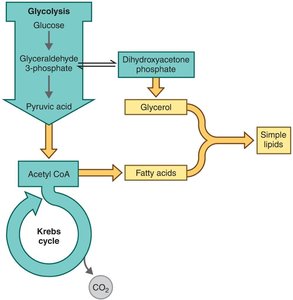
Lipid biosynthesis involves multiple routes, with dihydroxyacetone phosphate (from glycolysis) necessary for glycerol and acetyl CoA (from the Krebs cycle) required for fatty acid synthesis.
Glycerol Formation: From dihydroxyacetone phosphate.
Fatty Acid Synthesis: From acetyl CoA.
Simple Lipids: Formed by combining fatty acids and glycerol.
Biosynthesis of Amino Acids
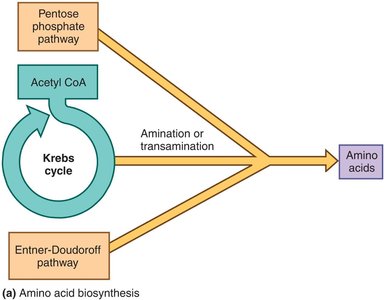
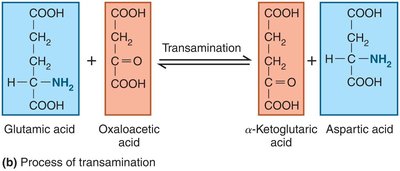
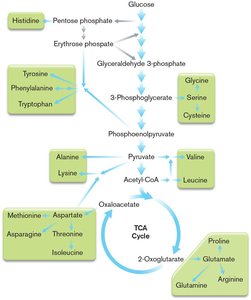
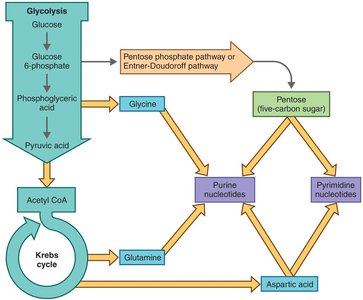
Amino acids are synthesized via amination and transamination of carbohydrate metabolism intermediates from the Krebs cycle, pentose phosphate pathway, and Entner-Doudoroff pathway.
Amination: Addition of an amino group to a precursor molecule.
Transamination: Transfer of an amino group from one molecule to another.
Metabolic Intermediates: Serve as carbon skeletons for amino acid synthesis.
Biosynthesis of Nucleotides
Nucleotides are composed of a purine or pyrimidine base, a pentose sugar, and a phosphate group. The pentose is derived from the pentose phosphate pathway or Entner-Doudoroff pathway, while amino acids from the Krebs cycle contribute to the purine and pyrimidine rings.
Pentose Sugar: From pentose phosphate pathway.
Amino Acid Contribution: Glutamine and aspartic acid provide atoms for nucleotide rings.
Amphibolic Pathways and Metabolic Integration
Amphibolic Pathways
Amphibolic pathways function in both anabolism and catabolism, allowing cells to efficiently use metabolic intermediates for multiple purposes. Many pathways operate simultaneously, sharing common intermediates.
Dual Function: Pathways serve both energy production and biosynthesis.
Examples: Glycolysis, Krebs cycle, pentose phosphate pathway.
Integration: Intermediates are used for synthesis of amino acids, nucleotides, lipids, and carbohydrates.
Summary of Energy Production and Metabolic Diversity
Energy Production: Cells produce energy via oxidative phosphorylation (respiration) and photophosphorylation (photosynthesis).
Metabolic Diversity: Organisms are classified by their energy and carbon sources, and their metabolic pathways reflect adaptation to diverse environments.
Amphibolic Pathways: Enable efficient integration of catabolic and anabolic processes.
