 Back
BackMicrobial Metabolism: Structured Study Notes for College Microbiology
Study Guide - Smart Notes
 Tailored notes based on your materials, expanded with key definitions, examples, and context.
Microbial Metabolism
Metabolism Basics
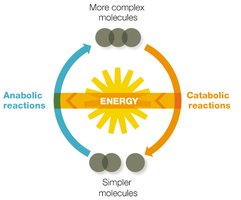
Metabolism encompasses all chemical reactions that organisms use to break down substances to release energy and to build new substances using that energy. These reactions are organized into biochemical pathways, where intermediates are transformed stepwise to end products.
Catabolic pathways: Break down substances, releasing energy; typically hydrolytic and exergonic.
Anabolic pathways: Build new substances using energy and molecules; involve dehydration synthesis and are endergonic.
Amphibolic pathways: Can function in both catabolic and anabolic roles.
Catabolic and anabolic reactions are often coupled, allowing energy released from catabolism to drive anabolism.
Adenosine Triphosphate (ATP)
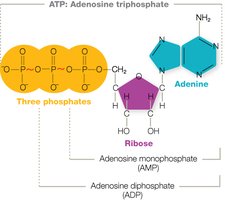
ATP is the primary energy currency in cells, produced by catabolic reactions and used to power anabolic reactions. Its structure consists of adenine, ribose, and three phosphate groups.
Dephosphorylation: Removal of the terminal phosphate group releases energy and produces ADP.
Phosphorylation: Addition of a phosphate group to ADP regenerates ATP.
Enzymes
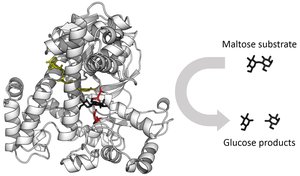
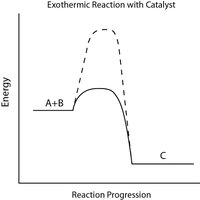
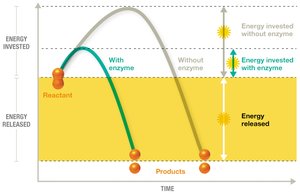
Enzymes are protein catalysts that facilitate chemical reactions under cellular conditions. They increase reaction rates, are not consumed in the reaction, and lower activation energy by holding reactants in proper orientation.
Enzyme names: Usually end in -ase.
Substrate: The molecule an enzyme acts upon.
Active site: The region where the substrate binds.
Induced fit model: Enzymes mold to the substrate for optimal catalysis.
Enzyme Classification
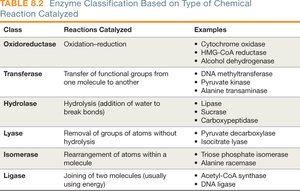
Enzymes are classified by the type of chemical reaction they catalyze.
Class | Reactions Catalyzed | Examples |
|---|---|---|
Oxidoreductase( | Oxidation-reduction | Cytochrome oxidase, Alcohol dehydrogenase |
Transferase | Transfer of functional groups | DNA methyltransferase, Pyruvate kinase |
Hydrolase | Hydrolysis(water break) | Lipase, Sucrase |
Lyase | Removal of groups without hydrolysis | Pyruvate decarboxylase |
Isomerase | Rearrangement within a molecule | Triose cphosphate isomerase |
Ligase | Joining of two molecules | Acetyl-CoA synthase |
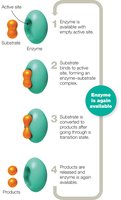
Enzyme-Substrate Complex
The enzyme-substrate complex is formed when the substrate binds to the enzyme's active site, allowing the reaction to proceed.
Proper positioning of reactants
Provision of activation energy
Stabilization of the transition state
Factors Affecting Enzyme Activity
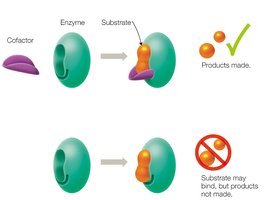
Cofactors: Nonprotein components required for enzyme function. Apoenzyme (inactive, no cofactor), holoenzyme (active, with cofactor).
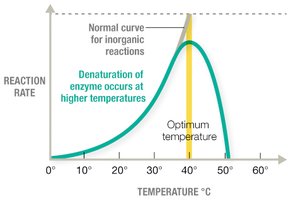
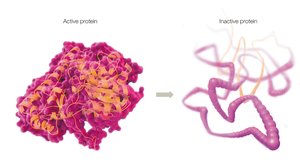
Temperature: Lowers activity at low temperatures, increases up to optimal, then decreases due to denaturation.
pH: Alters hydrogen and ionic bonds, extreme pH leads to denaturation.
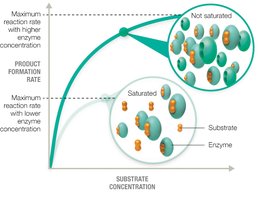
Substrate concentration: Rate depends on available active sites and substrate amount.
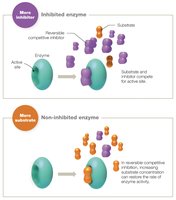
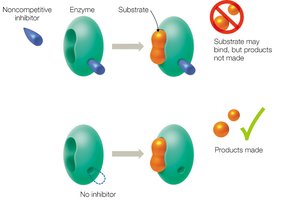
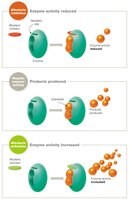
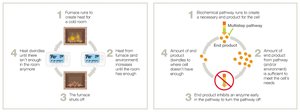
Inhibitors: Competitive (binds active site), noncompetitive (binds elsewhere), allosteric regulation, feedback inhibition.
Obtaining and Using Energy
Redox Reactions and Energy Extraction
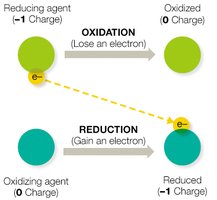
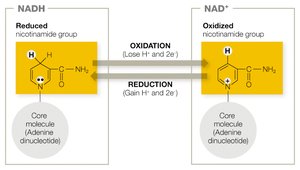
Cells extract energy from nutrients using oxidation-reduction (redox) reactions. Oxidation is the loss of electrons, reduction is the gain of electrons. Oxygen is a common oxidizing agent, hydrogen is often a reducing agent.
Enzymes rely on coenzymes like NAD+ and FAD as electron carriers.
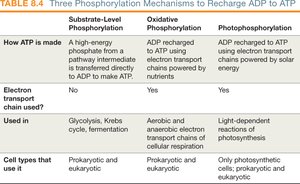
Redox reactions are often coupled to phosphorylation reactions that recharge ADP to ATP.
Phosphorylation Mechanisms
| How ATP is made | Electron transport chain used? | Used in | Cell types |
|---|---|---|---|---|
Substrate-Level | Direct transfer of phosphate | No | Glycolysis, Krebs cycle, fermentation | Prokaryotic & eukaryotic |
Oxidative | Electron transport chain | Yes | Cellular respiration | Prokaryotic & eukaryotic |
Photophosphorylation | Light-driven electron transport | Yes | Photosynthesis | Photosynthetic cells |
Cellular Respiration
Pathways of Cellular Respiration
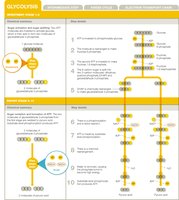
Cellular respiration is the primary process for extracting energy from carbohydrates, involving glycolysis, intermediate step, Krebs cycle, and electron transport chain.
Glycolysis: Ten reactions, energy investment and payoff stages. Products: 2 pyruvic acid, 2 water, 2 NADH, 2 ATP. Does not require oxygen.
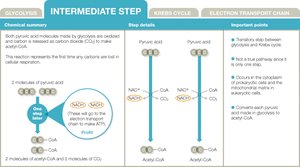
Intermediate step: Pyruvic acid converted to acetyl-CoA, NADH, and CO2.
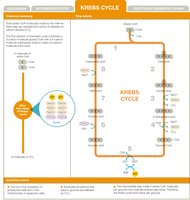
Krebs cycle: Series of redox and decarboxylation reactions. Products: 3 NADH, 1 FADH2, 1 ATP, 2 CO2.
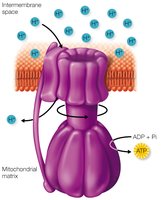
Electron transport chain: NADH and FADH2 donate electrons, protons pumped, ATP synthesized by chemiosmosis.
ATP Yield
Prokaryotes: 38 ATP per glucose
Eukaryotes: 36 ATP per glucose (2 used in transport)
Final Electron Acceptors
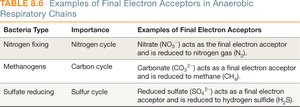
Bacteria Type | Importance | Examples of Final Electron Acceptors |
|---|---|---|
Nitrogen fixing | Nitrogen cycle | Nitrate (NO3-) |
Methanogens | Carbon cycle | Carbonate (CO32-) |
Sulfate reducing | Sulfur cycle | Sulfate (SO42-) |
Glucose Breakdown and Alternative Pathways
Pentose Phosphate and Entner-Doudoroff Pathways
Pentose Phosphate Pathway: Converts pentoses to trioses and hexoses, produces NADPH, used by many bacteria.
Entner-Doudoroff Pathway: Produces 1 ATP per glucose, makes NADPH, found in Gram-negative obligate aerobes.
Fermentation
Types of Fermentation
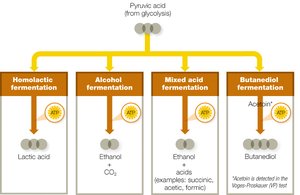
Fermentation sustains ATP production by glycolysis when respiratory chains are unavailable. NADH transfers electrons to organic molecules, regenerating NAD+.
Homolactic fermentation: Pyruvic acid reduced to lactic acid; 2 ATP produced; used by yogurt bacteria and human muscle cells.
Heterolactic fermentation: Produces lactic acid, ethanol, CO2, and minor acids; 1 ATP produced; used by various bacteria and fungi.
Alcohol fermentation: Pyruvic acid converted to ethanol and CO2; used by yeast and some bacteria.
Mixed acid fermentation: Produces various acids and gases; used by enteric bacteria.
Butanediol fermentation: Produces neutral end products like butanediol and ethanol.
Other Catabolic Pathways
Macromolecule Catabolism
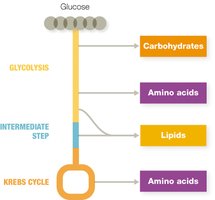
Lipases: Break lipids into glycerol and fatty acids. Glycerol enters glycolysis; fatty acids undergo beta-oxidation to acetyl-CoA for Krebs cycle.
Proteases: Break proteins into peptides and amino acids. Amino acids can be recycled or deaminated for catabolism.
Nucleases: Break nucleic acids into nucleotides, which are usually salvaged rather than catabolized for energy.
Biosynthesis (Anabolic Pathways)
Gluconeogenesis and Glycogenesis
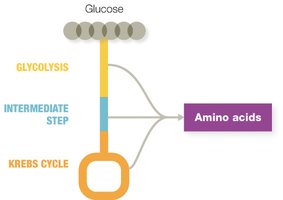
Gluconeogenesis: Building glucose from non-sugar materials using intermediates from glycolysis, Krebs cycle, and lipid/protein catabolism.
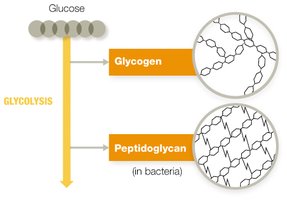
Glycogenesis: Production of glycogen from glucose.
Simple sugars can be assembled into polysaccharides.
Lipid and Amino Acid Biosynthesis
Glycerol is made from glycolysis intermediate (DHAP).
Fatty acids are synthesized by linking acetyl-CoA molecules.
Cells make nonessential amino acids by amination (addition of NH2 to an intermediate).
Degree of dependence on essential amino acids varies among species.
Nucleotide Biosynthesis
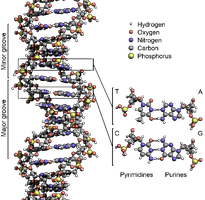
Purines (adenine, guanine) and pyrimidines (uracil, thymine, cytosine) are essential for nucleic acids and energy molecules.
Classification by Metabolic Properties
Carbon, Energy, and Reducing Power Sources
Autotrophs: Make organic carbon from inorganic sources via carbon fixation.
Heterotrophs: Require external organic carbon.
Phototrophs: Harvest energy from light.
Chemotrophs: Harvest energy from chemical bonds.
Lithotrophs: Use inorganic sources for reducing power.
Organotrophs: Use organic sources for reducing power.
Saprobes: Use dead organic material.
Tests to Identify Bacteria
Metabolic Profiling
Metabolic profiles serve as biochemical fingerprints for microbial identification.
Tests include specialized media, molecular, genetic, and metabolic assays.
Panel of tests: Pure culture, staining, microscopy, culture characteristics, and biochemical tests.
Amino Acid Catabolism Tests
Detect deaminases and decarboxylases.
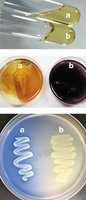
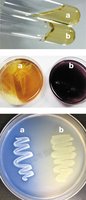
Phenylalanine deaminase, ornithine decarboxylase, sulfur reduction (black precipitate with iron).
Fermentation Tests
Media contains protein, carbohydrate, pH indicator, and Durham tube.
Acidic end products lower pH and change color; Durham tube captures gas.
Methyl Red/Voges-Proskauer (MRVP) Test
MR: Detects mixed acid fermentation (acidic products lower pH).
VP: Detects acetoin (intermediate of butanediol fermentation).
Oxidase and Catalase Tests
Oxidase: Tests for cytochrome c oxidase.
Catalase: Tests for catalase enzyme (breaks down hydrogen peroxide).
Rapid Identification Techniques
API® system: Semi-automated process for multiple tests with a single inoculation.
Summary
Microbial metabolism is a complex interplay of catabolic and anabolic pathways, regulated by enzymes and influenced by environmental factors. Understanding these processes is essential for identifying microbes and their roles in health, disease, and biotechnology.
