 Back
BackMicrobial Metabolism: Study Guide for College Microbiology
Study Guide - Smart Notes
 Tailored notes based on your materials, expanded with key definitions, examples, and context.
Microbial Metabolism
Overview of Metabolism
Microbial metabolism encompasses all the chemical reactions occurring within a microorganism. These reactions are essential for energy production, growth, and maintenance. Metabolism is divided into two main categories: catabolism and anabolism.
Catabolism: The breakdown of complex molecules into simpler ones, releasing energy and providing building blocks for anabolic reactions. Catabolic reactions are exergonic (energy-releasing).
Anabolism: The synthesis of complex molecules from simpler ones, requiring energy input. Anabolic reactions are endergonic (energy-consuming).
Oxidation-Reduction Reactions
Oxidation-reduction (redox) reactions are fundamental to microbial metabolism. These reactions involve the transfer of electrons between molecules, which is crucial for energy production.
Oxidation: Removal of electrons from a molecule.
Reduction: Addition of electrons to a molecule.
Redox Reaction: An oxidation reaction paired with a reduction reaction.

Energy Production and Common Energy Carriers
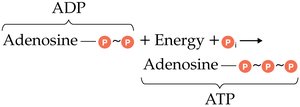
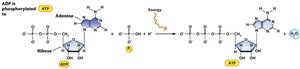
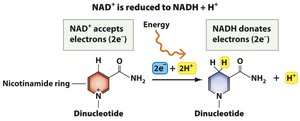
Microorganisms utilize common energy carriers to store and transfer energy within the cell. The most important carriers are ATP (adenosine triphosphate) and NADH (nicotinamide adenine dinucleotide).
ATP: Generated by the phosphorylation of ADP (adenosine diphosphate) with the input of energy.
NADH: Formed by the reduction of NAD+, carrying electrons and energy.
Carbohydrate Catabolism in Microorganisms
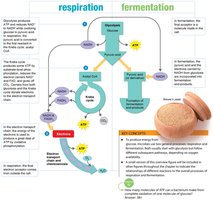
Respiration and Fermentation Overview
Microorganisms catabolize carbohydrates through two main pathways: respiration and fermentation. Both begin with glycolysis, but differ in subsequent steps and energy yield.
Respiration: Involves glycolysis, conversion of pyruvate to acetyl CoA, the Krebs cycle, and the electron transport chain. Yields more ATP.
Fermentation: Involves glycolysis followed by conversion of pyruvate to organic end-products. Yields less ATP.
Glycolysis
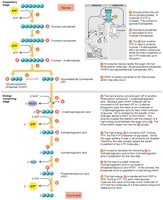
Glycolysis is the oxidation of glucose to pyruvic acid, producing ATP and NADH. It occurs in the cytoplasm of both prokaryotic and eukaryotic cells.
Preparatory (investment) stage: 2 ATP are used to split glucose into two molecules.
Energy-conserving stage: 2 pyruvic acid molecules are produced, 4 ATP are generated, and 2 NADH are formed.
Net gain: 2 ATP per glucose molecule.
Aerobic Respiration: Pyruvate Conversion and Krebs Cycle
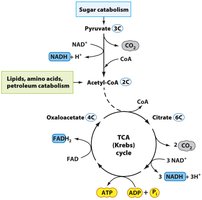
After glycolysis, pyruvic acid is converted to acetyl CoA, which enters the Krebs cycle. This process occurs in the cell membrane of prokaryotes and the mitochondrial matrix of eukaryotes.
Pyruvate conversion: Pyruvic acid is oxidized and decarboxylated, forming acetyl CoA and NADH.
Krebs cycle: Acetyl CoA is further oxidized, producing NADH, FADH2, ATP, and CO2 as waste.
Electron Transport Chain (ETC) and Chemiosmosis
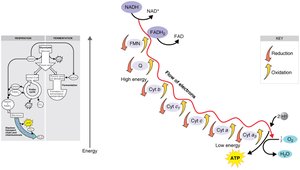
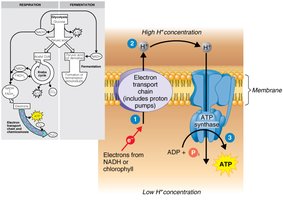
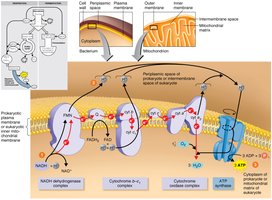
The ETC is a series of carrier molecules that are oxidized and reduced as electrons are passed down the chain. Energy released is used to produce ATP by chemiosmosis. The final electron acceptor in aerobic respiration is molecular oxygen.
Location: Plasma membrane of prokaryotes; inner mitochondrial membrane of eukaryotes.
Carrier molecules: Flavoproteins, cytochromes, and ubiquinones.
ATP synthesis: Protons are pumped across the membrane, creating a gradient. Protons flow back through ATP synthase, generating ATP.
Overall Reaction of Aerobic Respiration
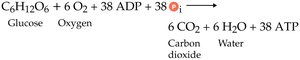
The complete oxidation of glucose in aerobic respiration produces carbon dioxide, water, and a large amount of ATP.
Equation:
Anaerobic Respiration
Anaerobic respiration follows the same steps as aerobic respiration, but the final electron acceptor in the electron transport chain is not oxygen. This process yields less energy than aerobic respiration.
Final electron acceptor: Inorganic molecules other than oxygen (e.g., nitrate, sulfate).
Energy yield: Lower than aerobic respiration.
Fermentation
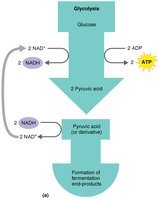
Fermentation is an anaerobic process that releases energy from the oxidation of organic molecules. It does not require oxygen and produces only small amounts of ATP.
Starts with glycolysis
Does not use: Pyruvate conversion to acetyl CoA, Krebs cycle, or ETC
Final electron acceptor: Organic molecule
ATP yield: Low
Types of Fermentation
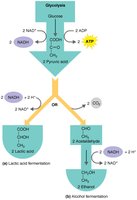
Fermentation can produce different end-products depending on the microorganism and pathway.
Lactic acid fermentation: Produces lactic acid.
Homolactic fermentation: Produces only lactic acid.
Heterolactic fermentation: Produces lactic acid and other compounds.
Example: Lactobacillus spp. fermentation produces yogurt from milk.
Summary Table: Comparison of Metabolic Pathways
Pathway | Oxygen Requirement | Final Electron Acceptor | ATP Yield | Key End-Products |
|---|---|---|---|---|
Aerobic Respiration | Required | Oxygen | High (up to 38 ATP) | CO2, H2O |
Anaerobic Respiration | Not required | Inorganic molecules (e.g., NO3-, SO42-) | Moderate | Varies (e.g., NO2, H2S) |
Fermentation | Not required | Organic molecules | Low (2 ATP) | Lactic acid, ethanol, CO2 |
Key Terms and Concepts
Metabolism: All chemical reactions in a cell.
Catabolism: Breakdown of molecules, energy release.
Anabolism: Synthesis of molecules, energy consumption.
ATP: Main energy currency of the cell.
NADH: Electron carrier involved in energy production.
Glycolysis: First step in carbohydrate catabolism.
Krebs cycle: Central metabolic pathway for energy production.
Electron Transport Chain: Series of electron carriers for ATP synthesis.
Fermentation: Anaerobic process producing organic end-products.
Additional info: The notes above expand on brief points from the original slides, providing academic context and definitions for clarity. All images included directly reinforce the adjacent explanations and are essential for visualizing metabolic pathways and molecular processes.
