 Back
BackMicrobial Nutrition and Environmental Factors Affecting Microbial Growth
Study Guide - Smart Notes
 Tailored notes based on your materials, expanded with key definitions, examples, and context.
Microbial Nutrition
Essential Elements for Microbial Life
Microorganisms require a variety of elements to sustain life, growth, and metabolism. These elements are classified as essential nutrients, which must be provided to the organism because they cannot synthesize them independently.
Key Essential Elements: Carbon, Hydrogen, Oxygen, Nitrogen, Phosphorus, and Sulfur (often abbreviated as CHNOPS).
Other Important Elements: Potassium, Calcium, Iron, Sodium, Chlorine, Magnesium, and trace elements such as manganese, zinc, and nickel.

Macronutrients vs. Micronutrients
Essential nutrients are further categorized based on the quantity required and their function in the cell.
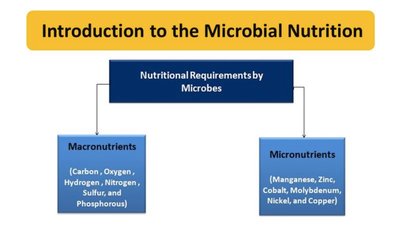
Macronutrients: Required in large amounts; involved in cell structure and metabolism. Examples include carbon, oxygen, hydrogen, nitrogen, sulfur, and phosphorus.
Micronutrients (Trace Elements): Required in smaller amounts; important for enzyme function and maintenance of protein structure. Examples include manganese, zinc, cobalt, molybdenum, nickel, and copper.
Organic vs. Inorganic Nutrients
Nutrients can also be classified based on their carbon content.
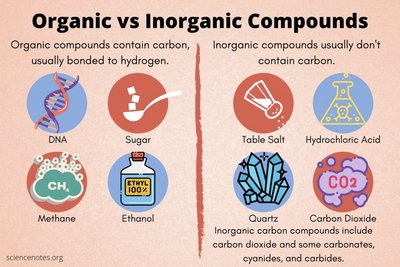
Inorganic Nutrients: Atoms or molecules that do not contain both carbon and hydrogen. Examples: table salt (NaCl), hydrochloric acid (HCl), carbon dioxide (CO2).
Organic Nutrients: Contain both carbon and hydrogen, usually produced by living organisms. Examples: DNA, sugar, methane (CH4), ethanol.
Microbial Nutritional Types
Autotrophs vs. Heterotrophs
Microbes are classified based on how they obtain their carbon and energy sources.
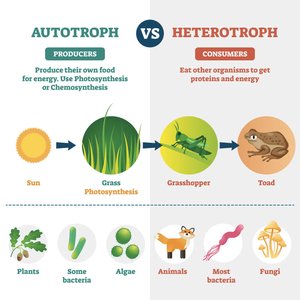
Autotrophs: Use inorganic CO2 as their carbon source. They are not nutritionally dependent on other living things and can convert CO2 into organic compounds.
Heterotrophs: Must obtain carbon in an organic form, typically from other organisms.
Metabolic Diversity: Nutritional Modes
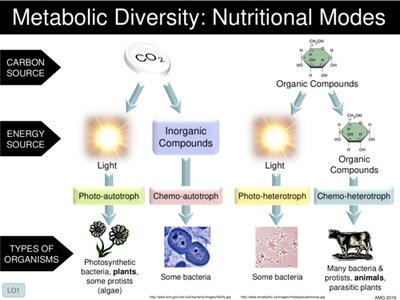
Microbes can be further classified based on their energy and carbon sources:
Photoautotrophs: Use light energy and CO2 as a carbon source (e.g., photosynthetic bacteria, plants, algae).
Chemoautotrophs: Use inorganic compounds for energy and CO2 as a carbon source (e.g., some bacteria).
Photoheterotrophs: Use light for energy but require organic compounds for carbon (e.g., some bacteria).
Chemoheterotrophs: Use organic compounds for both energy and carbon (e.g., many bacteria, animals, fungi).
Transport Mechanisms in Microbes
Diffusion and Osmosis
Microbial cells must transport nutrients into the cell and waste products out.
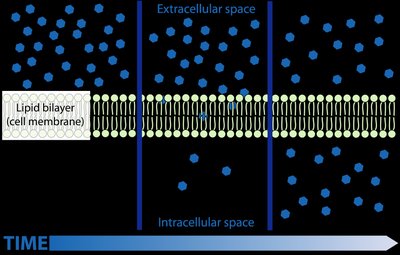
Diffusion: Movement of molecules from an area of higher concentration to lower concentration.
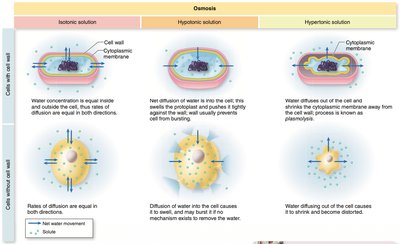
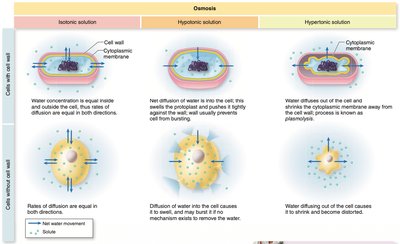
Osmosis: Diffusion of water across a selectively permeable membrane. Water moves from the side with more water (lower solute concentration) to the side with less water (higher solute concentration) until equilibrium is reached.
Osmotic Relationships: Isotonic, Hypotonic, Hypertonic
The osmotic relationship between cells and their environment is determined by the relative concentrations of solutes.
Isotonic: Equal solute concentration inside and outside the cell; no net change in cell volume.
Hypotonic: Lower solute concentration outside the cell; water enters the cell, causing it to swell and possibly burst.
Hypertonic: Higher solute concentration outside the cell; water leaves the cell, causing it to shrink.
Active Transport and Endocytosis
Active Transport: Movement of nutrients against the concentration gradient, requiring energy and specific membrane proteins (pumps).
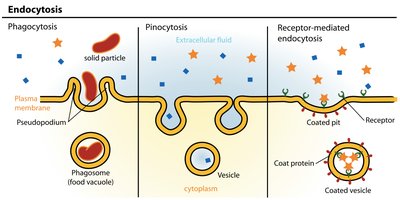
Endocytosis: Eukaryotic cells can transport large molecules, particles, or liquids by engulfing them.
Phagocytosis: Engulfment of solid particles.
Pinocytosis: Engulfment of liquids.
Environmental Factors Affecting Microbial Growth
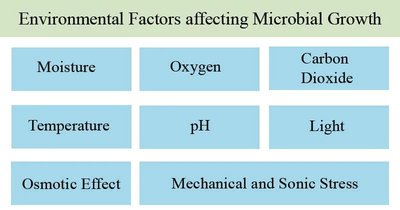
Overview of Environmental Factors
Microbes are influenced by a variety of environmental factors, which affect their growth and metabolism.
Temperature
Gases (O2, CO2)
pH
Osmotic Pressure
Radiation
Hydrostatic Pressure
Temperature and Microbial Growth
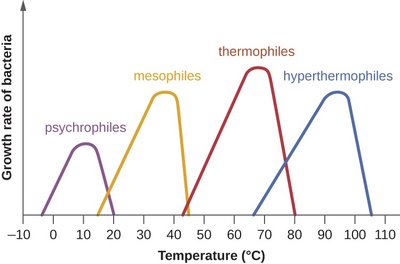
The growth of microbes is highly dependent on temperature, which can be described by three cardinal points: minimum, maximum, and optimum.
Minimum Temperature: Lowest temperature permitting growth.
Maximum Temperature: Highest temperature permitting growth.
Optimum Temperature: Temperature range promoting the fastest growth.
Temperature Adaptation Groups
Microbes are classified based on their optimal temperature ranges:
Psychrophiles: Grow optimally below 15°C, capable of growth at 0°C.
Mesophiles: Grow at intermediate temperatures (20°C to 40°C); most medically significant microbes.
Thermophiles: Grow optimally above 45°C; found in hot environments.
Other Environmental Factors
Gases: Oxygen and carbon dioxide are critical. Microbes are classified as aerobes, microaerophiles, facultative anaerobes, anaerobes, and aerotolerant anaerobes based on their oxygen requirements.
pH: Most microbes grow between pH 6 and 8. Acidophiles thrive in acidic environments, while alkaliphiles prefer basic conditions.
Osmotic Pressure: Halophiles thrive in high salt concentrations.
Radiation: Some microbes are resistant to ionizing radiation (e.g., Deinococcus radiodurans).
Pressure: Barophiles live under high hydrostatic pressure in deep-sea environments.
Microbial Interactions
Symbiosis and Other Relationships
Microbes interact with each other and their environment in various ways:
Mutualism: Both organisms benefit.
Commensalism: One benefits, the other is unaffected.
Parasitism: One benefits at the expense of the other.
Antagonism: One organism inhibits or destroys another.
Synergism: Cooperative interaction that benefits all participants.
Biofilms: Complex communities of microbes that communicate via quorum sensing.
Microbial Growth and Population Dynamics
Binary Fission and Growth Rate
Most bacteria reproduce by binary fission, where one cell divides into two.
Generation Time: The time required for a cell to divide and produce two daughter cells.
Exponential Growth: Population doubles with each generation.
Growth Curve Phases
In batch cultures, microbial populations exhibit a predictable growth curve:
Lag Phase: Cells adjust to environment; little or no growth.
Log (Exponential) Phase: Rapid cell division and population growth.
Stationary Phase: Growth rate slows; cell birth and death rates are equal.
Death Phase: Cells die due to depleted nutrients and accumulation of waste.
Methods for Analyzing Population Size
Turbidometry: Measures cloudiness of a culture to estimate population size.
Direct Cell Count: Microscopically counts cells, but cannot distinguish live from dead.
Coulter Counter: Automated electronic cell counting.
Flow Cytometry: Measures cell size and differentiates live/dead cells using fluorescent dyes.
Genetic Probing: Real-time PCR quantifies microbes without culturing.
Growth Phase | Description |
|---|---|
Lag Phase | Adjustment period; little growth |
Log Phase | Rapid, exponential growth |
Stationary Phase | Growth slows; birth and death rates equal |
Death Phase | Cells die due to resource depletion |
Summary
Understanding microbial nutrition and environmental factors is fundamental to microbiology. These concepts explain how microbes survive, grow, and interact with their environment, and are essential for applications in medicine, industry, and environmental science.
