 Back
BackMicrobial Nutrition and Growth II: Culture Methods, Media, and Bacterial Growth
Study Guide - Smart Notes
 Tailored notes based on your materials, expanded with key definitions, examples, and context.
Microbial Culture and Isolation
What Is Microbial Culture?
Microbial culture is the process of growing microorganisms in a controlled environment using nutrient-rich media. This process is fundamental for isolating, identifying, and studying microbes in the laboratory.
Culture: Refers to both the act of cultivating microbes and the resulting population.
Inoculum: The microbial sample introduced into the medium, which contains essential nutrients for growth.
Sources of inocula: Environmental specimens (soil, water, air), clinical specimens (blood, sputum, urine), and stored specimens (frozen stocks).
Understanding culture setup is foundational for isolating and identifying microbes in the lab.
Isolation of Microorganisms
To study a single species, pure cultures must be obtained. This requires aseptic technique and physical separation of individual cells.
Streak Plate Method: Cells are spread across the agar surface using a sterilized loop, diluting the sample until isolated colonies appear.
Pour Plate Method: Diluted samples are mixed with molten agar and poured into Petri dishes, allowing colonies to form within and on the surface of the agar.
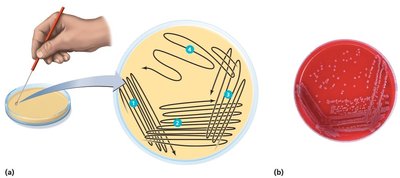
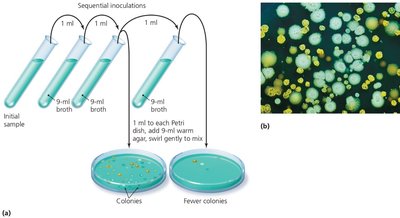
Other methods, such as serial dilution in liquid broth or micromanipulation, are used for organisms with unique growth requirements (e.g., fungi, protozoa).
Culture Media in Microbiology
Types of Culture Media
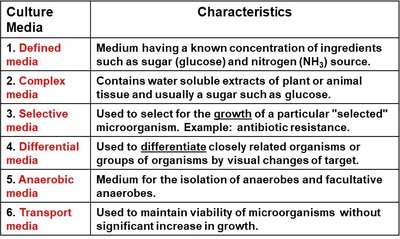
Culture media provide essential nutrients in a controlled form. The choice of media is critical for supporting microbial growth and accurate observation.
Culture Media | Characteristics |
|---|---|
1. Defined media | Medium with known concentrations of all ingredients (e.g., glucose, ammonium salts). |
2. Complex media | Contains extracts of plant or animal tissue; composition is not precisely known. |
3. Selective media | Suppresses some microbes while allowing others to grow (e.g., antibiotic resistance). |
4. Differential media | Distinguishes organisms based on visual changes (e.g., color, hemolysis). |
5. Anaerobic media | Supports growth of obligate anaerobes by excluding oxygen. |
6. Transport media | Maintains viability during specimen transfer without significant growth. |
Preservation of Microbial Cultures
Methods of Preservation
Refrigeration: Short-term storage at 4°C for weeks to months.
Deep-Freezing: Long-term storage at -20°C to -80°C for years, often with cryoprotectants.
Lyophilization (Freeze-Drying): Freezing followed by sublimation of water under vacuum, allowing storage for decades at 4–10°C.
Proper preservation ensures viability and genetic stability for future use.
Microbial Reproduction and Growth
Binary Fission
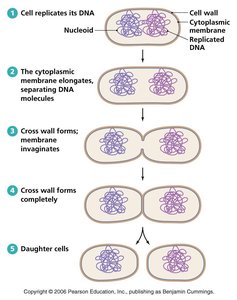
Most prokaryotes reproduce by binary fission, a form of asexual reproduction resulting in two genetically identical daughter cells.
DNA replicates, the cell elongates, and a cross wall forms, dividing the cell.
Generation time is the interval required for a population to double in number, often 20–60 minutes under optimal conditions.
Exponential and Logarithmic Growth
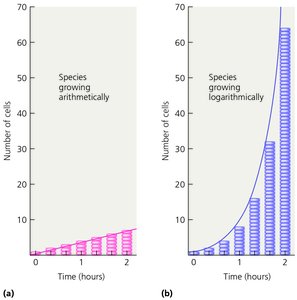
Microbial populations grow exponentially under optimal conditions, doubling each generation. Arithmetic growth is rare in biology, while logarithmic (exponential) growth is typical for microbes.
Exponential growth: Population doubles at a constant rate, producing a J-shaped curve.
Logistic growth: Growth slows as resources become limited, producing an S-shaped curve (carrying capacity, K).
Exponential growth equation:
Logistic growth equation:
Where: = population size, = time, = growth rate, = carrying capacity, = initial population size, = base of natural logarithm.
Bacterial Growth Curve
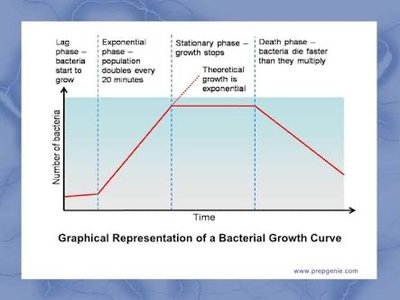
In a closed system, bacterial populations follow a predictable growth curve with four phases:
Lag Phase: Cells adjust to new conditions; little to no division.
Log (Exponential) Phase: Rapid cell division; best for measuring generation time.
Stationary Phase: Nutrient depletion and waste accumulation halt growth; cell division equals cell death.
Death (Decline) Phase: Cell death exceeds division due to exhaustion of resources.
Measuring Bacterial Reproduction
Direct Methods
Microscopic Count: Counting cells directly using a counting chamber.
Electronic Count: Automated counting using devices like Coulter counters or flow cytometers.
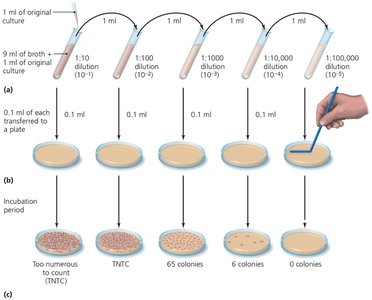
Serial Dilution and Plate Count: Diluting samples and plating to count colony-forming units (CFUs).
Membrane Filtration: Filtering large volumes to concentrate and count bacteria.
Indirect Methods
Turbidity: Measuring cloudiness of a culture with a spectrophotometer to estimate cell density.
Metabolic Activity: Assessing growth by measuring metabolic byproducts.
Dry Weight: Weighing cells after drying to estimate biomass.
Summary Table: Types of Culture Media
Culture Media | Characteristics |
|---|---|
Defined media | Known chemical composition; supports precise studies. |
Complex media | Contains extracts; supports a wide range of microbes. |
Selective media | Suppresses some microbes, allows others; e.g., antibiotic resistance. |
Differential media | Distinguishes organisms visually; e.g., color change, hemolysis. |
Anaerobic media | Supports obligate anaerobes by excluding oxygen. |
Transport media | Keeps microbes viable during transfer without growth. |
Additional info: These methods and concepts are foundational for laboratory and clinical microbiology, enabling the isolation, identification, and quantification of microorganisms for research, diagnostics, and industrial applications.
