 Back
BackMicrobial Nutrition and Growth: Structured Study Notes
Study Guide - Smart Notes
 Tailored notes based on your materials, expanded with key definitions, examples, and context.
Microbial Nutrition
Essential Nutrients and Elemental Requirements
Microorganisms require a variety of nutrients from their environment to support cellular activities and growth. These nutrients are classified based on their quantity and function in the cell.
Macronutrients: Required in large amounts; include carbon, hydrogen, oxygen, nitrogen, phosphorus, and sulfur (C, H, O, N, P, S). They are essential for cell structure and metabolism.
Micronutrients (Trace Elements): Needed in smaller quantities; involved in enzyme function and maintenance of protein structure (e.g., iron, magnesium, zinc).
Essential Nutrient: Any substance that must be provided to an organism because it cannot synthesize it.
Inorganic nutrients are simple molecules that do not contain both carbon and hydrogen, while organic nutrients contain both and are usually products of living things.
Nutritional Categories by Carbon and Energy Source
Microbes are classified based on their sources of carbon and energy:
Heterotrophs: Obtain carbon from organic sources; dependent on other life forms.
Autotrophs: Use inorganic CO2 as their carbon source; can convert CO2 into organic compounds.
Phototrophs: Gain energy from sunlight via photosynthesis.
Chemotrophs: Gain energy from chemical compounds.
Saprobes are organisms that feed on dead organic matter, while parasites live on or in a host, causing harm.
Growth factors are organic compounds (e.g., amino acids, vitamins) that cannot be synthesized by the organism and must be supplied by the environment.
Examples of Microbial Nutritional Types
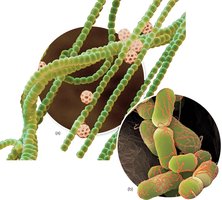
Photoautotrophs: Cyanobacteria, algae
Chemoautotrophs: Nitrifying bacteria
Chemoheterotrophs: Most bacteria, fungi, protozoa
Cell Membrane & Transport
Diffusion and Osmosis
Transport of nutrients and waste occurs across the cell membrane. Two fundamental processes are:
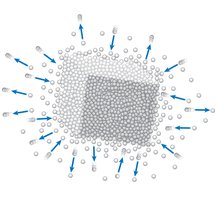
Diffusion: Movement of molecules from high to low concentration, driven by the concentration gradient.
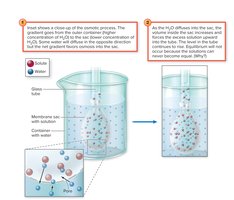
Osmosis: Movement of water across a selectively permeable membrane from an area of higher water concentration to lower water concentration.
Effects of Osmotic Conditions on Cells
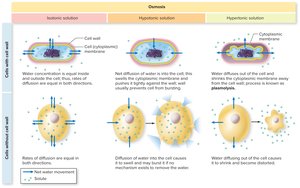
Cells respond differently to isotonic, hypotonic, and hypertonic environments:
Isotonic: Equal solute concentration inside and outside; water moves equally in both directions.
Hypotonic: Lower solute concentration outside; water enters the cell, causing swelling.
Hypertonic: Higher solute concentration outside; water leaves the cell, causing shrinkage (plasmolysis).
Passive and Active Transport
Transport mechanisms include:
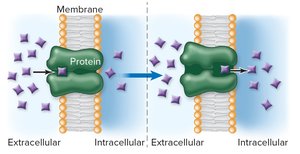
Passive Transport: Does not require energy; includes simple diffusion and facilitated diffusion.
Facilitated Diffusion: Uses membrane proteins to transport substances down their concentration gradient.
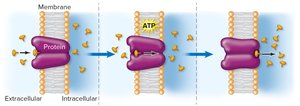
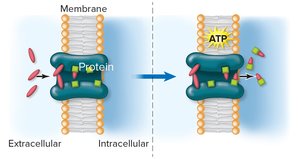
Active Transport: Requires energy (ATP); moves substances against their concentration gradient using membrane proteins (permeases and pumps).
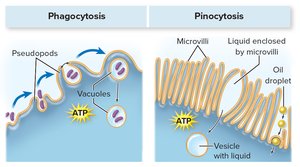
Endocytosis: Eukaryotic cells engulf large molecules or particles via phagocytosis (solid matter) or pinocytosis (liquids).
Dynamics of Microbial Growth
Environmental Factors Influencing Microbial Growth
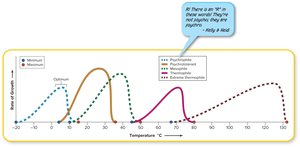
Microbial growth is affected by temperature, gases, pH, osmotic pressure, radiation, hydrostatic pressure, moisture, and interactions with other organisms.
Temperature Adaptation
Microbes are classified by their optimal growth temperatures:
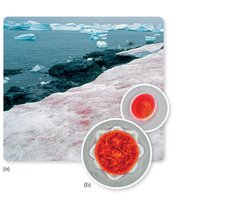
Psychrophiles: Grow below 15°C; found in cold environments.
Mesophiles: Grow between 20°C and 40°C; most human pathogens.
Thermophiles: Grow above 45°C; found in hot environments.
Extreme Thermophiles: Grow between 80°C and 121°C.
Oxygen Requirements
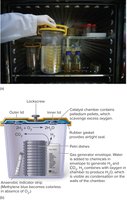
Aerobes: Require oxygen for growth.
Obligate Anaerobes: Cannot tolerate oxygen.
Facultative Anaerobes: Can grow with or without oxygen.
Microaerophiles: Require low levels of oxygen.
Aerotolerant Anaerobes: Do not use oxygen but can tolerate its presence.
Associations Between Organisms
Microbes interact with each other in various ways:
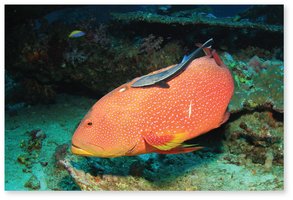
Symbiosis: Close partnership; includes mutualism, commensalism, and parasitism.
Nonsymbiotic Associations: Synergism (cooperation) and antagonism (competition).
Biofilms
Biofilms are complex communities of microbes attached to surfaces, exhibiting synergy and enhanced survival.
Microbial Growth and Population Dynamics
Binary Fission
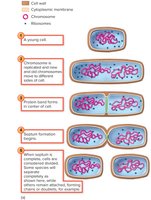
Bacterial cells reproduce by binary fission, a process involving cell enlargement, chromosome replication, septum formation, and division into two daughter cells.
Population Growth and Mathematical Representation
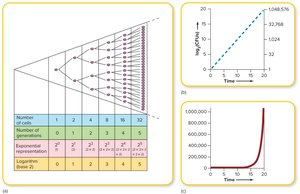
Microbial populations grow exponentially, doubling with each generation. The growth rate is measured by generation time (doubling time).
Exponential Growth Equation: Where is the population at time t, is the initial population, and is the number of generations.
Bacterial Growth Curve
The growth curve of a bacterial culture consists of four phases:
Lag Phase: Adjustment period; cells prepare for growth.
Log (Exponential) Phase: Rapid cell division and population increase.
Stationary Phase: Growth slows; nutrients become limited.
Death Phase: Cells die at an exponential rate due to depletion of resources.
Methods of Analyzing Population Growth
Viable Plate Count: Counting colonies formed on agar plates.
Turbidometry: Measuring cloudiness of a culture to estimate cell density.
Direct Microscopic Count: Counting cells using a calibrated grid.
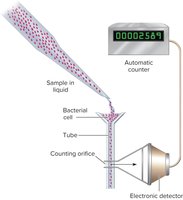
Coulter Counter and Flow Cytometer: Electronic methods for counting and differentiating cells.
Phase | Description |
|---|---|
Lag | Cells adjust, no significant growth |
Log | Rapid, exponential growth |
Stationary | Growth slows, equilibrium |
Death | Cells die, population declines |
Example: In a batch culture, the number of colonies increases over time, reflecting the exponential growth phase followed by stationary and death phases.
Additional info: These notes expand on brief points with academic context, definitions, and examples to ensure completeness and clarity for exam preparation.
