 Back
BackMicrobial Nutrition and Growth: Study Guidance
Study Guide - Smart Notes
 Tailored notes based on your materials, expanded with key definitions, examples, and context.
Q1. Define Nutrition.
Background
Topic: Microbial Nutrition
This question is testing your understanding of what nutrition means in the context of microbiology, specifically how microbes obtain and use nutrients for growth and metabolism.
Key Terms:
Nutrition: The process by which organisms acquire and use nutrients from their environment.
Nutrients: Substances required by organisms for energy, growth, and maintenance.
Step-by-Step Guidance
Consider what microbes need to survive and grow (e.g., energy sources, carbon, nitrogen, etc.).
Think about how microbes obtain these nutrients from their environment (absorption, ingestion, etc.).
Reflect on the importance of nutrients for cellular processes such as metabolism, growth, and reproduction.
Try solving on your own before revealing the answer!
Q2. Define Nutrient.
Background
Topic: Microbial Nutrition
This question is testing your ability to distinguish between the general concept of nutrition and the specific substances (nutrients) microbes require.
Key Terms:
Nutrient: Any chemical substance that an organism needs to sustain life.
Step-by-Step Guidance
Recall the types of nutrients microbes need (macronutrients like carbon, nitrogen, and micronutrients like vitamins).
Think about the role of nutrients in microbial metabolism and growth.
Consider examples of nutrients and their functions in cells.
Try solving on your own before revealing the answer!
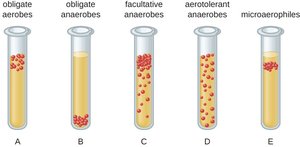
Q3. Describe each category of microbe: obligate aerobe, facultative anaerobe, microaerophile, aerotolerant anaerobe, obligate anaerobe.
Background
Topic: Oxygen Requirements of Microbes
This question is testing your understanding of how different microbes respond to oxygen and where they grow in a test tube.
Key Terms:
Obligate aerobe: Requires oxygen for growth.
Obligate anaerobe: Cannot tolerate oxygen; grows only in its absence.
Facultative anaerobe: Can grow with or without oxygen, but grows better with oxygen.
Microaerophile: Requires low levels of oxygen.
Aerotolerant anaerobe: Does not use oxygen but can tolerate its presence.
Step-by-Step Guidance
Review the definitions of each category and their oxygen requirements.
Think about where each type would grow in a test tube with a gradient of oxygen (top, bottom, throughout).
Use the provided image to visualize the growth patterns for each category.
Try solving on your own before revealing the answer!
Q4. What are 4 other environmental factors that affect microbial growth?
Background
Topic: Environmental Influences on Microbial Growth
This question is testing your knowledge of factors besides oxygen that influence microbial growth.
Key Terms:
Temperature
pH
Osmotic pressure
Salinity
Step-by-Step Guidance
List environmental factors that can affect microbial growth.
Think about how each factor influences microbial metabolism and survival.
Consider examples of microbes adapted to extreme environments (thermophiles, halophiles, etc.).
Try solving on your own before revealing the answer!
Q5. Define the following terms and give a microbial example: Symbiosis, Mutualism, Commensalism, Parasitism, Synergism, Antagonism.
Background
Topic: Microbial Interactions
This question is testing your understanding of different types of relationships between microbes and their environments or other organisms.
Key Terms:
Symbiosis: Close association between two organisms.
Mutualism: Both organisms benefit.
Commensalism: One benefits, the other is unaffected.
Parasitism: One benefits, the other is harmed.
Synergism: Cooperative interaction that benefits both.
Antagonism: One organism inhibits or destroys another.
Step-by-Step Guidance
Define each term clearly.
Think of a microbial example for each (e.g., E. coli in the gut for mutualism).
Consider how these relationships affect microbial communities and human health.
Try solving on your own before revealing the answer!
Q6. What is the process by which bacteria reproduce?
Background
Topic: Bacterial Reproduction
This question is testing your knowledge of the main method bacteria use to reproduce.
Key Terms:
Binary fission: The process by which bacteria reproduce.
Step-by-Step Guidance
Recall the steps involved in binary fission (cell growth, DNA replication, division).
Think about how binary fission leads to exponential growth.
Try solving on your own before revealing the answer!
Q7. Define growth rate and generation time.
Background
Topic: Microbial Growth Kinetics
This question is testing your understanding of how quickly bacteria grow and divide.
Key Terms:
Growth rate: The speed at which a microbial population increases.
Generation time: The time required for a population to double.
Step-by-Step Guidance
Define each term and relate it to bacterial reproduction.
Think about how environmental factors affect these rates.
Try solving on your own before revealing the answer!
Q8. How does refrigeration affect growth rate and generation time?
Background
Topic: Environmental Effects on Microbial Growth
This question is testing your understanding of how temperature influences microbial growth.
Key Terms:
Refrigeration: Lowering temperature to slow microbial growth.
Growth rate decreases, generation time increases.
Step-by-Step Guidance
Consider how temperature affects enzyme activity and metabolism in microbes.
Think about why food spoils more slowly in the refrigerator.
Try solving on your own before revealing the answer!
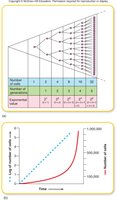
Q9. Identify and describe each phase of growth in the figure below: a, b, c, d.
Background
Topic: Bacterial Growth Curve
This question is testing your ability to interpret the phases of bacterial growth in a culture.
Key Terms:
Lag phase: Adjustment period, no growth.
Log (exponential) phase: Rapid growth.
Stationary phase: Growth rate slows, nutrients deplete.
Death phase: Cells die off.
Step-by-Step Guidance
Examine the provided graph and identify the four phases.
Describe what happens to the population in each phase.
Relate each phase to changes in nutrient availability and waste accumulation.
Try solving on your own before revealing the answer!
Q10. Calculating Bacterial Growth: How many bacteria are present after n generations?
Background
Topic: Exponential Growth of Bacteria
This question is testing your ability to use the exponential growth formula to calculate bacterial population size.
Key Formula:
Step-by-Step Guidance
Identify the starting number of bacteria and the number of generations.
Use the formula to set up the calculation.
Calculate for the given number of generations.
Multiply this value by the starting number of bacteria.
Try solving on your own before revealing the answer!
Q11. Calculating Number of Generations: If you know total culture time and generation time, how do you find the number of generations?
Background
Topic: Microbial Growth Calculations
This question is testing your ability to use time and generation time to calculate the number of generations.
Key Formula:
Step-by-Step Guidance
Identify the total culture time and the generation time (make sure units match).
Set up the formula .
Divide the total culture time by the generation time to find the number of generations.
Try solving on your own before revealing the answer!
Q12. Calculating Generation Time: If you know total culture time and number of generations, how do you find generation time?
Background
Topic: Microbial Growth Calculations
This question is testing your ability to rearrange the formula to solve for generation time.
Key Formula:
Step-by-Step Guidance
Identify the total culture time and the number of generations.
Set up the formula .
Divide the total culture time by the number of generations to find the generation time.
Try solving on your own before revealing the answer!
Q13. If a culture of E. coli has a generation time of 30 minutes and is incubated for 3 hours, how many generations will be produced?
Background
Topic: Microbial Growth Calculations
This question is testing your ability to use the formula for number of generations.
Key Formula:
Step-by-Step Guidance
Convert 3 hours to minutes (since generation time is in minutes).
Set up the formula .
Plug in the values and perform the division.
Try solving on your own before revealing the answer!
Q14. If the E. coli culture is placed at 4°C, what will happen to the generation time? Will there be more or fewer generations produced?
Background
Topic: Temperature Effects on Microbial Growth
This question is testing your understanding of how lower temperatures affect bacterial growth.
Key Concepts:
Lower temperature slows metabolism, increases generation time.
Fewer generations produced in the same time period.
Step-by-Step Guidance
Recall how temperature affects enzyme activity and cell division.
Predict the effect on generation time and number of generations.
Try solving on your own before revealing the answer!
Q15. A culture of Staphylococcus aureus has a generation time of 20 minutes and is grown for 300 minutes. How many generations will be produced?
Background
Topic: Microbial Growth Calculations
This question is testing your ability to calculate the number of generations using the formula.
Key Formula:
Step-by-Step Guidance
Identify the total culture time (300 minutes) and generation time (20 minutes).
Set up the formula .
Perform the division to find the number of generations.
Try solving on your own before revealing the answer!
Q16. A culture of Streptococcus pneumoniae is grown for 5 hours and 10 generations are produced. What is the generation time?
Background
Topic: Microbial Growth Calculations
This question is testing your ability to calculate generation time from total culture time and number of generations.
Key Formula:
Step-by-Step Guidance
Convert 5 hours to minutes if needed.
Set up the formula .
Divide to find the generation time.
Try solving on your own before revealing the answer!
Q17. A culture of Bacillus anthracis is grown for 300 minutes and 30 generations are produced. What is the generation time?
Background
Topic: Microbial Growth Calculations
This question is testing your ability to calculate generation time.
Key Formula:
Step-by-Step Guidance
Identify the total culture time and number of generations.
Set up the formula and perform the division.
Try solving on your own before revealing the answer!
Q18. You determine that the original number of cells in a sample is 12. How many bacteria will be present in 6 hours if the generation time is 15 minutes?
Background
Topic: Exponential Growth Calculations
This question is testing your ability to use the exponential growth formula.
Key Formula:
Step-by-Step Guidance
Calculate the number of generations:
Use the formula to set up the calculation.
Calculate and multiply by 12.
Try solving on your own before revealing the answer!
Q19. How many bacteria are present after 51 hours if a culture is inoculated with 1 bacterium, assuming the population doubles every 3 hours?
Background
Topic: Exponential Growth Calculations
This question is testing your ability to use the exponential growth formula.
Key Formula:
Step-by-Step Guidance
Calculate the number of generations:
Use the formula to set up the calculation.
Calculate and multiply by 1.
Try solving on your own before revealing the answer!
Q20. If you start out with a population of 200 bacteria that divide every 20 minutes, what will the population be at the end of two hours?
Background
Topic: Exponential Growth Calculations
This question is testing your ability to use the exponential growth formula.
Key Formula:
Step-by-Step Guidance
Calculate the number of generations:
Use the formula to set up the calculation.
Calculate and multiply by 200.
Try solving on your own before revealing the answer!
Q21. Salmonella has an infectious dose of approximately 1000 bacteria. An egg is contaminated with 50 bacteria, then left out for 3 hours. The bacteria divide every 30 minutes. If you eat the raw egg, will you get sick?
Background
Topic: Exponential Growth and Infectious Dose
This question is testing your ability to calculate whether the population reaches the infectious dose.
Key Formula:
Step-by-Step Guidance
Calculate the number of generations:
Use the formula to set up the calculation.
Compare the result to the infectious dose (1000 bacteria).
Try solving on your own before revealing the answer!
