 Back
BackMicrobial Nutrition and Growth: Study Guide
Study Guide - Smart Notes
 Tailored notes based on your materials, expanded with key definitions, examples, and context.
Microbial Nutrition
Essential Nutrients
Microbes require specific nutrients to survive, grow, and reproduce. These nutrients are classified based on their quantity and function:
Macronutrients: Needed in large amounts; essential for cell structure and metabolism. Examples: carbon, hydrogen, oxygen.
Micronutrients (Trace Elements): Needed in small amounts; important for enzyme function and protein structure. Examples: manganese, zinc, nickel.
Categorizing Nutrients by Carbon Content
Inorganic nutrients: Do not contain both carbon and hydrogen. Examples: water, salts, gases.
Organic nutrients: Contain both carbon and hydrogen; often products of living things. Examples: carbohydrates, proteins, lipids, nucleic acids.
Chemical Composition of Microbial Cytoplasm
Water constitutes about 70% of cell components.
Organic compounds make up 97% of dry cell weight.
Elements CHONPS (carbon, hydrogen, oxygen, nitrogen, phosphorus, sulfur) account for 96% of dry cell weight.
Nutritional Categories of Microbes
Heterotroph: Obtains carbon from organic sources.
Autotroph: Uses inorganic CO2 as carbon source; can convert CO2 into organic compounds.
Phototroph: Uses light as energy source.
Chemotroph: Uses chemical compounds for energy.
Autotrophs and Heterotrophs
Photoautotrophs: Photosynthetic; produce organic molecules using CO2.
Chemoautotrophs: Use inorganic minerals for energy and carbon.
Chemoheterotrophs: Derive both carbon and energy from organic compounds; includes saprobes (decomposers) and parasites (pathogens).
Other Important Nutrients
Potassium (K): Protein synthesis and membrane function.
Sodium (Na): Cell transport.
Calcium (Ca): Stabilizes cell wall and endospores.
Magnesium (Mg): Chlorophyll component, stabilizes membranes and ribosomes.
Iron (Fe): Cytochrome proteins in respiration.
Zinc (Zn): Regulatory element for eukaryotic genetics.
Microbial Transport Mechanisms
Diffusion and Osmosis
Microbes transport nutrients across membranes using passive and active mechanisms:
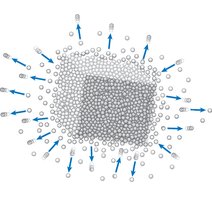
Diffusion: Movement of molecules from high to low concentration.
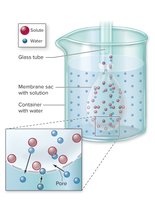
Osmosis: Diffusion of water through a selectively permeable membrane.
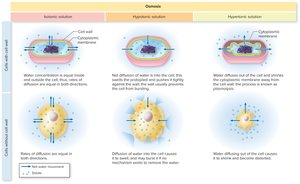
Effects of Osmotic Conditions:
Isotonic: Equal water concentration inside and outside; no net movement.
Hypotonic: Water enters cell; cell may swell.
Hypertonic: Water leaves cell; cell shrinks (plasmolysis).
Passive and Active Transport
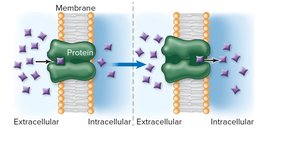
Passive Transport: Includes simple diffusion and facilitated diffusion (uses protein channels).
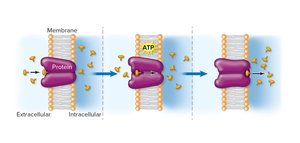
Active Transport: Requires energy (ATP) and membrane proteins; moves substances against concentration gradient.
Endocytosis
Phagocytosis: Ingestion of whole cells or large particles.
Pinocytosis: Ingestion of liquids or molecules in solution.
Microbial Growth and Environmental Factors
Temperature Requirements
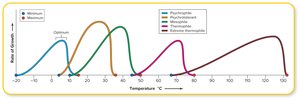
Microbes are classified by their optimal growth temperatures:
Psychrophiles: Optimum below 15°C; grow at 0°C.
Psychrotrophs: Optimum 15–30°C; can grow at refrigerator temperatures.
Mesophiles: Optimum 20–40°C; most human pathogens.
Thermoduric: Survive high temperatures briefly; usually mesophiles.
Thermophiles: Optimum above 45°C; extreme thermophiles up to 121°C.
Oxygen Requirements
Microbes differ in their need and tolerance for oxygen:
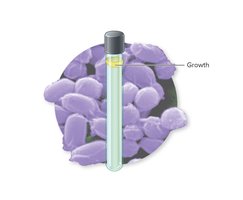
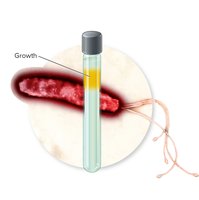
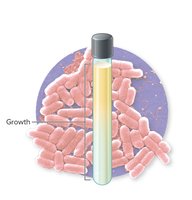
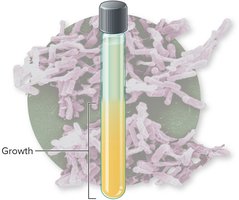
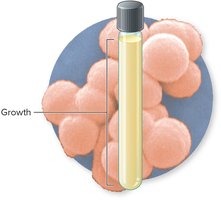
Aerobes: Require oxygen; possess enzymes to detoxify oxygen by-products.
Obligate Aerobes: Cannot grow without oxygen.
Microaerophiles: Require small amounts of oxygen; harmed by atmospheric levels.
Facultative Anaerobes: Use oxygen if present, but can grow without it.
Anaerobes: Cannot use or detoxify oxygen; die in its presence.
Aerotolerant Anaerobes: Do not use oxygen but can survive in its presence.
Other Environmental Factors
pH: Most microbes grow between pH 6 and 8; acidophiles and alkalinophiles thrive at extremes.
Osmotic Pressure: Halophiles require high salt; osmophiles tolerate high solute concentrations.
Radiation: Phototrophs use light; some microbes produce pigments to protect against light damage.
Pressure: Barophiles live under high pressure; rupture at normal atmospheric pressure.
Microbial Associations and Biofilms
Types of Microbial Associations
Mutualism: Both organisms benefit.
Commensalism: One benefits, the other is unaffected.
Parasitism: One benefits, the other is harmed.
Antagonism: Competition; production of inhibitory compounds.
Synergism: Cooperative interaction; not obligatory.
Biofilms
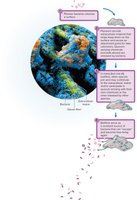
Biofilms are complex communities of microbes attached to surfaces. They form through a series of steps:
Pioneer bacteria colonize a surface.
Secrete extracellular material for attachment.
Other species join and contribute to the matrix.
Biofilms release bacteria to become free-living.
Quorum sensing: Communication between cells to monitor population size.
Bacterial Growth and Population Dynamics
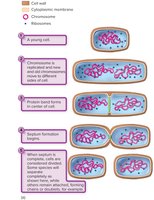
Binary Fission
Bacteria reproduce by binary fission, a process involving:
Cell enlargement
Chromosome duplication
Formation of a septum
Division into two daughter cells
Population Growth
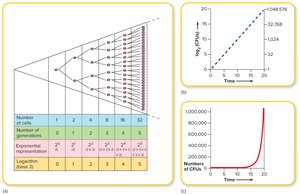
Bacterial populations grow exponentially under favorable conditions. The generation time (doubling time) is the time required for one cell to divide into two.
Average generation time: 30–60 minutes
Equation for population size: where is the total number of cells at time t, is the starting number, and is the number of generations.
Bacterial Growth Curve
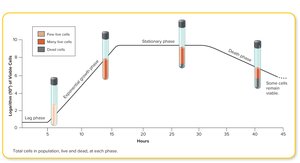
Growth in a closed system follows four phases:
Lag phase: Adjustment, no rapid growth.
Exponential (log) phase: Rapid, geometric increase.
Stationary phase: Birth and death rates equal; nutrients depleted.
Death phase: Cells die at an exponential rate; some remain viable but nonculturable.
Measuring Bacterial Growth
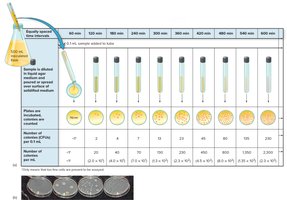
Viable Plate Count: Dilute and plate samples; count colonies to estimate population size.
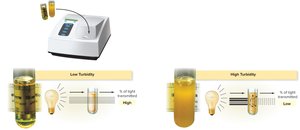
Turbidity: Cloudiness of a culture indicates population size; measured with a spectrophotometer.
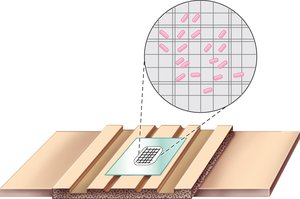
Direct Microscopic Count: Count cells on a grid under a microscope.
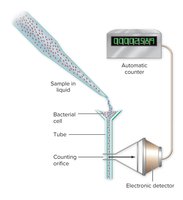
Coulter Counter: Electronic device counts cells as they pass through a detector.
Flow Cytometer: Measures cell size and differentiates live/dead cells.
Genetic Probing: Uses PCR to quantify bacteria in samples.
Summary Table: Essential Nutrients
Element | Source | Function |
|---|---|---|
Carbon | CO2, organic compounds | Cell structure, metabolism |
Hydrogen | H2O, organic compounds | Maintains pH, forms hydrogen bonds |
Oxygen | O2, H2O | Metabolism, cell structure |
Nitrogen | N2, NO3-, NH3 | Amino acids, nucleic acids |
Phosphorus | PO43-, H3PO4 | Nucleic acids, ATP |
Sulfur | SO42-, H2S | Amino acids, vitamins |
Potassium | K+ | Protein synthesis, membrane function |
Sodium | Na+ | Cell transport |
Calcium | Ca2+ | Cell wall, endospore stability |
Magnesium | Mg2+ | Chlorophyll, membrane stability |
Iron | Fe2+, Fe3+ | Respiration |
Zinc | Zn2+ | Enzyme regulation |
Additional info: Academic context and explanations have been expanded for clarity and completeness. All images included are directly relevant to the adjacent content and reinforce key concepts.
