 Back
Microbial Nutrition and Growth: Symbiosis, Biofilms, Culturing, and Measurement
Study Guide - Smart Notes
 Tailored notes based on your materials, expanded with key definitions, examples, and context.
Ecological Associations and Symbiosis
Types of Symbiotic Relationships
Microorganisms often live in close association with other species, forming various types of symbiotic relationships. These relationships are crucial for understanding microbial ecology and the impact of microbes on their environments.
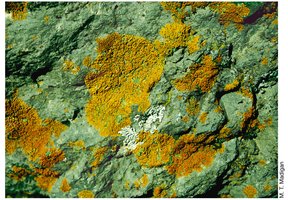
Mutualism: Both organisms benefit from the association. Example: Lichens are a mutualistic relationship between fungi and photosynthetic algae or cyanobacteria.
Commensalism: One organism benefits, while the other is neither helped nor harmed.
Parasitism: One organism benefits at the expense of the other, which is harmed.
Example: Lichens are a classic example of microbial mutualism, where the fungus provides structure and protection, while the photosynthetic partner supplies nutrients.
Biofilms
Importance and Development of Biofilms
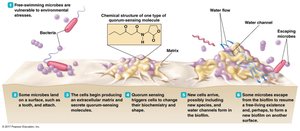
Biofilms are complex communities of microorganisms attached to surfaces and embedded in a self-produced extracellular matrix. They are significant in natural, industrial, and clinical settings due to their resilience and role in chronic infections.
Formation: Begins with the attachment of planktonic (free-living) cells to a surface, followed by the production of extracellular polymeric substances (EPS).
Quorum Sensing: Cell-to-cell communication mechanism that coordinates gene expression and behavior in response to cell density.
Ecological Impact: Biofilms protect microbes from environmental stresses, antibiotics, and the immune system.
Examples: Dental plaque is a common biofilm found on teeth.
Culturing Microorganisms
Obtaining and Maintaining Pure Cultures
To study microorganisms, it is essential to isolate and cultivate them in pure cultures. A pure culture contains cells derived from a single progenitor, known as a colony-forming unit (CFU).
Aseptic Technique: Procedures used to prevent contamination of cultures and the environment.
Isolation Methods: The two most common techniques are the streak plate and pour plate methods.
Streak Plate Method
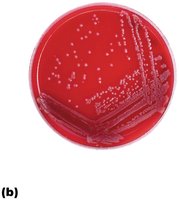
This method involves spreading a microbial sample over the surface of an agar plate to obtain isolated colonies.
Pour Plate Method
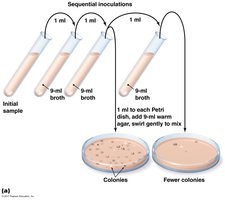
In this technique, diluted samples are mixed with molten agar and poured into Petri dishes, allowing colonies to grow both on the surface and within the medium.
Types of Culture Media
Classification and Applications
Culture media provide the nutrients required for microbial growth. The choice of medium depends on the nutritional needs of the microorganism and the experimental objectives.
Defined (Synthetic) Media: Composed of precise amounts of pure chemicals; the exact composition is known.
Complex Media: Contain extracts from natural sources (e.g., yeast, meat); composition is not precisely known.
Enriched Media: Supplemented with additional nutrients to support the growth of fastidious organisms.
Selective Media: Inhibit the growth of some organisms while allowing others to grow.
Differential Media: Distinguish between different types of microorganisms based on their biological characteristics.
Anaerobic Media: Designed to support the growth of anaerobes by removing oxygen.
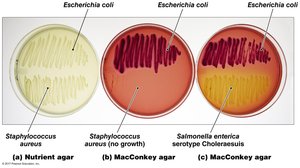
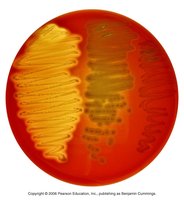
Example: MacConkey agar is both selective (for Gram-negative bacteria) and differential (lactose fermenters appear pink).
Example: Blood agar is enriched and differential, allowing the observation of hemolysis patterns (α, β, γ).
Batch Microbial Growth Phases
Phases of Growth in a Closed System
When microorganisms are grown in a batch culture (closed system), their population size changes in a characteristic pattern with four distinct phases:
Lag Phase: Cells adapt to new environment; little or no cell division occurs.
Log (Exponential) Phase: Rapid cell division and population growth; cells are most metabolically active.
Stationary Phase: Growth rate slows as nutrients are depleted and waste accumulates; number of new cells equals number of dying cells.
Death (Decline) Phase: Cells die at an exponential rate due to lack of nutrients and accumulation of toxic products.

Bacterial Growth Equations
Mathematical Description of Population Growth
Bacteria reproduce by binary fission, leading to exponential population growth. The following equations describe this process:
Population after time t:
Number of generations:
Logarithmic form:
Where: Nt = number of cells at time t, N0 = initial number of cells, n = number of generations, t = time, g = generation time.
Example: If 1,000 cells grow to 100 million in 6 hours, the generation time can be calculated using the above equations.
Measuring Bacterial Growth
Direct and Indirect Methods
Microbial growth can be measured by several methods, each with specific applications and limitations.
Direct Methods (No Incubation): Count both live and dead cells. Examples: Microscopic counts (Petroff-Hausser chamber), electronic counters (Coulter counter).
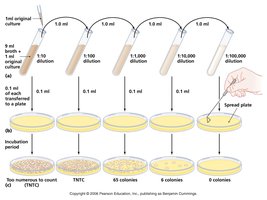
Direct Methods (With Incubation): Count only live cells. Examples: Serial dilution and viable plate counts, membrane filtration.
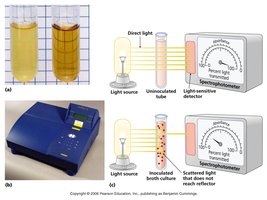
Indirect Methods: Estimate cell numbers based on turbidity (spectrophotometry), metabolic activity, dry weight, or molecular methods (e.g., qPCR).
Solving Dilution Problems
To determine the number of organisms per milliliter in an original culture using plate counts:
Calculate the dilution factor for each step and the cumulative dilution.
Use the formula: Number of organisms/ml = (Average number of colonies) × (1/dilution factor) / Amount plated
Example: If 200 colonies are counted on a plate from a 1:105 dilution and 0.2 ml was plated, the original concentration is:
