 Back
BackMicrobial Nutrition, Ecology, and Growth: Essential Elements and Metabolic Strategies
Study Guide - Smart Notes
 Tailored notes based on your materials, expanded with key definitions, examples, and context.
Microbial Nutrition: Essential Elements and Growth Factors
CHNOPS and the Building Blocks of Life
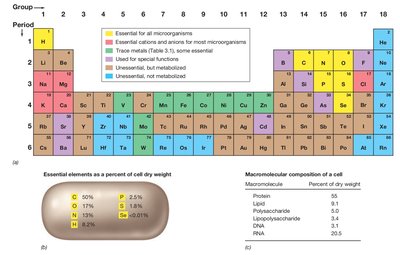
Microbial cells require a variety of chemical elements to build cellular structures and sustain life. The most important elements are often summarized by the acronym CHNOPS: Carbon (C), Hydrogen (H), Nitrogen (N), Oxygen (O), Phosphorus (P), and Sulfur (S). These elements are fundamental to the structure and function of macromolecules such as proteins, nucleic acids, lipids, and carbohydrates.
Carbon (C): Found in all organic molecules; forms the backbone of cellular structures.
Hydrogen (H): Present in water and organic compounds; involved in energy transfer and pH balance.
Nitrogen (N): Essential for amino acids, nucleic acids, and some coenzymes.
Oxygen (O): Component of water, many organic molecules, and is involved in cellular respiration.
Phosphorus (P): Found in nucleic acids (DNA, RNA), ATP, and phospholipids.
Sulfur (S): Present in some amino acids (cysteine, methionine) and vitamins.
Microbes obtain these elements from various sources in their environment, such as water, air, and organic matter.
Macronutrients vs. Micronutrients
Microbial nutrition distinguishes between macronutrients (required in large amounts) and micronutrients or trace elements (required in small amounts). Macronutrients include CHNOPS, potassium (K), magnesium (Mg), calcium (Ca), and iron (Fe). Micronutrients such as zinc (Zn), copper (Cu), nickel (Ni), and molybdenum (Mo) are often involved in enzyme function and structural stability.
Macronutrients: Structural and functional roles in cells (e.g., proteins, nucleic acids, cell walls).
Micronutrients: Serve as cofactors for enzymes and are essential for specific biochemical reactions.
Growth Factors
Some microbes require growth factors—organic compounds they cannot synthesize themselves. These include certain amino acids, vitamins, and nucleotides. Humans also require some of these as dietary essentials.
Vitamins: Often function as enzyme cofactors (e.g., NAD+, FAD).
Essential amino acids: Required for protein synthesis if not synthesized by the organism.
Electron carriers: Molecules like NAD+ and FAD are vital for energy metabolism.
Microbial Metabolic Strategies: Carbon and Energy Sources
Carbon Acquisition: Autotrophy vs. Heterotrophy
Microbes are classified based on how they acquire carbon:
Autotrophs: Use inorganic carbon (CO2) as their carbon source. They "fix" carbon into organic molecules through processes like photosynthesis or chemosynthesis.
Heterotrophs: Obtain carbon from organic compounds produced by other organisms.
Example: The cyanobacterium Anabaena is an autotroph capable of nitrogen fixation, allowing it to utilize atmospheric nitrogen that many other organisms cannot.
Energy Acquisition: Phototrophy, Chemotrophy, and Methanogenesis
Microbes also differ in how they obtain energy:
Phototrophs: Capture light energy to drive cellular processes (e.g., cyanobacteria).
Chemotrophs: Obtain energy from chemical compounds, which may be organic (chemoorganotrophs) or inorganic (chemolithotrophs).
Methanogens: Unique archaea that produce methane (CH4) from CO2 and H2.
Classification Table: Microbial Nutrition Types
Energy Source | Carbon Source | Example | Type |
|---|---|---|---|
Light | CO2 | Cyanobacteria | Photoautotroph |
Light | Organic compounds | Some purple non-sulfur bacteria | Photoheterotroph |
Chemicals (inorganic) | CO2 | Nitrifying bacteria | Chemoautotroph |
Chemicals (organic) | Organic compounds | Most bacteria, fungi | Chemoheterotroph |
Microbial Ecology: Environmental Adaptations and Symbiosis
Microbial Communities in Extreme Environments
Microbes inhabit diverse environments, including extreme habitats such as hot springs and deep-sea hydrothermal vents. These environments often feature stratified microbial communities, with different metabolic types occupying distinct layers based on light and chemical gradients.
Oxygenic phototrophs: Such as filamentous cyanobacteria, dominate the upper layers where light and oxygen are available.
Anoxygenic phototrophs: Such as certain filamentous bacteria, thrive in lower, less oxygenated layers and use alternative electron donors (e.g., H2S).

Symbiosis: Hydrothermal Vent Tube Worms and Bacterial Partners
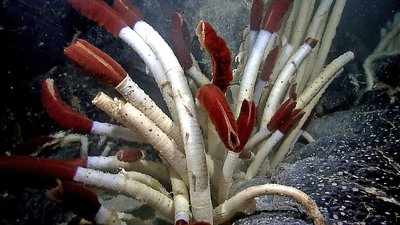
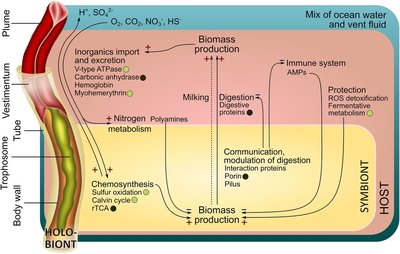
Some of the most remarkable microbial partnerships occur in deep-sea hydrothermal vents. The giant tube worm Riftia pachyptila harbors symbiotic bacteria (e.g., Candidatus Endoriftia persephone) that perform chemosynthesis, converting inorganic chemicals from vent fluids into organic matter that feeds the host.
Host: The tube worm provides a protected environment and access to vent chemicals.
Symbiont: The bacteria oxidize hydrogen sulfide (H2S) and fix CO2 into organic compounds.
Mutualism: Both partners benefit—the worm receives nutrition, and the bacteria gain a stable habitat.
Summary Table: Essential Elements and Macromolecular Composition
Element | Percent of Cell Dry Weight | Major Macromolecule(s) |
|---|---|---|
C | 50 | Proteins, lipids, carbohydrates, nucleic acids |
O | 20 | Proteins, lipids, carbohydrates, nucleic acids |
N | 14 | Proteins, nucleic acids |
H | 8 | All macromolecules |
P | 3 | Nucleic acids, phospholipids |
S | 1 | Proteins (some amino acids) |
Key Equations in Microbial Nutrition
Photosynthesis (Oxygenic):
Chemosynthesis (Sulfur-oxidizing bacteria):
Conclusion
Microbial nutrition and ecology are defined by the ability of microbes to acquire essential elements and energy from their environment. Their metabolic diversity allows them to colonize nearly every habitat on Earth, from sunlit surfaces to the darkest ocean depths. Understanding these processes is fundamental to microbiology and has broad implications for ecology, biotechnology, and human health.
