 Back
Microbial Nutrition, Growth, and Population Dynamics
Study Guide - Smart Notes
 Tailored notes based on your materials, expanded with key definitions, examples, and context.
Growth of Microbial Populations
Overview of Microbial Growth Requirements
Microbial growth is dependent on a variety of chemical and physical requirements. Understanding these requirements is essential for studying microbial physiology, ecology, and applications in medicine and industry.
Chemical Requirements: Carbon, nitrogen, sulfur, phosphorus, trace elements, oxygen, and organic growth factors.
Physical Requirements: Temperature, pH, osmotic pressure, hydrostatic pressure.
Microbial Nutritional Types
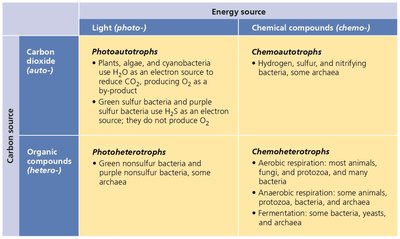
Microbes are classified based on their sources of carbon, energy, and electrons. These classifications help explain their ecological roles and metabolic capabilities.
Carbon Source: Autotrophs use CO2; Heterotrophs use organic compounds.
Energy Source: Chemotrophs use chemicals; Phototrophs use light.
Electron Source: Organotrophs use organic molecules; Lithotrophs use inorganic molecules.
Oxygen Requirements and Metabolism
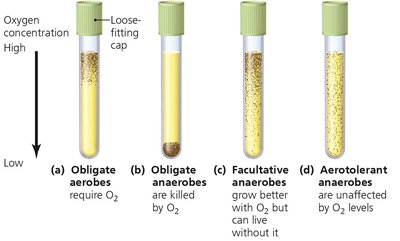
Oxygen is a critical factor in microbial metabolism. Its presence or absence determines the types of metabolic pathways microbes use and their ability to detoxify reactive oxygen species (ROS).
Obligate aerobes: Require oxygen for survival.
Obligate anaerobes: Oxygen is toxic; rely on anaerobic processes.
Facultative anaerobes: Can use oxygen but also survive without it.
Aerotolerant anaerobes: Survive in oxygen due to detoxifying enzymes.
Microaerophiles: Require low levels of oxygen.
Capnophiles: Thrive in high CO2 and low O2 environments.
Reactive Oxygen Species (ROS) and Detoxification
Toxic forms of oxygen include singlet oxygen, superoxide radicals, peroxide anion, and hydroxyl radical. Microbes use enzymes such as superoxide dismutase, catalase, and peroxidase to detoxify ROS.
Superoxide dismutase:
Catalase:
Peroxidase:
Nitrogen, Sulfur, Phosphorus, Trace Elements, and Growth Factors
Nitrogen is essential for anabolic processes, including protein and nucleotide synthesis. Most organisms require ammonia or nitrate rather than atmospheric nitrogen. Nitrogen fixation by certain bacteria is vital for life on Earth.

Phosphorus: Component of DNA, RNA, ATP, and membranes.
Sulfur: Found in amino acids, thiamine, and biotin.
Trace elements: Required in small amounts, often as enzyme cofactors.
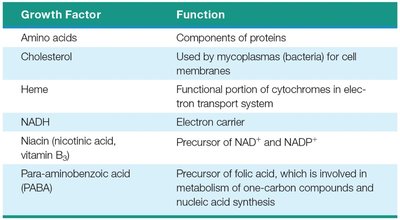
Growth factors: Organic chemicals required for growth but not synthesized by some organisms.
Temperature Requirements
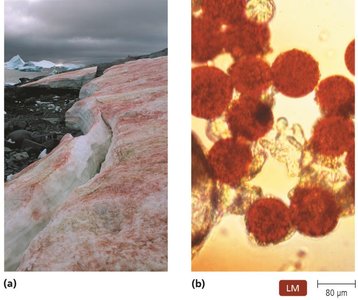
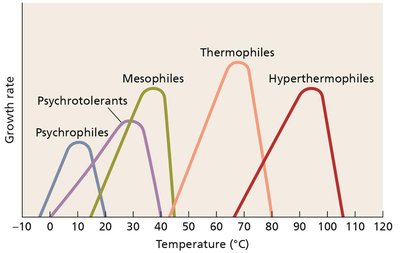
Temperature affects microbial growth by altering protein and membrane stability. Microbes are categorized by their optimal growth temperature.
Psychrophiles: Grow best below 15°C.
Mesophiles: Grow best between 20°C and 40°C; most human pathogens are mesophiles.
Thermophiles: Grow above 45°C.
Hyperthermophiles: Grow above 100°C.
pH Requirements
Microbes are sensitive to pH, which affects protein and nucleic acid structure. Most pathogenic bacteria are neutrophiles, growing best at pH 6.5–7.5. Acidophiles and alkalinophiles thrive in extreme pH environments.
Water, Osmotic, and Hydrostatic Pressure
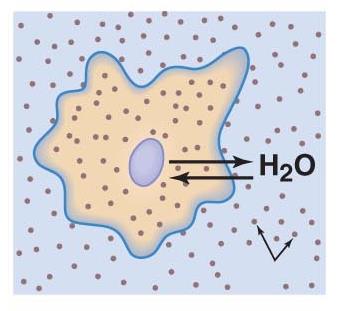
Water is essential for microbial survival. Osmotic pressure and hydrostatic pressure influence microbial growth and restrict organisms to specific environments.
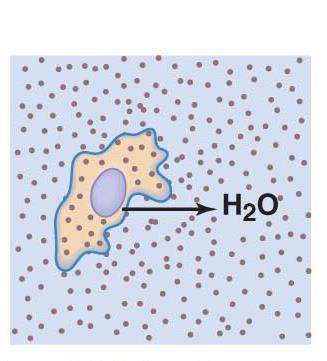
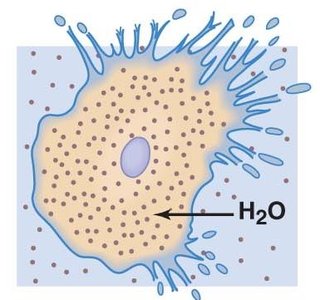
Osmotic pressure: Pressure exerted by solutes across a membrane.
Hypotonic solution: Cell swells as water enters.
Hypertonic solution: Cell shrivels as water leaves.
Halophiles: Require high salt concentrations.
Barophiles: Thrive under high hydrostatic pressure.
Microbial Associations and Biofilms
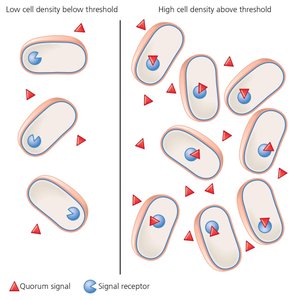
Microbes often live in association with other species, forming antagonistic, synergistic, or symbiotic relationships. Biofilms are complex communities that form on surfaces and involve quorum sensing.
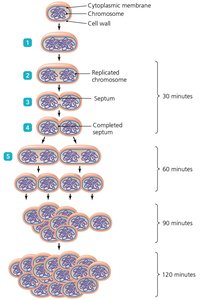
Microbial Reproduction: Binary Fission
Most microorganisms reproduce by binary fission, resulting in exponential population growth. Generation time is the period required for a cell to divide or a population to double.
Binary fission: One cell divides into two genetically identical daughter cells.
Generation time formula:
Population size formula:
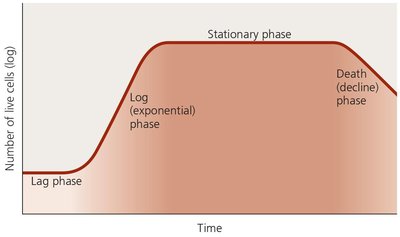
Microbial Growth Curve
Microbial populations exhibit distinct growth phases: lag, log (exponential), stationary, and death (decline). Growth rate is best visualized using logarithmic scales.
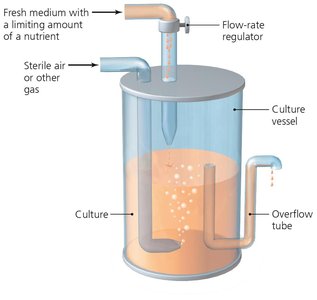
Continuous Culture: Chemostats
Chemostats are used to maintain microbial populations in a specific growth phase by continuously adding fresh medium and removing old medium. This technique is valuable in industrial microbiology.
Measuring Microbial Reproduction
Estimating microbial population size is important in medical and research settings. Methods are classified as direct or indirect.
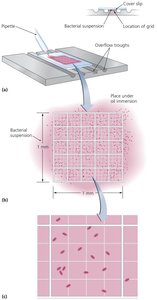
Direct methods: Count cells directly (e.g., electronic counters, microscopic counters, viable plate counts, membrane filtration, most probable number).
Indirect methods: Estimate population size based on metabolic activity, turbidity, dry weight, or molecular methods.
Summary Table: Most Probable Number (MPN)
The MPN method uses statistical probability to estimate the number of bacteria in a sample based on the number of positive tubes in serial dilutions.
Positive Tubes (Dilution 1) | Positive Tubes (Dilution 2) | Positive Tubes (Dilution 3) | MPN per 100 mL |
|---|---|---|---|
4 | 0 | 0 | 13 |
4 | 0 | 1 | 17 |
4 | 1 | 0 | 17 |
4 | 1 | 1 | 21 |
4 | 1 | 2 | 26 |
4 | 2 | 0 | 22 |
4 | 2 | 1 | 26 |
4 | 3 | 0 | 27 |
4 | 3 | 1 | 33 |
4 | 4 | 0 | 34 |
5 | 0 | 0 | 23 |
5 | 0 | 1 | 30 |
5 | 0 | 2 | 40 |
5 | 1 | 0 | 30 |
5 | 1 | 1 | 50 |
5 | 1 | 2 | 60 |
5 | 2 | 0 | 50 |
5 | 2 | 1 | 70 |
5 | 2 | 2 | 90 |
5 | 3 | 0 | 80 |
5 | 3 | 1 | 110 |
5 | 3 | 2 | 140 |
5 | 3 | 3 | 170 |
5 | 4 | 0 | 130 |
5 | 4 | 1 | 170 |
5 | 4 | 2 | 220 |
5 | 4 | 3 | 280 |
5 | 4 | 4 | 350 |
Indirect Methods: Turbidity and Other Approaches
Turbidity, measured by spectrophotometry, is an indirect method for estimating population size. Other methods include measuring metabolic activity, dry weight, and molecular techniques for unculturable microbes.
Example:
In clinical microbiology, viable plate counts and MPN are used to estimate bacterial load in patient samples, while turbidity is used in industrial fermentation monitoring.
