 Back
BackMicrobial Pathogenesis: Mechanisms and Clinical Implications
Study Guide - Smart Notes
 Tailored notes based on your materials, expanded with key definitions, examples, and context.
Microbial Pathogenesis
Introduction to Pathogenesis
Microbial pathogenesis refers to the mechanisms by which microorganisms cause disease in a host. Understanding these mechanisms is essential for diagnosing, treating, and preventing infectious diseases.
Pathogen: An organism capable of causing disease.
True pathogens: Cause disease in hosts with normal immune defenses.
Opportunistic pathogens: Cause disease when host defenses are compromised (e.g., wounds, age, stress, other diseases).
Virulence: The degree of pathogenicity or severity of disease caused by a microbe.
Virulence factor: Any characteristic or structure of the microbe that contributes to its ability to cause disease.
Contact, Colonization, Infection, and Disease
Normal Flora and Infection
The human body is colonized by a variety of microorganisms, known as normal (resident) flora, which typically do not cause disease and may even provide benefits. However, under certain conditions, these organisms can become pathogenic.
Transients: Microbes that occupy the body for only short periods.
Residents: Microbes that become established and are typically harmless unless displaced.
Superinfections: Overgrowth of certain microbes when the normal flora is disrupted.
Infection: The invasion and multiplication of pathogenic microbes in the body.
Infectious disease: An infection that causes damage or disruption to tissues or organs.
Biosafety Levels
Laboratory Safety and Pathogen Handling
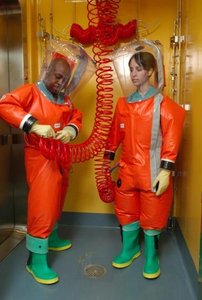
Biosafety levels (BSL) are classifications for laboratory practices, safety equipment, and facility design based on the risk associated with handling particular pathogens.
BSL-1: Low risk; standard microbiological practices.
BSL-2: Moderate risk; additional precautions such as biosafety cabinets.
BSL-3: High risk; pathogens may cause severe or lethal disease, especially via inhalation.
BSL-4: Extreme risk; dangerous and exotic agents with no available treatments or vaccines.
Universal Precautions
Preventing Transmission in Healthcare Settings
Universal precautions are a set of guidelines to prevent the transmission of infectious agents in healthcare environments, assuming all patients and specimens may be infectious.
Wear gloves when handling body fluids; change gloves and wash hands frequently.
Use masks, protective eyewear, and gowns during procedures that may generate droplets.
Handle needles and sharps carefully; dispose in puncture-proof containers.
Use resuscitation devices instead of mouth-to-mouth if possible.
Avoid patient care if you have open skin lesions.
Vaccinate when possible.
Portals of Entry
How Microbes Enter the Host
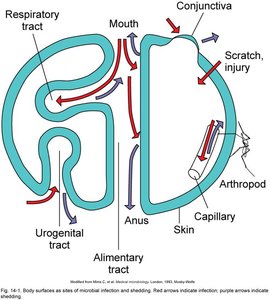
Microorganisms can enter the body through various portals, each presenting unique challenges for infection prevention.
Skin: Usually an effective barrier unless breached by cuts, abrasions, or bites.
Gastrointestinal tract: Entry via ingestion of contaminated food or water.
Respiratory tract: Entry through inhalation of airborne particles.
Urogenital tract: Entry during sexual contact or displacement of organisms.
Transplacental: Pathogens crossing the placenta from mother to fetus.
Requirement for an Infectious Dose (ID)
Minimum Number of Microbes Needed for Infection
The infectious dose (ID) is the minimum number of microbes required to establish an infection. This number varies greatly among different pathogens.
Measles virus: As few as 1 particle can cause infection.
Yersinia pestis: 100–500 cells.
Neisseria gonorrhoeae: 1,000 cells.
Vibrio cholerae: 100,000,000 cells.
Attaching to the Host
Mechanisms of Microbial Adhesion
Successful colonization requires that microbes attach to host tissues using specific structures or molecules.
Viruses: Surface proteins called "spikes" mediate attachment.
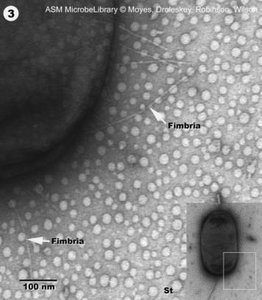
Bacteria: Fimbriae (adhesins), pili, flagella, and glycocalyx facilitate binding.
Eukaryotic pathogens: Structures such as flagella, cilia, suckers, hooks, and barbs aid in attachment.
Surviving Host Defenses
Microbial Strategies to Evade Immunity
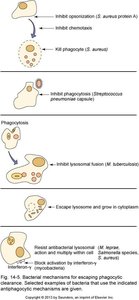
Pathogens have evolved various mechanisms to evade or inhibit host immune responses, allowing them to survive and proliferate.
Inhibition of complement activation.
Antiphagocytic factors (e.g., capsules, slime layers).
Leukocidins that kill white blood cells.
Escape from phagocytic digestion or survival within cells.
Inhibition of specific immunity (e.g., IgA/IgG proteases, protein A).
Antigenic variation or mimicry.
Down-regulation of MHC molecules by viruses.
Virulence Factors: Entry and Damage
Exoenzymes and Toxins
Microbes produce various substances that facilitate invasion and cause damage to host tissues.
Exoenzymes: Secreted enzymes that break down host defenses (e.g., hyaluronidase, mucinase, coagulase).
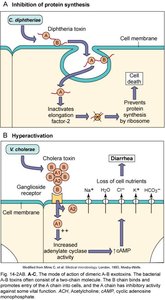
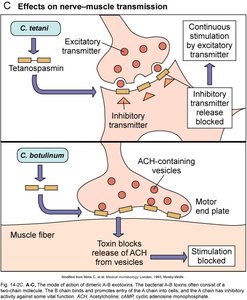
Exotoxins: Protein toxins secreted by living bacteria, highly antigenic, and can be converted to toxoids for vaccines.
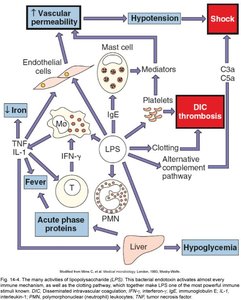
Endotoxins: Lipopolysaccharide (LPS) components of Gram-negative bacteria, released upon cell death, weakly antigenic, and heat stable.
Feature | Exotoxins | Endotoxins |
|---|---|---|
Chemical Nature | Protein | LPS (lipid A) |
Source | Gram+ and Gram- bacteria | Gram- bacteria only |
Heat Stability | Unstable | Stable |
Antigenicity | High | Low |
Toxicity | High | Moderate |
Fever | Usually no | Yes (pyrogenic) |
Stages of Clinical Infections
Progression of Infectious Disease
Infectious diseases typically progress through several stages, each with characteristic signs and symptoms.
Incubation period: Time between entry of microbe and appearance of symptoms.
Prodromal stage: Early, mild symptoms.
Acute stage: Peak of disease with most severe symptoms.
Decline stage: Symptoms begin to subside.
Convalescent stage: Recovery and return to health.
Some infections may be asymptomatic (subclinical) but still transmissible.
Signs, Symptoms, and Syndromes
Clinical Manifestations of Disease
Symptom: Subjective evidence of disease (e.g., pain, fatigue) reported by the patient.
Sign: Objective evidence of disease (e.g., fever, rash) observed or measured by others.
Syndrome: A group of signs and symptoms that collectively characterize a disease.
Persistence of Microbes and Pathologic Conditions
Chronicity, Latency, and Sequelae
Not all infections resolve with the elimination of the microbe; some may persist or cause lasting damage.
Latency: Microbe remains inactive in the host and can reactivate later.
Chronic infection: Microbe is continuously present, often with mild or no symptoms.
Sequelae: Long-term or permanent damage remaining after the infection is cleared.
Sources and Reservoirs of Microbes
Where Pathogens Originate and How They Spread
Source: The immediate individual or object from which an infection is acquired.
Reservoir: The primary habitat of the pathogen (e.g., humans, animals, soil, water).
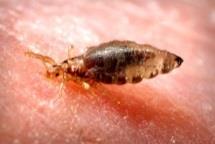
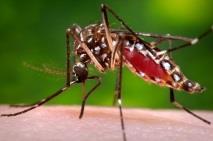
Vector: A living organism (often arthropods) that transmits pathogens between hosts.
Biological vector: The vector is infected and essential to the pathogen's life cycle.
Mechanical vector: The vector carries the pathogen without being infected.
Zoonosis: Diseases that are naturally transmissible from animals to humans.

Communicable and Non-Communicable Diseases
Modes of Transmission
Communicable diseases: Can be transmitted from one host to another (direct or indirect).
Direct transmission: Physical contact, droplets, vertical (mother to child), biological vectors.
Indirect transmission: Fomites (inanimate objects), food, water, aerosolization.
Non-communicable diseases: Not transmitted between hosts (e.g., tetanus, botulism).

Nosocomial Infections
Healthcare-Associated Infections
Nosocomial infections are acquired in healthcare settings and are a significant cause of morbidity and mortality.
Sources include surgical procedures, contaminated equipment, healthcare personnel, and drug-resistant organisms.
Common sites: urinary tract, respiratory tract, surgical incisions.
Prevention relies on strict adherence to infection control protocols.
