Back
Microbial Regulatory Systems: Mechanisms of Gene Expression Control in Bacteria
Study Guide - Smart Notes
 Tailored notes based on your materials, expanded with key definitions, examples, and context.
Microbial Regulatory Systems
Overview of Gene Expression and Regulation
Microbial cells employ sophisticated regulatory systems to control gene expression, ensuring that proteins are produced only when needed. Regulation occurs at multiple levels, including transcription, translation, and post-translational modification. The predominant mechanism in bacteria is transcriptional regulation, which allows cells to respond rapidly to environmental changes.
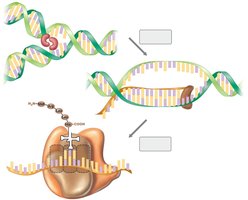
Gene expression: Transcription of DNA into messenger RNA (mRNA), followed by translation of mRNA into protein.
Constitutive expression: Some proteins are always needed and are expressed at constant levels.
Regulated expression: Most proteins are produced only under specific conditions.
Regulation mechanisms: Control of protein activity (post-translational modification), transcription, and translation.
Gene Organization: Operons and Polycistronic mRNA
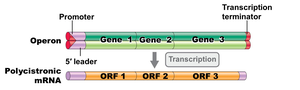
Bacterial genes are often organized into operons, which are clusters of genes transcribed together under the control of a single regulatory site. This arrangement allows coordinated expression of genes involved in related functions, such as biosynthesis of amino acids.
Operon: A group of genes transcribed from one promoter, producing a single polycistronic mRNA.
Promoter: Site where RNA polymerase binds to initiate transcription.
Terminator: Site where transcription ends.
Polycistronic mRNA: mRNA that encodes multiple proteins.
Major Modes of Regulation
Negative Control: Repression and Induction
Negative control involves repressor proteins that prevent transcription by binding to operator sites near promoters. Repressors are allosteric, meaning their conformation changes upon binding to effector molecules.
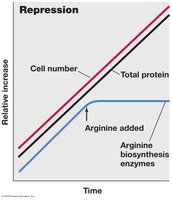
Repression: Synthesis of enzymes is prevented in response to a signal, often the presence of the end product of a biosynthetic pathway.
Induction: Production of enzymes is triggered by the presence of a substrate.
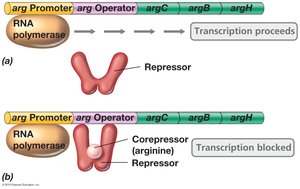
Repression Example: Arginine Biosynthesis
When arginine is present, its biosynthetic enzymes are repressed, reducing their synthesis.
Mechanism of Repression
The effector molecule (e.g., arginine) acts as a co-repressor, binding to the repressor and enabling it to bind DNA, blocking transcription.
Induction Example: Lactose Utilization
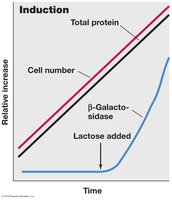
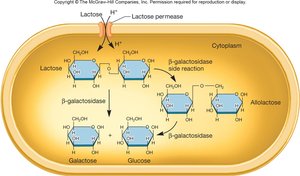
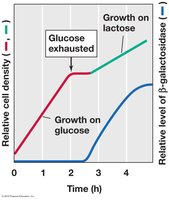
The presence of lactose induces expression of β-galactosidase, which cleaves lactose into glucose and galactose.
Mechanism of Induction
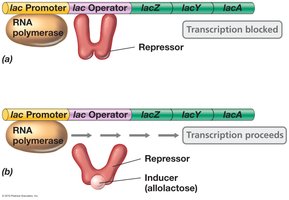
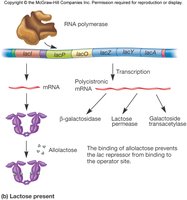
The effector molecule (e.g., lactose) acts as an inducer, binding to the repressor and inactivating it, allowing transcription to proceed.
Positive Control: Activator Proteins
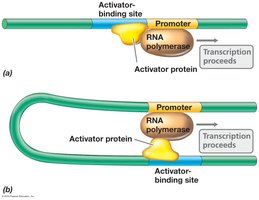
Positive control involves activator proteins that enhance transcription by helping RNA polymerase bind to the promoter. Promoters under positive control bind RNA polymerase weakly without the activator.
Activator protein: Binds to activator binding site near the promoter, increasing transcription.
Mechanisms: Bending DNA or direct interaction with RNA polymerase.
Positive Control of Maltose Operon
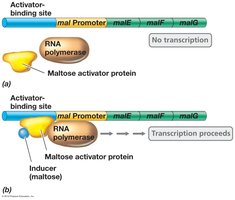
The maltose operon is activated by a maltose activator protein in the presence of maltose.
Activator Binding Sites and DNA Looping
Activator binding sites may be near or upstream of the promoter. DNA looping allows activator proteins to interact with RNA polymerase.
Regulons and Global Control
Regulons
Regulons are groups of operons controlled by the same regulatory protein, allowing coordinated regulation of multiple gene clusters. Regulons can be under positive or negative control, and some operons have multiple promoters with distinct control systems.
The Lac Operon: Structure and Regulation
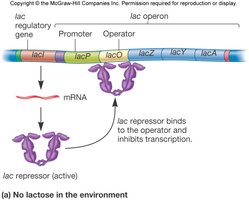
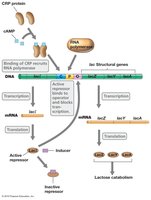
The lac operon is a classic example of gene regulation in bacteria. It consists of structural genes (lacZ, lacY, lacA) and regulatory elements (promoter, operator, CAP site). Expression is controlled by the lac repressor (LacI), which binds to the operator unless lactose is present.
lacZ: Encodes β-galactosidase.
lacY: Encodes lactose permease.
lacA: Encodes transacetylase.
LacI: Encodes the repressor protein.
Lac Operon Regulation
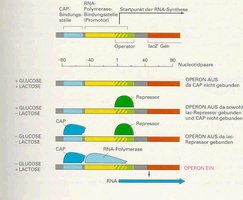
In the absence of lactose, the lac repressor binds to the operator, blocking transcription. When lactose is present, it acts as an inducer, binding to the repressor and preventing it from binding to the operator, allowing transcription.
Global Control Systems: Catabolite Repression
Catabolite Repression and the lac Operon
Global control systems regulate the expression of many genes in response to environmental signals. Catabolite repression ensures that the preferred carbon source (e.g., glucose) is used first. The presence of glucose represses the synthesis of enzymes for other carbon sources.
CRP (cyclic AMP receptor protein): Activator protein that recruits RNA polymerase to catabolic operons.
cAMP: Allosteric activator; CRP binds DNA only after binding cAMP.
High glucose lowers cAMP, inactivating CRP and preventing activation of catabolic operons.
Diauxic Growth
Diauxic growth is observed when two energy sources are available. Cells first use the preferred source (glucose), then switch to the second (lactose), resulting in two exponential growth phases.
Two-Component Regulatory Systems
Signal Transduction in Prokaryotes
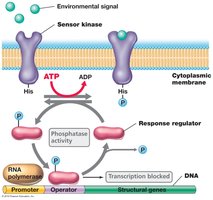
Prokaryotes use two-component regulatory systems to sense and respond to environmental changes. These systems consist of a sensor kinase in the membrane and a response regulator in the cytoplasm.
Sensor kinase: Detects environmental signals and autophosphorylates using ATP.
Response regulator: Receives phosphate and regulates transcription.
Feedback loop: Phosphatase removes phosphate to terminate the response.
Quorum Sensing
Population Density-Dependent Regulation
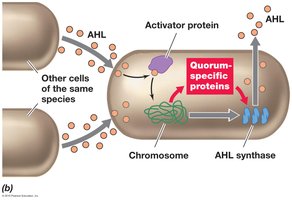
Quorum sensing allows bacteria to regulate gene expression based on cell density. Each species produces a specific autoinducer molecule, which accumulates as cell numbers increase and triggers transcription of specific genes.
Autoinducer: Small molecule that diffuses across the cell envelope and activates regulatory proteins.
AHLs (Acyl homoserine lactones): First identified autoinducers.
Quorum Sensing and Virulence
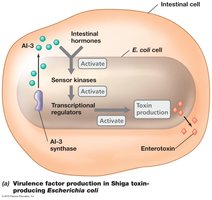
In pathogenic bacteria, quorum sensing can induce expression of virulence factors, enhancing infection. For example, E. coli O157:H7 produces an AHL called AI-3, which, along with host stress hormones, activates toxin production.
Sigma Factors and Global Gene Expression
Role of Sigma Factors
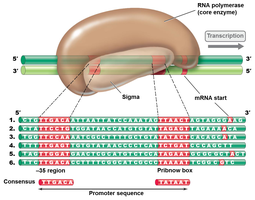
Sigma factors are subunits of RNA polymerase that recognize promoter consensus sequences, enabling transcription initiation. The major sigma factor, σ70, binds most genes, while alternative sigma factors regulate specific gene families.
σ70: Recognizes -35 and -10 promoter regions.
Alternative sigma factors: Control heat-shock, stress response, flagellar synthesis, nitrogen assimilation, and sporulation.
Sporulation in Bacillus subtilis
Sporulation is triggered by adverse conditions and regulated by multiple sensor kinases and sigma factors. High phosphorylation of Spo0A initiates sporulation, leading to activation of σF and a cascade of gene expression changes.
Spo0A: Master regulator of sporulation.
σF, σE, σG, σK: Sigma factors controlling different stages of sporulation.
End result: Formation and release of mature endospore.