 Back
BackMicrobial Virology and Bacterial Metabolism: Core Concepts and Mechanisms
Study Guide - Smart Notes
 Tailored notes based on your materials, expanded with key definitions, examples, and context.
The Microbial World: Viruses and Bacteriophages
Introduction to Viruses
Viruses are the most abundant biological entities on Earth, infecting all forms of life. They are obligate intracellular parasites, meaning they require a host cell to replicate. Viruses exist in two main forms: as infectious particles called virions outside the host cell, and as replicating genomes inside the host cell.
Virion: A complete virus particle consisting of genetic material (DNA or RNA), a protein coat (capsid), and sometimes a lipid envelope.
Genome diversity: Viral genomes can be DNA or RNA, single- or double-stranded, linear or circular, and vary greatly in size.
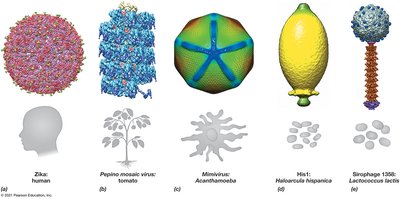
Bacteriophages: Viruses of Bacteria
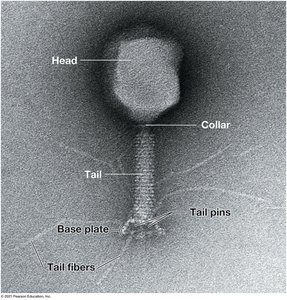
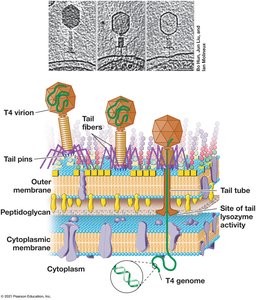
Bacteriophages (phages) are viruses that infect bacteria. They have complex virion structures, typically with a head (capsid) containing the genome and a tail apparatus for host recognition and genome injection.
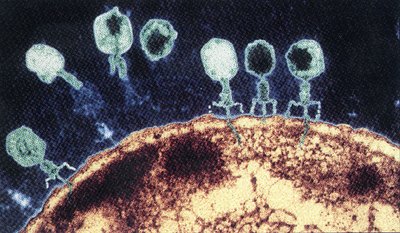
Attachment: Phages use tail fibers to recognize and bind specific receptors on the bacterial surface.
Genome injection: The phage injects its genome into the host cytosol, leaving the capsid outside.
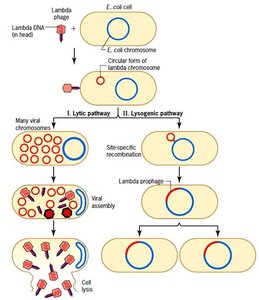
Phage Life Cycles: Lytic and Lysogenic Pathways
Lytic Cycle
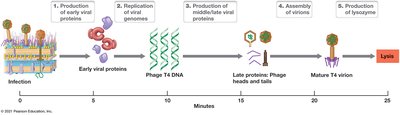
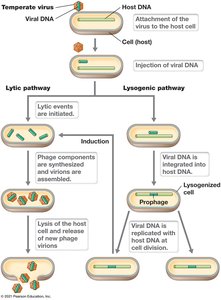
The lytic cycle is characteristic of virulent phages and results in the destruction of the host cell. The phage genome is replicated, new virions are assembled, and the host cell is lysed to release progeny.
Attachment and Penetration: Tail fibers adsorb to host receptors, tail sheath contracts, and the genome is injected.
Synthesis: Early genes shut down host processes and initiate viral replication; late genes encode structural proteins and lytic enzymes.
Assembly and Release: Virion components are assembled, and host cell lysis releases new phages.
Phage Genome Packaging and Circular Permutation
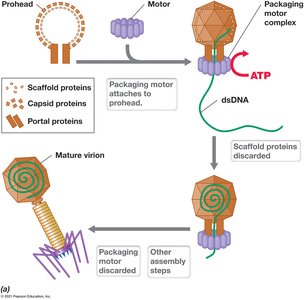
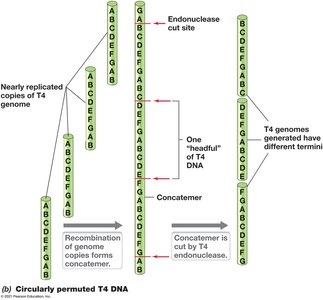
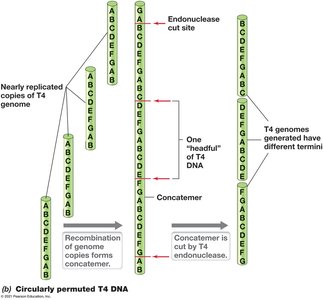
During replication, phage genomes may form concatemers (long DNA molecules with repeated genome units). The 'headful' packaging mechanism fills each capsid with slightly more than one genome length, resulting in terminal redundancy and circular permutation.
Headful packaging: DNA is cut and packaged into capsids until full, not at precise genome ends.
Circular permutation: Each virion may have a different gene order due to variable cut sites.
Lysogenic Cycle
Temperate phages can enter a lysogenic cycle, integrating their genome into the host chromosome as a prophage. The host cell, now a lysogen, replicates the prophage along with its own DNA. The prophage can later be induced to enter the lytic cycle.
Integration: Viral DNA integrates at specific att sites in the host genome.
Maintenance: The prophage is passively replicated until induction triggers the lytic cycle.
Genetic Switch: Regulation of Lytic vs. Lysogenic Pathways
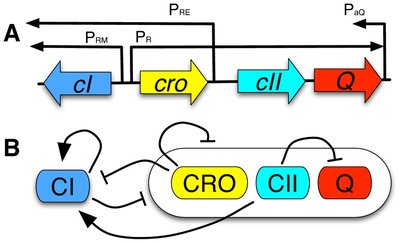
The decision between lytic and lysogenic cycles in lambda phage is controlled by a genetic switch involving the CI repressor, Cro protein, and other regulatory elements.
CI repressor: Maintains lysogeny by repressing lytic genes.
Cro protein: Promotes the lytic cycle by repressing CI expression.
CII protein: Activates CI expression under certain conditions, favoring lysogeny.
Viral Communication and the Arbitrium System
Phage Communication
Recent research shows that some phages communicate using small peptides (arbitrium system) to influence the decision between lysis and lysogeny, coordinating infection strategies within a population.
Arbitrium system: Involves aimR (receptor), aimP (peptide producer), and aimX (regulator).
Population sensing: High peptide concentrations favor lysogeny, reducing host destruction.
*Additional info: This system is an example of viral quorum sensing, allowing phages to adapt to host population density.*
Viral Structure and Diversity
Virion Morphology
Virions exhibit diverse morphologies, including helical, icosahedral, and complex forms. The structure is closely related to the virus's mode of infection and host specificity.
Helical: Rod-shaped, with genome spiraled inside a protein cylinder.
Icosahedral: Spherical, with 20 triangular faces.
Complex: Multiple structural components, as seen in many bacteriophages.
Microbial Metabolism: Respiration and Fermentation
Overview of Microbial Metabolism
Microbial metabolism encompasses all chemical reactions in a cell, divided into catabolism (energy-releasing) and anabolism (energy-consuming). Microbes require water, energy, carbon, nutrients, and electrons for growth.
Catabolism: Breakdown of molecules to release energy.
Anabolism: Synthesis of cellular components, requiring energy.
Electron carriers: NADH and FADH2 are major carriers in redox reactions.
Aerobic Respiration
Aerobic respiration is the process by which cells use oxygen as the terminal electron acceptor to generate ATP. It involves glycolysis, the citric acid cycle, and the electron transport chain.
Glycolysis: Glucose is split into pyruvate, producing ATP and NADH.
Citric Acid Cycle: Pyruvate is oxidized, generating more NADH, FADH2, and CO2.
Electron Transport Chain: Electrons from NADH/FADH2 are transferred to O2, generating a proton motive force used by ATP synthase to produce ATP.
Anaerobic Respiration and Fermentation
When oxygen is absent, some microbes use alternative electron acceptors (anaerobic respiration) or rely on fermentation, where organic molecules serve as both electron donors and acceptors.
Anaerobic respiration: Uses NO3-, SO42-, Fe3+, or CO2 as terminal electron acceptors.
Fermentation: ATP is generated by substrate-level phosphorylation; NAD+ is regenerated by transferring electrons to organic products (e.g., lactate, ethanol).
Measuring Microbial Growth
Direct and Indirect Methods
Microbial growth can be measured by direct cell counts (microscopy, flow cytometry), viable counts (plate counts, MPN), or indirect methods (optical density, biomass, molecular techniques).
Direct counts: Counting cells under a microscope or using electronic counters.
Viable counts: Counting colony-forming units on agar plates or estimating populations in liquid culture (MPN).
Indirect methods: Measuring turbidity, cell components, or metabolic activity.
Microbial Genomics and Omics
Genome Structure and Sequencing
The genome is the complete set of genetic material in an organism. Genomics involves sequencing, assembling, and annotating genomes to understand gene content and function.
Sequencing: Determining the order of nucleotides (e.g., Sanger, Illumina, Nanopore).
Assembly: Piecing together short DNA fragments into complete genomes.
Annotation: Identifying genes, regulatory elements, and predicting functions.
Comparative and Metagenomics
Comparative genomics reveals evolutionary relationships and horizontal gene transfer. Metagenomics analyzes pooled DNA from environmental samples, providing insights into uncultured microbial communities.
Biogeochemical Cycles: The Nitrogen Cycle
Nitrogen Transformations
Microbes play key roles in the nitrogen cycle, mediating transformations between different oxidation states of nitrogen compounds.
Nitrogen fixation: Conversion of N2 to NH3 by diazotrophs.
Nitrification: Oxidation of NH3 to NO2- and NO3- by lithotrophs.
Denitrification: Reduction of NO3- to N2 gas, returning nitrogen to the atmosphere.
Anammox: Anaerobic ammonium oxidation, combining NO3- reduction and NH3 oxidation to produce N2.
Compound | Oxidation State of N |
|---|---|
Organic N, NH3 | -3 |
N2 | 0 |
N2O | +1 |
NO | +2 |
NO2- | +3 |
NO2 | +4 |
NO3- | +5 |
Microbial Symbioses
Types of Symbiosis
Microbial symbioses are prolonged associations between microbes and hosts, classified as parasitic, pathogenic, commensal, or mutualistic. A classic example is the mutualism between legumes and nitrogen-fixing rhizobia.
Specificity: Symbiosis is specific to certain plant and bacterial species.
Bacteroids: Differentiated rhizobia in root nodules fix nitrogen for the plant in exchange for organic acids.
Oxygen control: Leghemoglobin regulates O2 to protect nitrogenase.
*Additional info: Symbioses are crucial for nutrient cycling and ecosystem productivity.*
