 Back
BackMicrobiological Analysis of Drinking Water: Detection of Coliforms and Waterborne Pathogens
Study Guide - Smart Notes
 Tailored notes based on your materials, expanded with key definitions, examples, and context.
Water Microbiology and Public Health
Importance of Safe Drinking Water
Safe drinking water is essential for public health and must be free from harmful chemicals and pathogenic microorganisms. Microbiological testing is crucial because waterborne pathogens can cause severe diseases, and their detection is challenging due to their low numbers in water samples. Instead of directly testing for pathogens, microbiologists use indicator organisms, primarily coliform bacteria, to assess fecal contamination and water safety.
Waterborne Pathogens and Diseases
Major Diseases from Contaminated Water
Typhoid Fever (Salmonella typhi): Spread only through feces; symptoms include high fever, diarrhea, and headache.
Cholera (Vibrio cholerae): Grows in the small intestine, produces exotoxins, causes 'rice water stool' and severe dehydration.
Bacillary Dysentery (Shigellosis): Spread person-to-person; symptoms include multiple bowel movements, fever, and abdominal cramps.
These diseases are primarily transmitted via the fecal-oral route, highlighting the importance of monitoring water for fecal contamination.
Coliforms as Indicators of Fecal Contamination
Definition and Characteristics of Coliforms
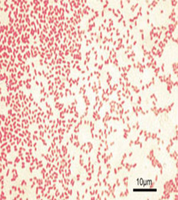
Coliforms are normal flora enteric bacteria, primarily Gram-negative bacilli, non-endospore forming, and capable of fermenting lactose to produce acid and gas.
They are used as indicators because pathogens are often present in low numbers, while coliforms are abundant in the intestines of humans and animals and can survive outside the body for extended periods.
Coliforms include genera such as Escherichia, Enterobacter, Klebsiella, Citrobacter, and Hafnia.
Significance of Coliform Testing
Coliforms are used as indicators because they are more numerous and easier to detect than specific pathogens.
Their presence in water suggests fecal contamination and the possible presence of pathogenic microorganisms.
Detection of Coliforms: The Multiple Tube Fermentation (MTF) Technique
Overview of the Coliform Test
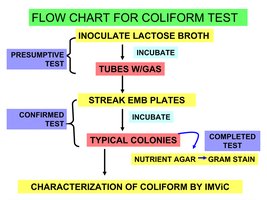
The standard method for detecting coliforms in water involves a three-stage process: presumptive, confirmed, and completed tests. This sequence increases the reliability of detecting true coliforms and estimating their numbers.
1. Presumptive Test
This initial test screens for lactose-fermenting bacteria that produce gas, a key characteristic of coliforms. Water samples are inoculated into lactose broth tubes, often containing Durham tubes to capture gas.
Sample volumes (e.g., 10 mL, 1 mL, 0.1 mL) are tested in single or double-strength lactose broth.
Phenol red may be added as a pH indicator; a color change and gas production indicate a positive result.
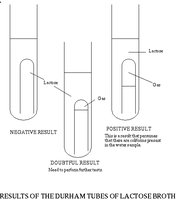
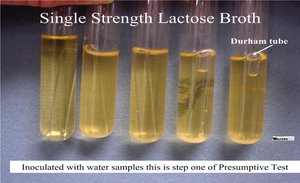
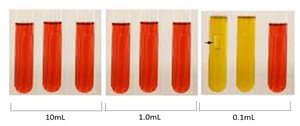
Key By-products: Acid (detected by color change) and gas (trapped in Durham tube).
2. Confirmed Test
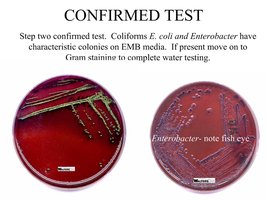
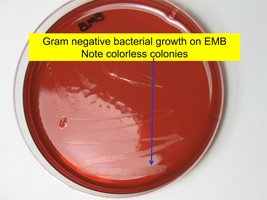
Samples from positive presumptive tubes are streaked onto Eosin Methylene Blue (EMB) agar, which is selective for Gram-negative bacteria and differential for lactose fermenters.
Lactose fermenters produce acid, lowering the pH and causing colonies to absorb dye and appear purple-black.
Non-fermenters remain colorless.
E. coli typically forms colonies with a green metallic sheen, while Enterobacter aerogenes forms pink, mucoid colonies with a brown center.
3. Completed Test
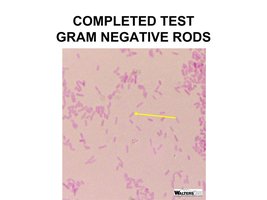
This final step confirms that the isolated colonies are Gram-negative rods capable of fermenting lactose. Colonies from EMB are inoculated into lactose broth and Gram stained.
Positive result: Gram-negative rods that ferment lactose with acid and gas production.
Most Probable Number (MPN) Method
The MPN method is a statistical estimation of the number of coliforms in a water sample, based on the pattern of positive and negative results in multiple tubes.
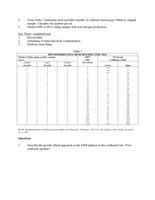
Interpretation: If more than 2.2 coliforms per 100 mL are detected, the water is considered unsafe for drinking.
Membrane Filter Technique
Principle and Procedure
The membrane filter technique provides a direct count of bacteria in water. A measured volume of water is passed through a membrane filter that traps bacteria. The filter is then placed on differential media to allow colony growth and enumeration.
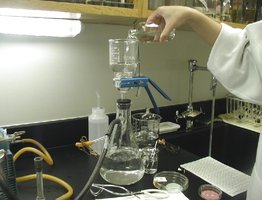
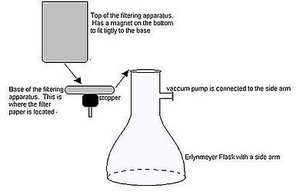
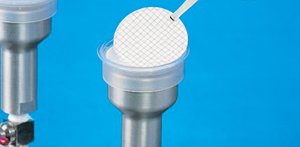
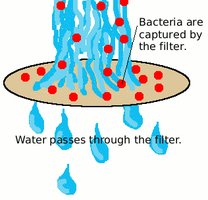
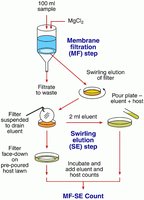
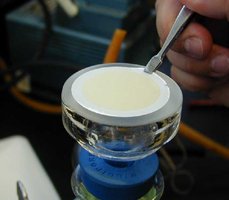
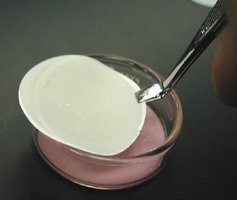
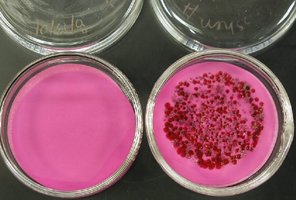
Allows for direct enumeration of viable bacteria in a water sample.
Colonies are counted to determine the concentration of bacteria per unit volume.
Summary Table: Key Features of Coliform Testing Methods
Test | Purpose | Medium/Method | Positive Result |
|---|---|---|---|
Presumptive | Detect lactose fermenters | Lactose broth + Durham tube | Acid and gas production |
Confirmed | Confirm Gram-negative lactose fermenters | EMB agar | Purple-black colonies (E. coli: green sheen) |
Completed | Confirm Gram-negative rods | Lactose broth, Gram stain | Gram-negative rods, acid/gas |
Membrane Filter | Direct count of bacteria | Membrane filter, differential media | Colony count |
Key Terms and Concepts
Coliforms: Indicator bacteria for fecal contamination, Gram-negative, lactose fermenting rods.
Fecal-oral route: Transmission pathway for many waterborne diseases.
EMB Agar: Selective and differential medium for Gram-negative, lactose fermenting bacteria.
Most Probable Number (MPN): Statistical method for estimating bacterial concentration.
Membrane Filter Technique: Direct enumeration method for bacteria in water samples.
Additional info: The IMViC tests (Indole, Methyl Red, Voges-Proskauer, Citrate) are often used for further characterization of coliforms, especially to distinguish E. coli from other coliforms.
