 Back
BackMicrobiological Differential and Selective Media & Biochemical Tests
Study Guide - Smart Notes
 Tailored notes based on your materials, expanded with key definitions, examples, and context.
Microbiological Differential and Selective Media
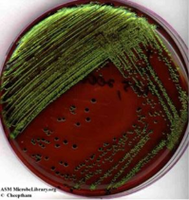
Eosin-Methylene Blue (EMB) Agar
EMB agar is a selective and differential medium used to isolate and differentiate Gram-negative bacteria, particularly coliforms, based on their ability to ferment lactose.
Selective Agents: Eosin and methylene blue dyes inhibit the growth of Gram-positive bacteria, allowing only Gram-negative bacteria to grow.
Differential Indicator: The medium differentiates bacteria based on lactose fermentation:
Purple colonies: Positive for lactose fermentation.
Green metallic sheen: Indicates very strong, rapid lactose fermentation (e.g., Escherichia coli).
Clear/colorless colonies: Negative for lactose fermentation.
Example: E. coli produces a green metallic sheen on EMB agar due to vigorous lactose fermentation.
Mannitol Salt Agar (MSA)
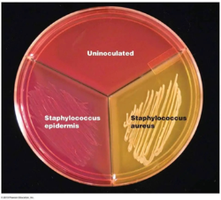
MSA is a selective and differential medium primarily used to isolate and differentiate Staphylococcus species based on their ability to ferment mannitol.
Selective Agent: High salt concentration (7.5% NaCl) selects for halophilic (salt-tolerant) Gram-positive bacteria, especially Staphylococcus spp.
Differential Indicator: Phenol red is a pH indicator that detects mannitol fermentation:
Yellow medium: Positive for mannitol fermentation (e.g., Staphylococcus aureus).
Pink/red medium: Negative for mannitol fermentation (e.g., Staphylococcus epidermidis).
Example: S. aureus ferments mannitol, turning the medium yellow, while S. epidermidis does not, leaving the medium pink.
Biochemical Tests for Microbial Identification
Citrate Utilization Test
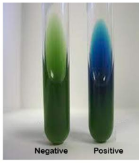
This test determines the ability of bacteria to use citrate as a sole carbon source. The medium contains bromothymol blue as a pH indicator.
Positive result: Blue color (alkaline pH due to ammonia production from ammonium phosphate breakdown).
Negative result: Green color (no citrate utilization).
Example: Enterobacter aerogenes is citrate positive; Escherichia coli is citrate negative.
Fermentation Tubes
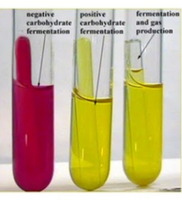
Fermentation tubes are used to detect carbohydrate fermentation and gas production by bacteria in the absence of oxygen. Phenol red is used as a pH indicator.
Positive result: Yellow color (acid production from fermentation lowers pH).
Negative result: Red color (no acid production).
Gas production: Detected by a Durham tube; gas bubble indicates fermentation with gas production.
Example: E. coli ferments glucose, producing acid (yellow) and gas (bubble in Durham tube).
Protein Catabolism: Urea Hydrolysis
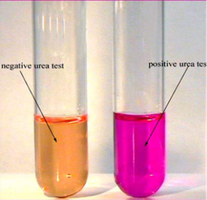
This test detects the ability of bacteria to hydrolyze urea using the enzyme urease. Phenol red is used as a pH indicator.
Positive result: Hot pink color (alkaline pH due to ammonia production).
Negative result: Yellow or no color change.
Example: Proteus vulgaris is urease positive.
Protein Catabolism: Gelatin Hydrolysis
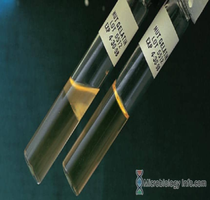
This test determines the ability of bacteria to produce gelatinase, an enzyme that hydrolyzes gelatin.
Positive result: Liquefaction of gelatin (medium remains liquid after refrigeration).
Negative result: Medium remains solid.
Example: Pseudomonas aeruginosa is gelatinase positive.
Catalase Test
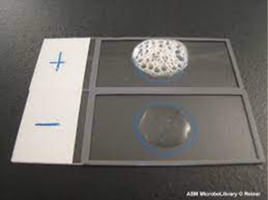
The catalase test identifies organisms that produce the enzyme catalase, which breaks down hydrogen peroxide (H2O2) into water and oxygen gas.
Positive result: Immediate bubbling (release of O2 gas).
Negative result: No bubbles.
Example: Staphylococcus spp. are catalase positive; Streptococcus spp. are catalase negative.
SIM Medium (Sulfur, Indole, Motility)
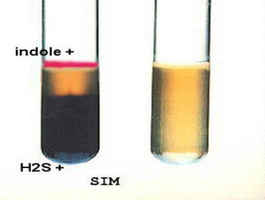
SIM medium is a multipurpose test used to assess three bacterial properties: sulfur reduction, indole production, and motility.
Sulfur Reduction: Detects H2S production from cysteine breakdown.
Positive: Black precipitate (ferrous sulfide formation).
Negative: No color change.
Indole Production: Detects conversion of tryptophan to indole by tryptophanase.
Positive: Red ring after adding Kovac's reagent.
Negative: No color change.
Motility: Assessed by diffuse growth away from the stab line.
Positive: Cloudy medium (motile bacteria).
Negative: Growth only along the stab line (non-motile).
Example: Escherichia coli is indole positive, motile, and does not reduce sulfur.
Thioglycolate Broth
Thioglycolate broth is used to determine the oxygen requirements of bacteria by observing their growth patterns in the medium.
Obligate Aerobes: Grow only at the top where oxygen is present.
Obligate Anaerobes: Grow only at the bottom where oxygen is absent.
Facultative Anaerobes: Grow throughout the tube but more densely at the top due to more efficient aerobic respiration.
Example: Clostridium spp. are obligate anaerobes; Bacillus spp. are obligate aerobes.
Summary Table: Key Differential and Selective Media & Biochemical Tests
Test/Medium | Purpose | Positive Result | Negative Result | Key Indicator |
|---|---|---|---|---|
EMB Agar | Gram-negative selection, lactose fermentation | Purple/green sheen colonies | Clear colonies | Eosin, methylene blue |
MSA | Halophile selection, mannitol fermentation | Yellow medium | Pink/red medium | Phenol red |
Citrate Test | Citrate utilization | Blue medium | Green medium | Bromothymol blue |
Fermentation Tubes | Carbohydrate fermentation | Yellow (acid), gas bubble | Red (no acid) | Phenol red |
Urea Hydrolysis | Urease activity | Hot pink | Yellow/no change | Phenol red |
Gelatin Hydrolysis | Gelatinase activity | Liquid medium | Solid medium | Physical state |
Catalase Test | Catalase enzyme | Bubbles | No bubbles | H2O2 |
SIM Medium | Sulfur reduction, indole, motility | Black (H2S), red ring (indole), diffuse growth (motility) | No color change, no ring, growth only at stab | Iron, Kovac's reagent |
Thioglycolate Broth | Oxygen requirements | Growth pattern varies | — | — |
