 Back
BackMicrobiology Chapter 11 Review: Prokaryotic Diversity, Endospores, and Bacterial Morphology
Study Guide - Smart Notes
 Tailored notes based on your materials, expanded with key definitions, examples, and context.
Q1. What type of arrangement is shown in the image? (Streptobacilli)
Background
Topic: Bacterial Morphology and Arrangements
This question tests your understanding of how bacteria are classified based on their shape and arrangement. Streptobacilli refers to rod-shaped bacteria (bacilli) arranged in chains.
Key Terms:
Bacillus: Rod-shaped bacterium.
Strepto-: Prefix meaning 'in chains.'
Streptobacilli: Chains of rod-shaped bacteria.
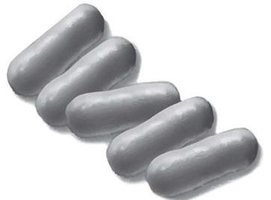
Step-by-Step Guidance
Observe the shape of the cells in the image: they are elongated and rod-like, which is characteristic of bacilli.
Notice the arrangement: the rods are lined up in a chain, not singly or in clusters.
Recall that the prefix 'strepto-' is used for chain arrangements, and 'bacilli' refers to rod-shaped bacteria.
Combine the shape and arrangement to determine the correct term for this bacterial morphology.
Try solving on your own before revealing the answer!
Q2. This shape of bacteria is called vibrio.
Background
Topic: Bacterial Shapes
This question is about recognizing the basic shapes of bacteria. Vibrio refers to bacteria that are curved or comma-shaped.
Key Terms:
Vibrio: A genus and shape descriptor for bacteria that are curved rods, resembling a comma.
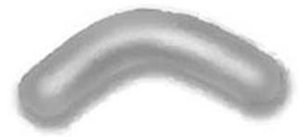
Step-by-Step Guidance
Look at the image and note the overall shape: it is not straight, but gently curved.
Recall that cocci are spherical, bacilli are straight rods, and spirilla are spiral-shaped.
Recognize that a curved rod is described as 'vibrio.'
Think of examples such as Vibrio cholerae, which causes cholera and has this shape.
Try solving on your own before revealing the answer!
Q3. Contamination with Endospores is a concern because they are highly resistant to killing.
Background
Topic: Endospores and Microbial Resistance
This question addresses why endospores are significant in microbiology, especially in sterilization and infection control.
Key Terms:
Endospore: A tough, dormant structure formed by some bacteria for survival in harsh conditions.
Resistance: The ability to withstand adverse conditions, such as heat, chemicals, and radiation.
Step-by-Step Guidance
Recall which genera of bacteria are known for endospore formation (e.g., Bacillus and Clostridium).
Think about the environments where endospores might be a concern (e.g., hospitals, food processing).
Consider why endospores are difficult to eliminate compared to vegetative cells.
List some methods used to destroy endospores (e.g., autoclaving, strong disinfectants).
Try solving on your own before revealing the answer!
Q4. Characteristics of endospores: Dormant, highly resistant survival structures
Background
Topic: Endospore Structure and Function
This question tests your knowledge of the unique features that make endospores important in microbiology.
Key Terms:
Dormant: Inactive, non-growing state.
Highly resistant: Able to survive extreme conditions (heat, desiccation, chemicals).
Survival structure: Specialized cell type for enduring unfavorable environments.
Step-by-Step Guidance
Recall the main function of endospores in bacterial life cycles.
List the environmental stresses that endospores can survive.
Think about the structural features that contribute to their resistance (e.g., thick spore coat, dipicolinic acid).
Consider why these features are important for bacterial survival and transmission.
Try solving on your own before revealing the answer!
