 Back
BackMicrobiology Chapter 5: Genetics – Structured Study Notes
Study Guide - Smart Notes
 Tailored notes based on your materials, expanded with key definitions, examples, and context.
Genotype Determines Phenotype
Genetics and Genomes
Genetics is the study of genes, their functions, and how variations arise in genomes. The genome is the entire collection of genetic material in a cell or virus, acting as an instruction manual for all cellular features.
Gene: Heritable unit of genetic material determining a specific trait.
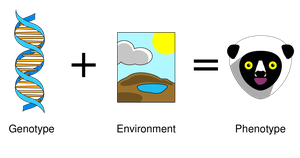
Genotype: The genetic makeup of an organism.
Phenotype: The observable physical and physiological traits influenced by genotype.
Example: A gene coding for pigment affects the color phenotype of a cell.
Genome Basics
Organization and Complexity
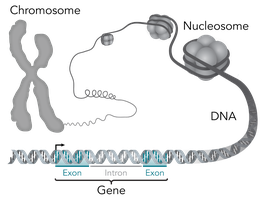
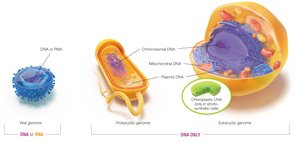
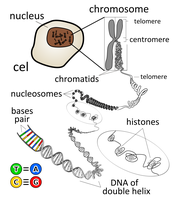
Organisms vary in gene number, but chromosome count does not determine sophistication. Genomes are organized into chromosomes, which are carefully packaged DNA strands with organizational proteins.
Eukaryotes: Multiple linear chromosomes in the nucleus, organized by histones.
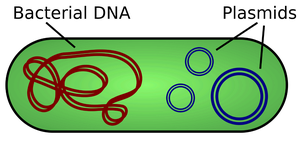
Prokaryotes: 1-3 circular chromosomes in the nucleoid, organized by histone-like proteins.
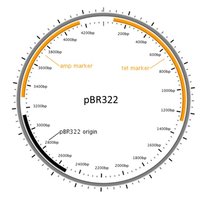
Plasmids: Extra-chromosomal DNA pieces, often conferring survival advantages (e.g., antibiotic resistance).
DNA Structure
Nucleotides and Double Helix
DNA is composed of nucleotides, each with a phosphate group, a sugar (deoxyribose), and a nitrogen base. Nitrogen bases are classified as purines (A, G) or pyrimidines (C, T).
Purines: Adenine (A), Guanine (G)
Pyrimidines: Cytosine (C), Thymine (T)
Base Pairing: A pairs with T, G pairs with C
Double Helix: Two antiparallel strands forming a twisted ladder, with phosphodiester bonds linking the sugar-phosphate backbone.
Directionality: DNA strands run 5’ to 3’ and 3’ to 5’.
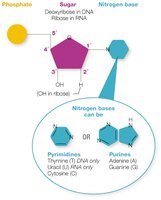
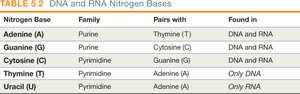
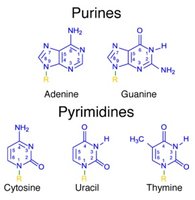
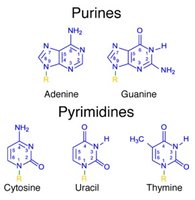
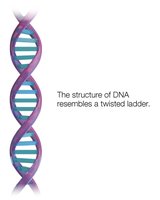
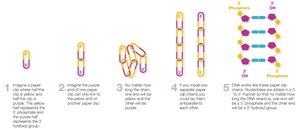
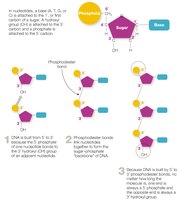
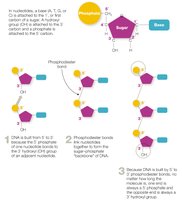
Table: DNA and RNA Nitrogen Bases
Nitrogen Base | Family | Pairs with | Found in |
|---|---|---|---|
Adenine (A) | Purine | Thymine (T) | DNA and RNA |
Guanine (G) | Purine | Cytosine (C) | DNA and RNA |
Cytosine (C) | Pyrimidine | Guanine (G) | DNA and RNA |
Thymine (T) | Pyrimidine | Adenine (A) | Only DNA |
Uracil (U) | Pyrimidine | Adenine (A) | Only RNA |
RNA Structure
Differences from DNA
RNA nucleotides contain ribose sugar and uracil (U) instead of thymine (T). RNA is usually single-stranded and can form helical and loop structures.
Ribonucleotides: Phosphate group, ribose, nitrogen base (A, G, C, U)
Directionality: 5’ to 3’
Single-stranded: Allows folding into complex shapes
Central Dogma of Molecular Biology
Information Flow
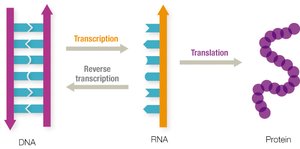
The central dogma describes the flow of genetic information: DNA directs the production of RNA, which directs the assembly of proteins.
Transcription: DNA to RNA
Translation: RNA to protein
DNA Replication
Process Overview
DNA replication is the process by which a cell copies its genome before division. It is fast and accurate, involving several enzymes.
Unwinding: Helicase unwinds DNA
Copying: DNA polymerase III synthesizes new DNA
Rewinding: Ligase seals nicks in the backbone
Semiconservative: Each new DNA helix contains one original and one new strand
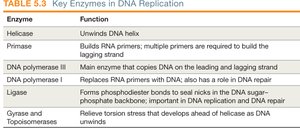
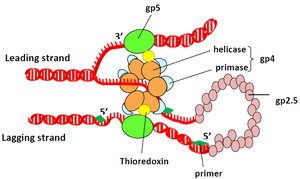
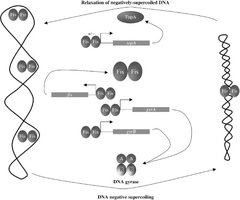
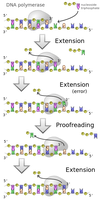
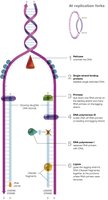
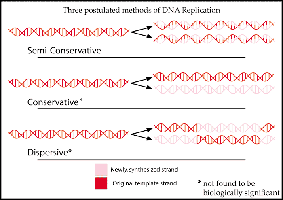
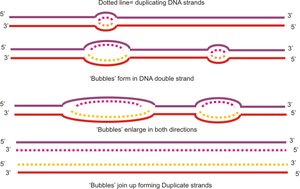
Table: Key Enzymes in DNA Replication
Enzyme | Function |
|---|---|
Helicase | Unwinds DNA helix |
Primase | Builds RNA primers |
DNA polymerase III | Main enzyme that copies DNA |
DNA polymerase I | Replaces RNA primers with DNA |
Ligase | Seals nicks in the DNA backbone |
Gyrase and Topoisomerases | Relieve torsion stress ahead of helicase |
Transcription
RNA Synthesis
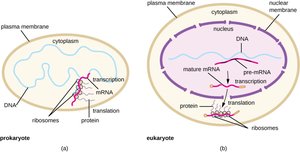
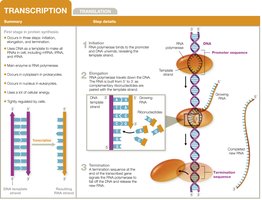
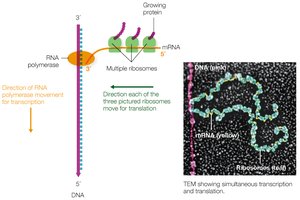
Transcription is the process of synthesizing RNA from a DNA template. It occurs in the nucleus of eukaryotes and the cytoplasm of prokaryotes.
RNA polymerase: Binds promoter, unwinds DNA, synthesizes RNA
Base pairing: U pairs with A, G pairs with C
Termination: RNA polymerase falls off at termination sequence
Types of RNA
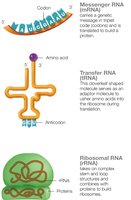
Messenger RNA (mRNA): Contains codons for amino acids or stop signals
Transfer RNA (tRNA): Anticodon loop, carries amino acids to ribosome
Ribosomal RNA (rRNA): Combines with proteins to form ribosomes
RNA Splicing (Eukaryotes)
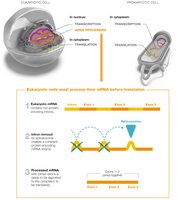
RNA splicing removes introns (non-coding regions) and joins exons (coding regions) to produce mature mRNA.
Genetic Code
Codons and Redundancy
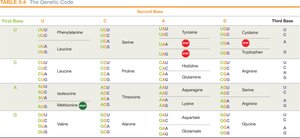
The genetic code consists of 64 codons (triplets of nucleotides), encoding 22 amino acids, start, and stop signals. The code is redundant; multiple codons can specify the same amino acid.
Start codon: AUG (methionine)
Stop codons: UAA, UAG, UGA
Translation
Protein Synthesis
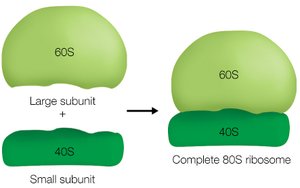
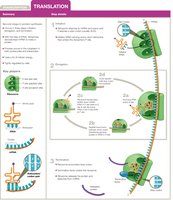
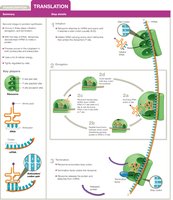
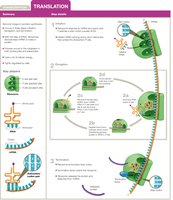
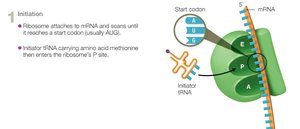
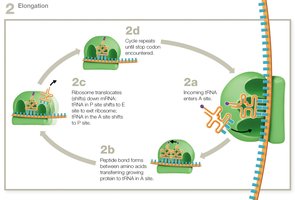
Translation is the process by which ribosomes synthesize proteins using mRNA as a template. Ribosomes consist of large and small subunits.
Initiation: Ribosome binds mRNA, initiator tRNA enters P site
Elongation: tRNA brings amino acids, peptide bonds form
Termination: Stop codon signals release of completed protein
Controlling Protein Synthesis
Gene Expression Regulation
Protein synthesis is resource-intensive, so cells regulate gene expression. Housekeeping genes are constitutively expressed, while facultative genes are expressed in response to environmental changes.
Housekeeping genes: Always expressed
Facultative genes: Expressed as needed
Mutations
Types and Effects
Mutations are changes in genetic material. They can be insertions, deletions, or substitutions, and their effects range from silent to detrimental.
Silent: No change in amino acid sequence
Reversion: Mutation corrected by another mutation
Nonsense: Codon changed to stop signal
Missense: Codon changed to encode a different amino acid
Frameshift: Insertion/deletion alters reading frame
Causes of Mutations
Spontaneous and Induced
Mutations can occur spontaneously during DNA replication or be induced by mutagens (chemical, physical, or biological agents). Carcinogens are mutagens that promote cancer development.
Spontaneous: Natural errors in replication
Mutagens: Increase mutation rate (e.g., UV light, chemicals, viruses)
Carcinogens: Mutagens causing cancer
Changes to DNA
DNA Repair and Gene Transfer
Cells have mechanisms to repair DNA, such as proofreading by DNA polymerases and excision repair. Genetic information can be transferred vertically (parent to offspring) or horizontally (between cells).
Excision repair: Enzymes remove damaged DNA, DNA polymerase I fills gaps, ligase seals backbone
Vertical gene transfer: Through cell division
Horizontal gene transfer: Conjugation, transformation, transduction, transposons
Horizontal Gene Transfer Mechanisms
Conjugation: Transfer via pilus and fertility plasmid
Transformation: Uptake of environmental DNA
Transduction: Transfer by bacteriophage (virus)
Transposons: "Jumping genes" move within genome
Summary Table: Types of Mutations
Type | Description | Effect |
|---|---|---|
Silent | Base change, no amino acid change | Neutral |
Missense | Base change, wrong amino acid | Variable |
Nonsense | Base change, stop codon | Usually detrimental |
Frameshift | Insertion/deletion, alters reading frame | Often devastating |
Practice Questions
What are the four types of DNA nucleotides? A, T, C, G
Match each enzyme involved in DNA replication with its function.
Why is DNA replication called semiconservative?
In which direction is DNA synthesized? 5′ → 3′
Which type of RNA contains hairpin loops and carries amino acids? tRNA
Which horizontal transfer mechanism involves bacteriophage? Transduction
Which mutation is most devastating? Frameshift mutation
Which molecule is inherited by daughter cells? DNA
Which is not a method of horizontal gene transfer? Binary fission
Transfer of DNA as naked DNA in solution is called? Transformation
