 Back
BackMicrobiology Exam 2 Review: Prokaryotes, Eukaryotes, Viruses, Viroids, and Prions
Study Guide - Smart Notes
 Tailored notes based on your materials, expanded with key definitions, examples, and context.
Characterizing and Classifying Prokaryotes
Prokaryotic Morphologies
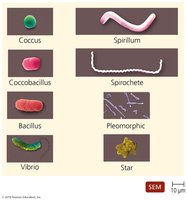
Prokaryotic cells exhibit a variety of shapes, which are important for identification and classification. The three basic shapes are:
Coccus: Spherical-shaped cells
Bacillus: Rod-shaped cells
Spirals: Spiral-shaped cells, further divided into spirilla (stiff) and spirochetes (flexible)
Vibrio: Slightly curved rods
Coccobacillus: Intermediate between cocci and bacilli
Pleomorphic: Cells that vary in shape and size
Star-shaped, triangular, and rectangular: Less common morphologies
Arrangements of Prokaryotic Cells
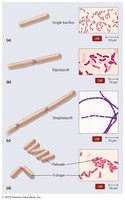
Cell arrangements result from the planes in which cells divide and whether daughter cells remain attached after division. Common arrangements include single cells, pairs (diplo-), chains (strepto-), clusters (staphylo-), and others.
Prokaryotic Classification
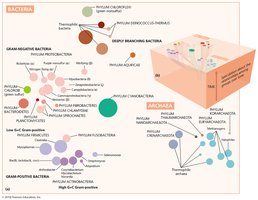
Modern classification of prokaryotes is based primarily on rRNA sequence similarities. This molecular approach helps clarify evolutionary relationships among bacteria and archaea.
Endospores
Endospores are stable, dormant structures formed by some Gram-positive bacteria (notably Bacillus and Clostridium) under unfavorable conditions. They are not reproductive structures but serve as a defensive strategy, allowing survival in harsh environments. Endospores germinate when conditions improve.
Reproduction of Prokaryotic Cells
All prokaryotes reproduce asexually. The three main methods are:
Binary fission (most common): Cell divides into two identical daughter cells
Snapping division: A variation of binary fission with a snapping movement
Budding: A small outgrowth (bud) forms and eventually detaches
Archaea
Archaea are prokaryotes distinct from bacteria. Key features include:
Lack true peptidoglycan in cell walls
Branched hydrocarbon chains in membrane lipids
Initial amino acid in protein synthesis is methionine (like eukaryotes)
Reproduce by binary fission, budding, or fragmentation
Often extremophiles (thermophiles, hyperthermophiles, halophiles, methanogens)
Not known to cause disease
Deeply Branching Bacteria
These bacteria are thought to resemble the earliest forms of life, living in extreme environments and often autotrophic.
Phototrophic Bacteria: Cyanobacteria
Cyanobacteria are Gram-negative phototrophs that perform oxygenic photosynthesis using chlorophyll a. They reproduce by binary fission and are important for nitrogen fixation and the evolution of Earth's oxygen-rich atmosphere. Chloroplasts in plants are believed to have evolved from cyanobacteria.
Gram-Positive Bacteria Classification
Gram-positive bacteria are classified based on their G+C content:
Low G+C bacteria (<50%): Includes Clostridia, Mycoplasmas, Bacillus, Listeria, Lactobacillus, Streptococcus, Enterococcus, Staphylococcus
High G+C bacteria (>50%): Includes Corynebacterium, Mycobacterium, Actinomycetes
Gram-Negative Bacteria Classification
Gram-negative bacteria are classified into six classes of Proteobacteria (Alpha-, Beta-, Gamma-, Delta-, Epsilon-, Zetaproteobacteria) based on rRNA sequences. Other important groups include Chlamydias, Spirochetes, and Bacteroids.
Characterizing and Classifying Eukaryotes
Reproduction of Eukaryotes
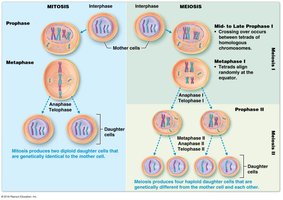
Eukaryotic cells may be haploid or diploid. They reproduce by mitosis (producing genetically identical cells) or meiosis (producing genetically diverse gametes).
Protozoa
Protozoa are unicellular, eukaryotic organisms lacking cell walls. Most reproduce asexually by binary fission or schizogony. Schizogony involves multiple mitoses followed by cytokinesis, producing many daughter cells.

Classification of Protozoa
Protozoa are classified based on nucleotide sequencing and structural features. Major groups include Parabasala, Diplomonadida, Euglenozoa, Alveolates, Rhizaria, and Amoebozoa. Each group has unique characteristics and pathogenic representatives.
Fungi
Fungi are chemoheterotrophic eukaryotes with chitinous cell walls. They exist as molds (filamentous hyphae), yeasts (unicellular), or dimorphic forms. Fungi reproduce asexually (budding, spores) and sexually (spores). Mycology is the study of fungi; mycoses are fungal diseases.
Lichens
Lichens are symbiotic partnerships between fungi and photosynthetic microbes. They are important for soil formation and as indicators of environmental health.

Algae
Algae are eukaryotic photoautotrophs with diverse morphologies and reproductive strategies. Classification is still being refined.
Parasitic Helminths and Arthropod Vectors
Parasitic helminths have microscopic stages important for diagnosis. Arthropod vectors (arachnids and insects) transmit many microbial diseases. Arachnids have four pairs of legs; insects have three pairs and three body regions.
Characterizing and Classifying Viruses, Viroids, and Prions
Viruses
Viruses are acellular infectious agents with either DNA or RNA genomes. They cannot carry out metabolism or reproduce independently. Outside a host cell, a virus is called a virion, consisting of a nucleic acid core and a protein capsid; some have an envelope.
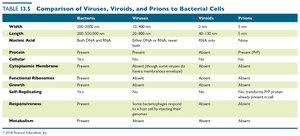
Comparison of Viruses, Viroids, Prions, and Bacterial Cells
Feature | Bacterial Cells | Viruses | Viroids | Prions |
|---|---|---|---|---|
Cellular | Yes | No | No | No |
Nucleic Acid | DNA and RNA | DNA or RNA | RNA only | None |
Protein Coat | No | Yes | No | No |
Envelope | No | Some | No | No |
Metabolism | Present | Absent | Absent | Absent |
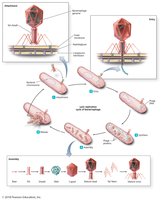
Viral Replication Cycles
Lytic replication results in host cell lysis and release of new virions. The stages are attachment, entry, synthesis, assembly, and release.
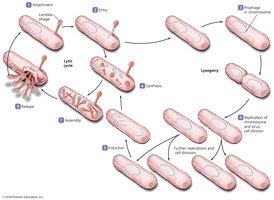
Lysogeny is a modified cycle where the viral genome integrates into the host DNA as a prophage, remaining dormant until induced to enter the lytic cycle.
Animal Viruses
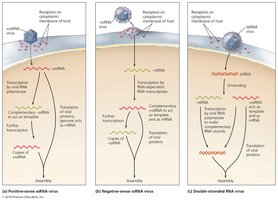
Animal viruses replicate similarly to bacteriophages but with differences due to the presence of envelopes and the eukaryotic nature of host cells. Positive-sense RNA viruses (+ssRNA) can act directly as mRNA, while negative-sense RNA viruses (–ssRNA) require transcription to +ssRNA before translation.
Latency and Cancer
Some animal viruses can remain latent (proviruses) in host cells for years. Viruses may contribute to cancer by carrying oncogenes, promoting host oncogenes, or interfering with tumor suppressors.
Viroids
Viroids are small, circular pieces of ssRNA that infect plants. They lack a protein coat and do not code for proteins, causing disease by interfering with plant RNA.
Prions
Prions are infectious proteins that cause neurodegenerative diseases. Normal cellular PrP (c-PrP) can be converted into the disease-causing prion PrP (p-PrP), which accumulates and damages brain tissue.
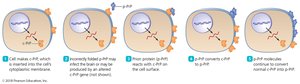
Prion diseases are resistant to standard sterilization and cooking; only extreme heat or specific enzymes can deactivate them.
