 Back
BackMicrobiology Exam 2 Study Guide: Genetics, DNA Structure, Central Dogma, Operons, and Mutations
Study Guide - Smart Notes
 Tailored notes based on your materials, expanded with key definitions, examples, and context.
Q1. What is the general structure of a nucleotide, and how is the sugar component different in DNA and RNA?
Background
Topic: Nucleotide Structure and Differences Between DNA and RNA
This question tests your understanding of the basic building blocks of nucleic acids and the structural differences between DNA and RNA, which are fundamental concepts in microbiology and genetics.
Key Terms and Formulas
Nucleotide: The monomer unit of nucleic acids, composed of a phosphate group, a five-carbon sugar, and a nitrogenous base.
Deoxyribose: The sugar found in DNA; lacks an oxygen atom at the 2' carbon compared to ribose.
Ribose: The sugar found in RNA; has an OH group at the 2' carbon.
Phosphodiester bond: The covalent bond linking nucleotides in a nucleic acid chain.
Step-by-Step Guidance
Examine the structure of a nucleotide: It consists of three main components—a phosphate group, a five-carbon sugar, and a nitrogenous base.
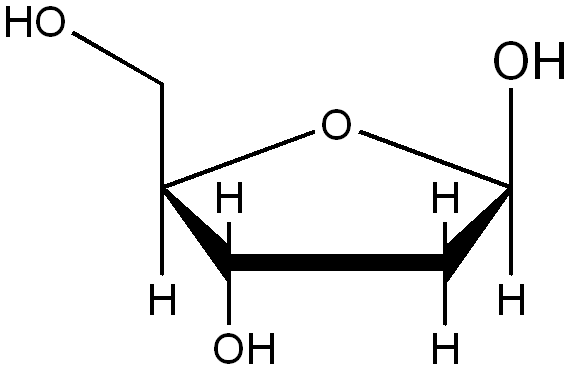
Identify the sugar: In DNA, the sugar is deoxyribose; in RNA, it is ribose. The key difference is at the 2' carbon—deoxyribose has a hydrogen (H), while ribose has a hydroxyl group (OH).
Look at the chemical structure of the sugar to determine if it is ribose or deoxyribose. Pay attention to the functional groups attached to each carbon.
Number the carbons on the sugar ring (1' to 5') and identify where the phosphate group and nitrogenous base attach.
Try solving on your own before revealing the answer!
Final Answer:
The sugar shown is ribose, which is found in RNA. The presence of the hydroxyl group (OH) at the 2' carbon distinguishes ribose from deoxyribose (which has only a hydrogen at this position). In nucleotides, the phosphate group attaches to the 5' carbon, and the nitrogenous base attaches to the 1' carbon.
Q2. Describe the process of transcription, including initiation, elongation, and termination.
Background
Topic: Transcription (DNA to RNA)
This question assesses your understanding of how genetic information is transferred from DNA to RNA, a key step in gene expression.
Key Terms and Formulas
Transcription: The process by which RNA is synthesized from a DNA template.
RNA polymerase: The enzyme responsible for synthesizing RNA.
Promoter: DNA sequence where RNA polymerase binds to initiate transcription.
Sigma factor: Protein that helps RNA polymerase recognize the promoter in bacteria.
Termination: The process that ends transcription, either by intrinsic (stem-loop) or rho-dependent mechanisms.
Step-by-Step Guidance
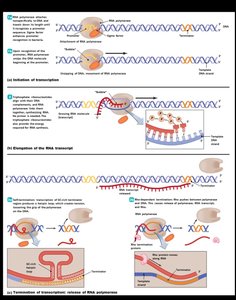
Transcription begins when RNA polymerase binds to the promoter region of DNA, often with the help of a sigma factor in prokaryotes.
Initiation occurs at the transcription start site (TSS), where the DNA unwinds and the first ribonucleotide is added.
During elongation, RNA polymerase moves along the DNA template, adding ribonucleotides (NTPs) to the growing RNA strand via phosphodiester bonds.
Termination happens when RNA polymerase encounters a termination signal, which can be a stem-loop structure (intrinsic) or require the rho protein (rho-dependent).
Try solving on your own before revealing the answer!
Final Answer:
Transcription involves three main steps: initiation (RNA polymerase binds to promoter), elongation (RNA strand is synthesized), and termination (RNA polymerase releases the completed RNA transcript). The sigma factor is essential for promoter recognition in bacteria, and termination can be intrinsic or rho-dependent.
Q3. What is an operon, and how does negative control regulate gene expression in bacteria?
Background
Topic: Regulation of Gene Expression—Operons
This question tests your knowledge of how bacterial genes are organized and regulated, specifically through operons and negative control mechanisms.
Key Terms and Formulas
Operon: A cluster of genes under the control of a single promoter and operator, allowing coordinated expression.
Promoter: DNA sequence where RNA polymerase binds.
Operator: DNA sequence where a repressor protein can bind to block transcription.
Repressor: Protein that binds to the operator to prevent transcription.
Inducer/Corepressor: Molecules that modulate the activity of the repressor.
Step-by-Step Guidance
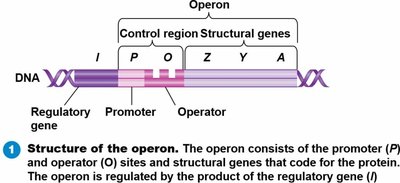
Understand the structure of an operon: It includes a promoter, operator, and structural genes.
Negative control involves a repressor protein binding to the operator, blocking RNA polymerase from transcribing the genes.
The repressor can be inactivated by an inducer (e.g., allolactose in the lac operon) or activated by a corepressor (e.g., tryptophan in the trp operon).
When the repressor is inactive, transcription proceeds; when active, transcription is blocked.
Try solving on your own before revealing the answer!
Final Answer:
An operon is a group of genes regulated together. Negative control occurs when a repressor binds to the operator, preventing transcription. Inducers or corepressors modulate the repressor's activity, allowing or blocking gene expression as needed.
Q4. What is diauxic growth, and how does the lac operon respond to the presence or absence of glucose and lactose?
Background
Topic: Catabolite Repression and Diauxic Growth in Bacteria
This question explores how bacteria prioritize carbon sources and regulate gene expression through the lac operon, a classic example of both positive and negative control.
Key Terms and Formulas
Diauxic growth: A two-phase growth pattern observed when bacteria consume one carbon source (e.g., glucose) before switching to another (e.g., lactose).
Catabolite repression: The inhibition of the lac operon by glucose, mediated by cAMP and the CRP/CAP activator protein.
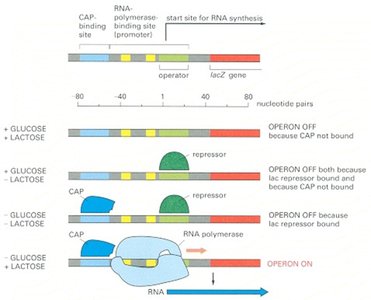
Positive control: Activation of transcription by CRP/CAP when cAMP levels are high (glucose is absent).
Negative control: Repression of transcription by the lac repressor when lactose is absent.
Step-by-Step Guidance
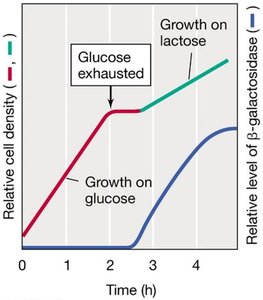
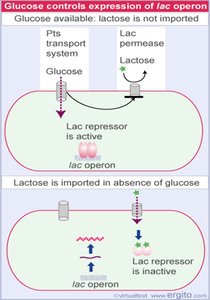
During growth on glucose, the lac operon is repressed because cAMP levels are low and the CAP activator is inactive.
When glucose is exhausted, cAMP levels rise, activating CAP and allowing transcription of the lac operon if lactose is present.
The lac repressor is inactivated by allolactose (a lactose derivative), permitting transcription only when lactose is available.
Diauxic growth is observed as a lag phase when switching from glucose to lactose, followed by renewed growth as the lac operon is activated.
Try solving on your own before revealing the answer!
Final Answer:
Diauxic growth occurs when bacteria first use glucose, then switch to lactose after glucose is depleted. The lac operon is activated only when glucose is absent (high cAMP, CAP active) and lactose is present (lac repressor inactive), allowing efficient use of available carbon sources.
